


TL;DR:
- All-at-once toothbrushes use a U-shaped design and sonic technology to clean teeth rapidly and effortlessly. Their clinical effectiveness varies, especially regarding gumline contact and molar coverage, making them more suitable for children and limited-dexterity users. Complementary interdental cleaning remains essential for comprehensive oral hygiene, regardless of the device used.
The idea of a toothbrush that brushes all teeth at once sounds almost too good to be true. For anyone who rushes through a morning routine or skips a full two minutes of brushing more often than they’d like to admit, the promise of simultaneous brushing is genuinely appealing. But does the technology actually deliver on that promise? This guide breaks down how these devices work, what the clinical evidence says, and how to make a smart decision for your specific oral health needs.
Table of Contents
- Key takeaways
- How traditional brushing compares to all-at-once toothbrushes
- How simultaneous brushing devices actually work
- Clinical effectiveness and limitations
- Complementary practices for complete oral hygiene
- Choosing the right toothbrush for your lifestyle
- My take on where this technology actually stands
- Y-Brush: fast brushing with clinically backed results
- FAQ
Key takeaways
| Point | Details |
|---|---|
| All-at-once brushes save time | These devices claim to clean every tooth simultaneously, cutting brushing time to under 30 seconds. |
| Clinical effectiveness varies | Some models leave gumline and molar areas inadequately cleaned compared to traditional brushing. |
| Fit affects coverage | One-size-fits-all designs can miss critical areas due to natural mouth shape differences. |
| Adjunct tools remain necessary | Flossing or water flossing is still required for complete plaque removal regardless of brush type. |
| Children may benefit most | Kids often show better brushing compliance with U-shaped designs due to ease and engagement. |
How traditional brushing compares to all-at-once toothbrushes
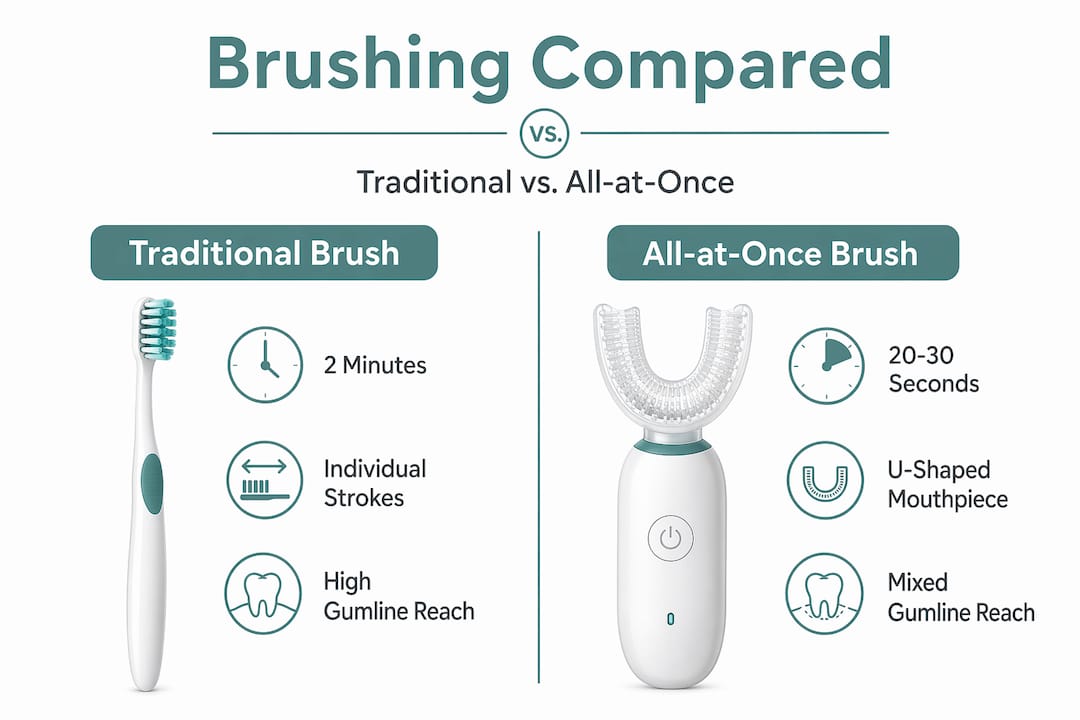
Most dental professionals recommend brushing for a full two minutes, covering all tooth surfaces with deliberate strokes. In practice, very few people actually hit that mark. Most people brush only half the recommended time, typically spending 45 to 60 seconds before putting the brush down. That gap between what people know they should do and what they actually do is exactly where all-at-once devices try to compete.
Standard manual brushing requires moving the brush across each quadrant of the mouth, angling bristles at the gumline, and covering both inner and outer surfaces. It demands attention and technique. Most people develop habits that favor easy-to-reach areas and unconsciously rush through the back molars.
Electric toothbrushes address part of this problem. Built-in timers and quadrant pacers help users spend the right amount of time on each section of the mouth, which measurably improves brushing consistency. They do not, however, eliminate the need for correct technique and deliberate movement.
Here is where the all teeth toothbrush concept enters the conversation. Rather than improving how you move a brush, these devices attempt to remove the movement requirement entirely. The core appeal is straightforward:
- Speed: Brushing time drops from two minutes to 20 to 30 seconds.
- Ease: No technique is required. You bite down and the device does the work.
- Consistency: Every tooth theoretically receives contact at the same time.
- Accessibility: Useful for people with limited dexterity or mobility challenges.
The question is whether simultaneous contact actually translates to effective plaque removal. That distinction matters more than most marketing materials acknowledge.
How simultaneous brushing devices actually work
A toothbrush for quick cleaning that covers all teeth at once typically uses a U-shaped mouthpiece lined with bristles on both the inner and outer surfaces. You place the device in your mouth, bite down gently, and either move it side to side manually or let a built-in motor vibrate the bristles against your teeth.
The toothbrush design varies considerably across models, but most share a few core features:
- Sonic or vibrating motor: Higher-end models use sonic frequency vibrations to agitate plaque and debris from tooth surfaces.
- Silicone or nylon bristle trays: The mouthpiece holds bristles in a fixed position against teeth on all sides simultaneously.
- Timer function: Some models include a built-in countdown to indicate when the cleaning cycle is complete.
- Size variants: Children’s versions are scaled down and often include softer bristles and more flexible trays.
Manual versions of the U-shaped design require the user to move the device themselves, which reintroduces the technique variable. Automatic versions with motors reduce that dependency but add cost and battery requirements.
One notable distinction in the market: only one U-shaped toothbrush currently holds the ADA Seal of Acceptance, meaning independent clinical verification of efficacy is limited across most models. That is a meaningful data point when evaluating any innovative brushing tool.
Clinical effectiveness and limitations
Here is where the honest evaluation gets more nuanced. The appeal of a simultaneous brushing device is undeniable. The clinical picture is more complicated.

Clinical evaluations show variable effectiveness across U-shaped models, with particular concern around gumline contact and molar coverage. The gumline is the most critical area for plaque removal because that is where periodontal disease begins. A device that contacts tooth surfaces without adequately angling into the gumline misses the most important zone.
Some U-shaped brushes perform no better than manual brushing in clinical tests, and a few perform worse. The core issue is not whether the device touches your teeth. It is whether the bristle contact generates enough mechanical action at the right angles to actually disrupt the biofilm.
Mouth shape variability compounds this problem. A fixed U-shaped tray designed for an average mouth will not conform to every arch width, tooth spacing, or jaw alignment. For users whose mouths fall outside the design parameters, coverage gaps are almost inevitable.
| Factor | Traditional Electric Brush | U-Shaped All-at-Once Brush |
|---|---|---|
| Gumline contact | High with correct technique | Variable, often insufficient |
| Molar coverage | Good with proper movement | Inconsistent across models |
| Time required | 2 minutes recommended | 20 to 30 seconds |
| Technique dependency | High | Low to moderate |
| Clinical backing | Extensive | Limited for most models |
| Fit variability | Minimal | Significant |
There is one population where the evidence tilts more favorably. Children often comply better with U-shaped toothbrushes because the ease and novelty factor improves their willingness to brush consistently. For kids who resist brushing entirely, a device that makes the process faster and more engaging may deliver better real-world outcomes than a technically superior brush they refuse to use.
Pro Tip: If you are evaluating an all-at-once device, look specifically for clinical data on gumline plaque scores, not just overall plaque reduction. Surface plaque is easier to remove. Subgingival plaque is where the real risk lives.
Complementary practices for complete oral hygiene
Regardless of which brushing tool you use, no toothbrush alone provides complete oral care. The spaces between teeth and below the gumline require dedicated interdental cleaning. This is true for traditional brushes, electric brushes, and all-at-once devices alike.
For time-constrained users, here is a practical sequence that covers all the bases without adding significant time to a routine:
- Brush first. Use your chosen device, whether traditional, electric, or U-shaped, to clear surface plaque and food debris from tooth faces.
- Follow with interdental cleaning. Water flossers used after brushing significantly reduce plaque and gingival bleeding compared to brushing alone. They flush biofilm from spaces bristles cannot reach.
- Address problem spots deliberately. If you know you have a crowded area, a bridge, or a spot your dentist flags regularly, give it 10 extra seconds of direct attention.
- Use a timer if technique is your weak point. Electric brushes with built-in quadrant timers remove the guesswork from coverage and keep you honest about time spent per section.
- Replace brush heads on schedule. Worn bristles lose their mechanical effectiveness regardless of how long you brush. Most heads should be replaced every three months.
Efficient dental care for busy individuals always involves adjunct interdental cleaning alongside brushing. Relying solely on any single device, no matter how advanced, risks leaving critical areas untreated.
Pro Tip: If you find flossing tedious, a water flosser takes about 60 seconds and removes the manual dexterity requirement entirely. Pair it with any brushing tool and your routine is genuinely complete.
Choosing the right toothbrush for your lifestyle
The best toothbrush for you is the one that fits your actual habits, not the one that performs best in a lab when used perfectly. That framing changes the decision considerably.
When choosing oral care products, consider these factors honestly:
Time available. If you consistently brush for under a minute, a device that delivers adequate cleaning in 20 to 30 seconds may produce better real-world outcomes than a superior tool you use poorly. Honest self-assessment here matters more than product specifications.
Fit and comfort. U-shaped devices are not universal. If possible, look for models with multiple size options or flexible trays that accommodate different arch shapes. A poor fit negates the speed advantage entirely.
Clinical verification. The ADA Seal of Acceptance is the most reliable indicator of independently verified efficacy. Most U-shaped models do not carry it. That does not automatically disqualify them, but it does mean you are relying on manufacturer claims rather than third-party data.
Maintenance requirements. Mouthpiece trays need regular replacement, typically every one to three months depending on the model. Factor that cost into your evaluation alongside the device price.
Trial options. Some brands offer return windows or trial periods. Use them. Fit and comfort are highly individual, and no amount of research substitutes for actually placing the device in your mouth and assessing coverage.
For a structured comparison of automatic toothbrush options that balance speed with cleaning effectiveness, look for models that combine sonic technology with customizable fit rather than fixed universal trays.
My take on where this technology actually stands
I’ve spent considerable time reviewing the clinical literature on all-at-once brushing devices, and my honest assessment is this: the technology is genuinely promising, but the current generation of products is not uniformly ready to replace traditional brushing for most adults.
What I’ve found is that the gap between marketing claims and clinical performance is widest in the gumline and interproximal areas. Those are precisely the areas that matter most for long-term oral health. The main issue with all-at-once brushes is not coverage in the broad sense. It is whether bristle contact at fixed angles can match the mechanical disruption that deliberate brushing motion creates.
That said, I think the framing of “does it work as well as traditional brushing” is the wrong question for most users. The right question is: “Does it produce better outcomes than what I’m actually doing?” For someone who brushes for 45 seconds with poor technique, a well-designed simultaneous brushing device with sonic technology may genuinely outperform their current routine.
Where I’d caution against overreliance is in treating speed as a complete solution. Convenience appeals strongly to users but should not replace careful oral hygiene techniques. The most effective approach pairs a fast, well-designed brushing tool with consistent interdental cleaning. Neither element alone is sufficient.
My practical advice: if you are consistently falling short of two minutes with a traditional brush, explore the efficient brushing options that combine speed with verified cleaning performance. Just do not skip the floss.
— Joris
Y-Brush: fast brushing with clinically backed results
Y-Brush was built specifically for the reality that 90% of people brush for under a minute, not the ideal of two minutes that almost no one achieves. The Y-Brush Essential Sonic Toothbrush uses a custom-fit mouthpiece with sonic vibration technology to deliver a thorough clean in just 20 seconds. Unlike generic U-shaped devices, Y-Brush addresses the fit variability problem with multiple mouthpiece sizes and replaceable bristle trays designed to maintain consistent gumline contact.
For families, the Y-Brush KidsBrush brings the same speed and ease to children ages 4 to 12, making consistent brushing habits far more achievable. If you want to see the full range of what Y-Brush offers, including the latest additions to their lineup, explore the new Y-Brush products page for current options.
FAQ
What is a toothbrush that brushes all teeth at once?
It is a U-shaped device lined with bristles that covers all tooth surfaces simultaneously when placed in the mouth. Most models use vibration or sonic technology to clean teeth in 20 to 30 seconds.
Are all-at-once toothbrushes as effective as regular brushing?
Clinical results vary by model. Some devices show adequate plaque removal on tooth surfaces, but gumline and molar coverage is often insufficient compared to traditional brushing with correct technique.
Who benefits most from a simultaneous brushing device?
Children tend to show the strongest benefit due to improved compliance. Adults with limited dexterity or those who consistently under-brush with traditional tools may also see real-world gains.
Do I still need to floss if I use an all-at-once brush?
Yes. No toothbrush, including all-at-once designs, cleans the spaces between teeth. Water flossers after brushing are particularly effective at removing interproximal plaque and reducing gingival bleeding.
What should I look for when choosing an all-at-once toothbrush?
Prioritize models with multiple size options for better fit, sonic technology for mechanical cleaning action, and ideally an ADA Seal of Acceptance or published clinical data supporting their plaque removal claims.


