


TL;DR:
- Tongue cleaning mechanically removes bacterial biofilm and debris, significantly reducing halitosis and oral bacterial load.
- Integrating tongue scraping twice daily enhances breath, taste, and gum health beyond brushing and flossing alone.
Tongue cleaning is defined as the mechanical removal of bacterial biofilm, food debris, and dead cells from the tongue surface, and it is one of the most underutilized practices in daily oral hygiene. The role of tongue cleaning extends well beyond fresh breath. It directly reduces the anaerobic bacteria responsible for volatile sulfur compounds (VSCs), the primary biochemical cause of halitosis. Clinical research confirms that combining toothbrushing with tongue scraping reduces VSCs by 75%, compared to just 45% from toothbrushing alone. That gap is significant. It means millions of people who brush twice daily are still leaving the largest bacterial reservoir in their mouth untouched. Tongue cleaning is not a replacement for brushing or flossing. It is the missing complement that makes both more effective.
What are the main benefits of tongue cleaning for oral health?
The most direct benefit of tongue cleaning is the reduction of halitosis through VSC elimination. The dorsal posterior tongue is the primary site for anaerobic bacteria that produce these odor-causing compounds, making it the most critical area to target during any cleaning routine. When you consistently remove the biofilm from this region, you cut off the bacterial fuel supply that drives chronic bad breath.
Beyond breath improvement, tongue cleaning delivers several evidence-based oral health benefits:
- Reduced bacterial load: Mechanical removal of tongue biofilm lowers the overall count of anaerobic bacteria in the mouth, which reduces the risk of plaque transfer to teeth and gums.
- Improved taste sensation: A thick coating of biofilm on the tongue physically blocks taste receptors. Regular cleaning restores sensitivity to sweet, salty, sour, and bitter flavors.
- Better gum health: Lower oral bacterial counts correlate with reduced gingival inflammation, making tongue hygiene a supporting factor in periodontal disease management.
- Sustained halitosis control: A randomized controlled trial found that combining tongue brushing with oral probiotics produced the greatest sustained reductions in VSC levels and halitosis scores over a four-week intervention, with improvements maintained at follow-up.
“Mechanical removal of tongue biofilm reduces anaerobic bacteria that produce odor-causing volatile sulfur compounds, aligning with clinical recommendations to include tongue cleaning in oral hygiene regimens.” — Merck Manual Professional Edition
The benefits are particularly pronounced for periodontal patients and older adults, who tend to carry higher bacterial loads on the tongue surface. For these groups, tongue hygiene is not optional. It is a clinically relevant part of disease management.
How does tongue cleaning compare to other oral hygiene practices?
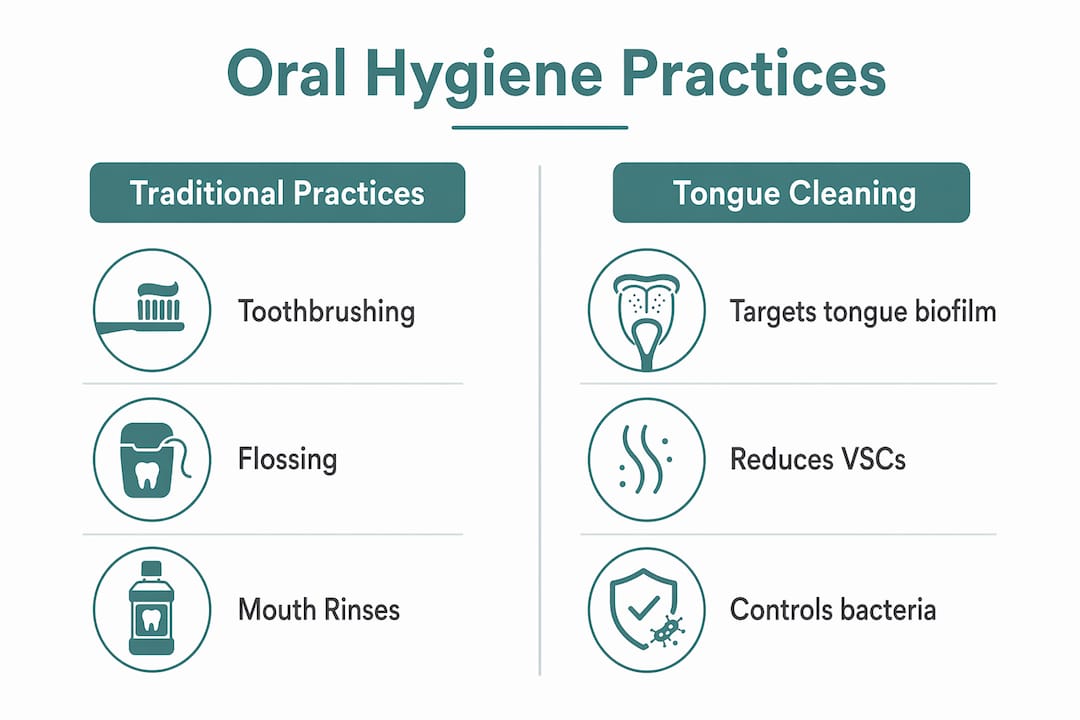
Tongue cleaning occupies a distinct role in oral care because it targets a surface that brushing and flossing do not adequately address. The comparison below clarifies what each practice does and does not accomplish.

| Practice | Primary target | Effect on VSCs | Effect on tongue biofilm |
|---|---|---|---|
| Toothbrushing | Tooth surfaces, enamel | Moderate reduction (45%) | Minimal |
| Flossing | Interproximal spaces | Negligible | None |
| Mouthwash | Whole oral cavity | Temporary, limited adjunctive benefit | Superficial |
| Tongue scraping | Tongue dorsum | High reduction (up to 75% combined) | Direct and significant |
| Tongue brushing | Tongue dorsum | Moderate reduction | Moderate |
The Merck Manual confirms that mouth rinses have limited adjunctive benefit for halitosis when used without mechanical tongue cleaning. This is because mouthwash cannot physically dislodge the structured biofilm matrix that anchors bacteria to the tongue’s papillae. It masks odor temporarily but does not address the source.
Tongue scrapers outperform toothbrushes specifically on the tongue surface. Clinical studies show that tongue scrapers removed 30% more VSCs than soft-bristled toothbrushes. The geometry of a scraper allows it to collect and remove debris across the full width of the tongue in a single pass, while a toothbrush tends to redistribute rather than extract the biofilm.
Pro Tip: If you already brush and floss consistently, adding 30 seconds of tongue scraping each morning will deliver a measurable improvement in breath freshness that no amount of additional brushing can replicate.
The takeaway from this comparison is straightforward. Each practice targets a different oral surface and a different type of microbial activity. A complete oral care routine includes all of them, not just the most familiar ones.
What are effective tongue cleaning techniques and tools?
Choosing the right tool and using it correctly determines how much of the bacterial biofilm you actually remove. Here is a practical breakdown of the most effective approaches.
- Select your tool. Stainless steel and copper tongue scrapers are the most durable and hygienic options. Plastic scrapers are widely available and effective, though they require more frequent replacement. A soft-bristled toothbrush works as a secondary option but is less efficient at biofilm removal.
- Position correctly. Extend your tongue fully and place the scraper as far back on the dorsal surface as comfortable. The back of the tongue is where anaerobic bacteria concentrate most densely, so starting there maximizes odor control.
- Apply gentle, even pressure. Pull the scraper forward in one smooth motion from back to front. Rinse the scraper after each pass. Repeat three to five times, covering the full width of the tongue.
- Manage the gag reflex. This is the most common barrier to consistent practice. Start with the scraper positioned mid-tongue and gradually work further back over several days as your reflex adapts. Breathing through your nose during the motion also reduces the reflex significantly.
- Clean twice daily. Biofilm reforms rapidly during eating and through normal salivary flow, so once-daily cleaning is not sufficient for sustained bacterial control. Morning and evening sessions align naturally with existing brushing habits.
- Consider oral probiotics. Research shows that combining tongue brushing with oral probiotics produces more sustained improvements in halitosis than mechanical cleaning alone. Probiotic lozenges or rinses introduce beneficial bacteria that compete with odor-producing anaerobes.
Pro Tip: Keep your tongue scraper next to your toothbrush so it becomes part of the same automatic routine. Habit stacking, attaching a new behavior to an existing one, is the most reliable way to build consistent tongue hygiene.
For those looking to optimize their oral hygiene routine, the technique matters as much as the tool. Even the best scraper delivers limited results if used only on the front third of the tongue.
What happens if you don’t clean your tongue regularly?
Neglecting tongue hygiene creates a compounding problem. Biofilm accumulates in the tongue’s papillae, providing an anaerobic environment where odor-producing bacteria thrive unchecked. The consequences extend beyond bad breath and affect multiple dimensions of oral health.
- Chronic halitosis: Without mechanical removal, VSC production continues uninterrupted. Neglecting tongue hygiene correlates directly with persistent bad breath that brushing and mouthwash cannot resolve.
- Higher cavity risk: Bacteria from the tongue transfer to tooth surfaces during chewing and swallowing, increasing the acid-producing microbial load that drives enamel erosion and decay.
- Gum inflammation: Elevated oral bacterial counts contribute to gingival irritation and, over time, to the progression of periodontal disease in susceptible individuals.
- Reduced taste perception: A thick tongue coating physically blocks taste receptors, dulling the ability to detect flavors. Many people who begin tongue cleaning report a noticeable improvement in taste sensitivity within the first week.
- Low adherence patterns: Research shows that without structured education, only a minority of people clean their tongues consistently. Tongue cleaning prevalence among periodontal patients was just 32.9% before hygiene instruction, rising to 76.2% after structured training. This data confirms that most people skip tongue cleaning not because they disagree with it, but because no one has shown them how or why.
The oral microbiome is a dynamic system. Leaving the tongue’s bacterial reservoir intact while cleaning teeth is the equivalent of mopping a floor while leaving the source of the mess untouched.
Key takeaways
Tongue cleaning is the most direct mechanical intervention for reducing oral bacteria and controlling halitosis, and it belongs in every daily oral hygiene routine alongside brushing and flossing.
| Point | Details |
|---|---|
| VSC reduction is measurable | Combining tongue scraping with brushing cuts volatile sulfur compounds by 75%, versus 45% from brushing alone. |
| Scrapers outperform toothbrushes | Tongue scrapers remove 30% more VSCs than soft-bristled toothbrushes on the tongue surface. |
| Twice-daily cleaning is necessary | Biofilm reforms rapidly, so once-daily cleaning does not sustain bacterial control throughout the day. |
| Education drives adherence | Structured tongue hygiene instruction raised daily cleaning rates from 11.2% to 45.4% in periodontal patients. |
| Probiotics extend the benefit | Combining tongue brushing with oral probiotics produces more sustained halitosis improvements than mechanical cleaning alone. |
Why tongue cleaning deserves more attention than it gets
I have spent years reviewing oral health research and talking with dental professionals, and the pattern is consistent. Tongue cleaning is the step that gets mentioned last in a dental appointment, if it gets mentioned at all. Most patients leave with instructions to brush twice and floss once, and the tongue never comes up. That is a real gap in standard care.
What strikes me most about the 2026 research on periodontal patients is not the outcome data. It is the baseline. Only 11.2% of patients were cleaning their tongues daily before receiving structured instruction. These are people who are already engaged enough with their oral health to be in periodontal care. If the adherence rate is that low among motivated patients, the general population is almost certainly lower.
The gag reflex barrier is real, but it is also overestimated. In my experience reviewing patient feedback and clinical commentary, most people who try tongue scraping correctly, starting mid-tongue and working back gradually, adapt within a week. The discomfort is temporary. The benefit is not.
My practical recommendation is to treat tongue cleaning the same way you treat flossing. You do not skip flossing because it takes an extra 60 seconds. Apply the same logic to the tongue. A stainless steel scraper costs less than a single tube of toothpaste and lasts for years. The return on that investment, in breath quality, taste sensitivity, and bacterial control, is disproportionately high relative to the effort involved.
The effective oral care habits that actually move the needle are rarely complicated. They are just consistently applied.
— Joris
Upgrade your oral hygiene routine with Y-Brush
If you are serious about oral health, the tools you use matter. Y-Brush designs sonic toothbrushes built for people who want a thorough, clinically effective clean without spending five minutes in front of the mirror. The Y-Brush Essential Sonic Toothbrush delivers a full clean in 20 seconds, making it far easier to maintain the consistent twice-daily routine that tongue cleaning and tooth brushing both require. When your brushing routine is fast and effective, adding a tongue scraper to the sequence feels natural rather than burdensome. Y-Brush also offers brush head replacement plans so your tools stay hygienic and performing at their best. Better oral health starts with a routine you will actually stick to.
FAQ
What is the role of tongue cleaning in oral hygiene?
Tongue cleaning mechanically removes bacterial biofilm and debris from the tongue surface, reducing the volatile sulfur compounds that cause bad breath and lowering the overall oral bacterial load. It is a clinically recommended complement to brushing and flossing, not a replacement.
How often should you clean your tongue?
Twice daily is the recommended frequency. Biofilm reforms on the tongue surface during eating and through normal salivary flow, so a single daily cleaning does not maintain bacterial control throughout the day.
Is tongue scraping better than using a toothbrush on the tongue?
Yes. Clinical studies show that tongue scrapers remove 30% more volatile sulfur compounds than soft-bristled toothbrushes, because the scraper’s geometry collects and extracts biofilm across the full tongue width in a single pass.
Can tongue cleaning improve your sense of taste?
Consistent tongue cleaning removes the biofilm coating that physically blocks taste receptors, and most people notice improved sensitivity to flavors within the first week of regular practice.
Does tongue cleaning help with gum disease?
Tongue cleaning reduces the overall oral bacterial load, which lowers the microbial pressure on gum tissue. Research on periodontal patients confirms that integrating tongue hygiene into a daily routine supports better gum health outcomes alongside professional dental treatment.


