


Brushing twice a day feels like enough. You’re consistent, you use a good toothbrush, and your mouth feels fresh afterward. But even the most thorough brushing cleans only about 60% of your tooth surfaces. That missing 40% sits in the tight gaps between your teeth, quietly collecting plaque, bacteria, and food debris. Interdental cleaning, which means cleaning between your teeth using floss, brushes, or a water flosser, is the step that fills that gap. This article breaks down why those spaces matter, what the best methods are, and how to make it work even on your busiest days.
Table of Contents
- The hidden risks between your teeth
- How cleaning between teeth protects your mouth
- Proven interdental cleaning methods: Which is right for you?
- Fitting interdental cleaning into a busy lifestyle
- Upgrade your oral care routine with Y-Brush solutions
- Frequently asked questions
Key Takeaways
| Point | Details |
|---|---|
| Brushing isn’t enough | Brushing cleans only about 60% of tooth surfaces, leaving gaps where plaque accumulates. |
| Prevents gum disease | Consistently cleaning between teeth lowers your risk of gum disease, cavities, and bad breath. |
| Choose the right tool | Pick interdental brushes, floss, or water flossers based on your teeth and what you use daily. |
| Consistency is key | Daily interdental cleaning matters more than perfect technique or timing. |
| Supports overall health | Oral hygiene habits like cleaning between teeth may help reduce health risks beyond the mouth. |
The hidden risks between your teeth
Your toothbrush bristles are great at cleaning the front, back, and chewing surfaces of your teeth. But they simply cannot reach the narrow spaces between them. That’s where plaque builds up quietly, day after day, without any friction to slow it down.
Those interdental spaces are vulnerable to plaque accumulation leading to cavities, gingivitis, periodontitis, and bad breath. Gingivitis is early-stage gum inflammation. Periodontitis is the more serious version, where infection damages the bone and tissue holding your teeth in place. Both start in the same hidden spots your toothbrush misses.
The consequences go beyond your mouth. Poor oral hygiene is linked to systemic issues like cardiovascular disease and diabetes. Chronic inflammation from untreated gum disease can affect your whole body over time. That’s a significant price to pay for skipping one step in your routine.
Here’s a quick look at what’s actually at stake when those gaps go uncleaned:
- Plaque buildup hardens into tartar within 24 to 48 hours, which only a dentist can remove
- Cavities form between teeth when acid-producing bacteria sit undisturbed
- Gingivitis causes red, swollen, bleeding gums that are easy to reverse early but worsen fast
- Periodontitis leads to gum recession, loose teeth, and potential tooth loss
- Bad breath often originates from bacteria trapped between teeth, not the tongue or throat
“Brushing alone leaves roughly 40% of tooth surfaces untouched. That’s nearly half your mouth going uncleaned every single day.”
Exploring different teeth cleaning methods can help you understand where your current routine has gaps and what tools can fill them.
How cleaning between teeth protects your mouth
Adding an interdental step to your routine isn’t just about removing food particles. It’s about disrupting the bacterial colonies that cause real damage. Brushing alone leaves those colonies intact in the spaces between teeth.
Interdental cleaning removes plaque and debris, preventing gum disease, tooth decay, and reducing bad breath. The mechanical action of floss or an interdental brush physically breaks up the biofilm (the sticky layer of bacteria) that brushing can’t reach. That disruption is what prevents the chain reaction from plaque to inflammation to disease.

Research also shows that interdental cleaning adds significant plaque reduction, and interdental brushes may actually outperform floss in many cases. The key variable is consistency. A tool you use every day beats a theoretically superior tool you use once a week.
Here’s what regular interdental cleaning delivers over time:
| Benefit | What it means for you |
|---|---|
| Reduced gum inflammation | Less bleeding, less tenderness, healthier tissue |
| Fewer cavities between teeth | Plaque removed before it produces enamel-damaging acid |
| Fresher breath | Bacteria between teeth is a primary source of halitosis |
| Lower systemic risk | Less chronic inflammation in the body overall |
| Healthier gums long term | Reduced risk of periodontitis and tooth loss |
One thing that surprises many people: bleeding gums when you first start. This is normal. It usually means your gums are already inflamed and need care, not that you’re doing something wrong. With consistent cleaning, that bleeding typically stops within one to two weeks.
Pro Tip: If you’re unsure whether to floss before or after brushing, go before. Cleaning between your teeth first loosens debris and bacteria, so brushing sweeps it all away more effectively.
The comparison between brushing vs flossing often misses the point. They’re not competing. They clean different surfaces, and you need both.
Proven interdental cleaning methods: Which is right for you?
Not all interdental tools are created equal, and the best one for you depends on the size of your gaps, your dental work, and honestly, what you’ll actually stick with. Here’s a breakdown of the main options.
Dental floss is the classic choice. It’s thin enough to slide into very tight spaces between teeth where nothing else fits. Traditional string floss works well, and floss picks make it easier to reach back teeth without contorting your fingers.
Interdental brushes look like tiny bottle brushes and come in different sizes. Interdental brushes are more effective than floss for plaque reduction, especially in wider gaps. They’re also easier for many people to use, particularly those with limited dexterity or arthritis. You simply insert the brush between teeth and move it back and forth a few times.
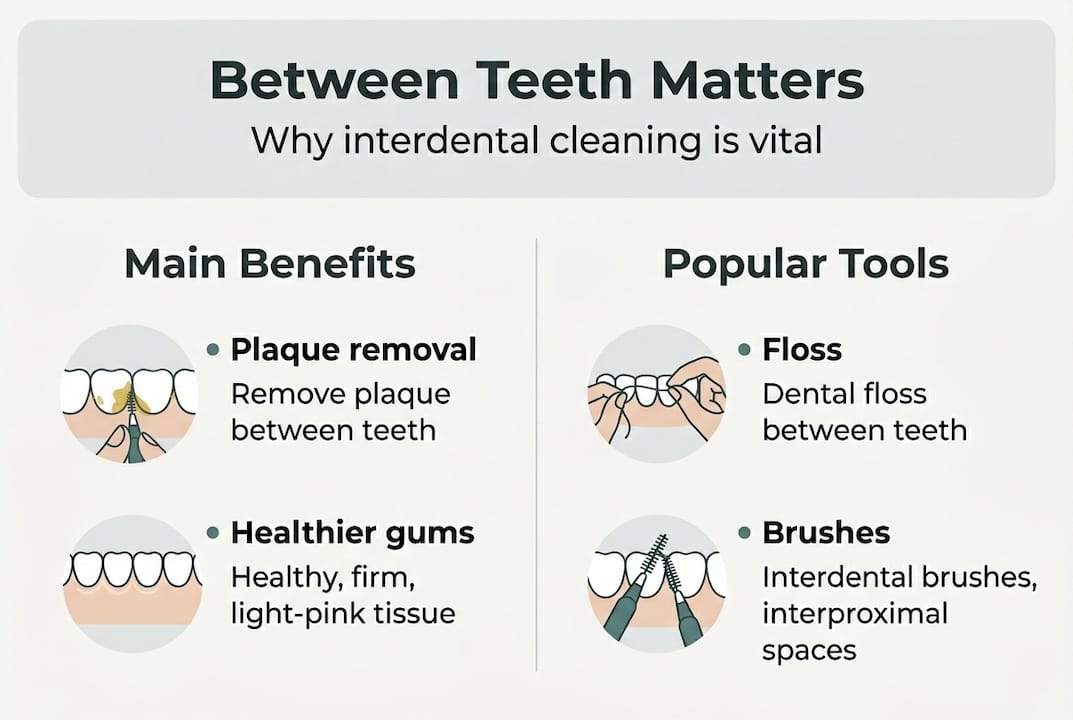
Water flossers use a pressurized stream of water to flush out debris and bacteria. They’re especially useful for people with braces, implants, or bridges. Water flossers and brushes may be preferred for orthodontic and implant care because they can reach areas that physical tools struggle with.
Here’s a side-by-side comparison to help you choose:
| Tool | Best for | Ease of use | Plaque removal |
|---|---|---|---|
| Dental floss | Tight spaces, no gaps | Moderate | Good |
| Interdental brushes | Medium to wide gaps | Easy | Very good |
| Water flosser | Braces, implants, bridges | Very easy | Good (adjunct) |
| Floss picks | Back teeth, travel | Easy | Good |
A few things to keep in mind when choosing:
- Match the brush size to your gap size. Too small and it won’t clean. Too large and it can damage gum tissue.
- Braces wearers benefit most from water flossers or special orthodontic floss threaders.
- Implant patients should ask their dentist about soft-pick tools or water flossers to avoid damaging the implant surface.
- Consistency beats perfection. The tool you use daily is always the right tool.
Pro Tip: If you have multiple gap sizes in your mouth (common as we age), keep two interdental brush sizes on hand. Use the smaller one for tighter spots near the front and the larger one for wider gaps toward the back.
Learn more about water flosser benefits if you’re considering adding one to your routine. And if you wear braces, there’s specific guidance on oral hygiene with braces that covers the best tools and techniques for keeping your teeth clean around brackets and wires.
Fitting interdental cleaning into a busy lifestyle
Knowing you should clean between your teeth and actually doing it every day are two very different things. The gap between knowledge and habit is where most people get stuck. The good news: this step doesn’t have to take long or feel complicated.
Daily use is key, and the best method is the one you’ll actually reach for. For most people, interdental brushes are easier and faster than floss. For tight spaces, floss is still the better tool. The point is to pick something and use it.
Timing matters too. Cleaning between teeth once a day, ideally before brushing, gives you the best results. When you clean first, the fluoride from your toothpaste can penetrate the spaces between teeth more effectively. It’s a small sequence change with a real payoff.
Here’s a practical approach to building the habit:
- Start with one area. If the full mouth feels overwhelming, begin with just your front four teeth. Build from there.
- Stack it onto an existing habit. Do it right before brushing at night, when you’re already at the sink.
- Keep tools visible. A container of floss picks on the counter gets used. One buried in a drawer does not.
- Use a reminder. A phone alarm or sticky note on the mirror works until the habit is automatic.
- Accept imperfect days. Missing one day doesn’t undo your progress. Just pick it back up the next night.
“An imperfect routine you actually follow beats a perfect routine you abandon after three days.”
Initial discomfort is real. Your gums may feel sore or bleed for the first week or two. That’s inflammation responding to cleaning, not a sign you’re hurting yourself. Push through that initial phase and your gums will adapt quickly.
Pro Tip: Keep a travel-size pack of floss picks in your bag or car. You’re far more likely to clean between your teeth if the tool is already in your hand during a quiet moment.
For more strategies on saving time without cutting corners, check out this guide on efficient oral care that covers how to get a thorough clean even on your most hectic days.
Upgrade your oral care routine with Y-Brush solutions
You now know that interdental cleaning is non-negotiable for a truly clean mouth. But the brushing part of your routine matters just as much, and most people are still spending under a minute on it without getting a complete clean.
At Y-Brush, we built our products around one simple truth: people need a better clean that actually fits their life. Our essential sonic toothbrush delivers a thorough clean in just 20 seconds, covering all surfaces that a standard brush covers in two minutes. Pair that with a daily interdental routine and you have a complete oral care system that takes almost no time at all. See what the future of toothbrushing looks like, and take the first step to upgrade your oral care today.
Frequently asked questions
Is cleaning between teeth really necessary if I brush well?
Yes. Even excellent brushing only cleans 60% of tooth surfaces, leaving the spaces between teeth untouched and vulnerable to plaque and decay.
How often should I clean between my teeth?
Once a day is enough. Cleaning before brushing is the ideal sequence because it allows fluoride from toothpaste to reach between teeth more effectively.
Which is better: floss, interdental brushes, or water flossers?
Interdental brushes outperform floss for wider gaps, floss is better for tight spaces, and water flossers are a strong option for people with braces, implants, or bridges.
What if my gums bleed when I first start cleaning between teeth?
Mild bleeding is normal at first and signals that your gums are inflamed and need attention. It typically resolves within one to two weeks of consistent interdental cleaning.
Does cleaning between teeth really help overall health?
Regular interdental cleaning reduces chronic oral inflammation, which research links to a lower risk of systemic conditions like cardiovascular disease and diabetes, though direct causal evidence is still developing.


