


Plaque disclosing tablets are a safe, clinically backed visual audit tool that temporarily stains dental plaque so you can see exactly where your brushing falls short. Use them after an initial brush to check your coverage, then re-brush the stained spots. They work best for children learning technique, people with braces, and anyone who wants to build a more consistent routine. One caution applies to everyone: do not swallow the tablet, and check the ingredient label if you have dye allergies. A randomized orthodontic trial found that patients who used plaque-disclosing tablets at home, in addition to chairside instruction, achieved significantly lower plaque index scores at both one and three months compared with instruction alone (p<0.05).
- When to use them: After a first brush to check effectiveness, or before brushing to reveal your baseline
- Who benefits most: Children learning to brush, orthodontic patients, caregivers coaching technique
- Key safety caution: Do not swallow; supervise young children; check the label for dye allergies
Key Takeaways
Plaque disclosing tablets are a clinically supported visual audit tool that improves brushing technique when used consistently at home, especially during the first weeks of a new routine or orthodontic treatment.
| Point | Details |
|---|---|
| Use after brushing for best feedback | Brushing first, then disclosing, shows exactly which areas your technique missed. |
| Two-tone tablets prioritize re-brushing | Blue or purple staining marks older plaque; address those areas before red-stained zones. |
| Home use outperforms clinic-only demos | A randomized trial found home tablet users had significantly lower plaque index scores compared with other groups. |
| Tablets are an audit tool, not a treatment | They reveal plaque but cannot remove tartar; persistent staining after re-brushing signals a need for professional cleaning. |
| Y-brush complements the feedback loop | Y-brush’s Y-shaped brush head covers all surfaces in 20 seconds, addressing the coverage gaps disclosing tablets reveal. |
Table of Contents
- What are plaque disclosing tablets and what do they actually show?
- How do plaque disclosing tablets work, and how do you read the colors?
- Why use disclosing tablets? Benefits for brushing technique and motivation
- Are disclosing tablets safe? Ingredients, allergy cautions, and supervision
- Step-by-step: how to use disclosing tablets with your brushing routine
- Who benefits most from disclosing tablets, and who should be cautious?
- How often should you use disclosing tablets?
- What disclosing tablets won’t do, and how to handle common pitfalls
- What does the research say about disclosing tablets and brushing effectiveness?
- Alternatives to tablets: gels, swabs, chairside disclosure, and tech-based feedback
- Why disclosing tablets deserve a regular spot in your routine
- Y-brush: a faster way to close the gap between brushing and clean teeth
- Sources
What are plaque disclosing tablets and what do they actually show?
Plaque disclosing tablets are small, chewable tablets that contain a dye which temporarily stains dental plaque, the soft bacterial biofilm that builds up on tooth surfaces between brushings. Chewing one coats your teeth, and wherever plaque remains, the dye clings to it and turns a visible color. The result is an honest map of every spot your toothbrush missed.
Two things they cannot do are worth stating clearly. Disclosing tablets do not remove plaque, and they will not dissolve hardened tartar (calculus). They are an educational and motivational tool, not a treatment. Think of them as a diagnostic step that makes an invisible problem visible so you can act on it.
Format options in the U.S. market include chewable tablets, disclosing gels, mouthwash-style rinses, and disclosing toothpastes. Chewable tablets are the most widely available format in U.S. stores and online, according to Dentaly. Gels and swabs tend to suit younger children or people who have difficulty chewing.
How do plaque disclosing tablets work, and how do you read the colors?
The dye in a disclosing tablet adheres to the organic matrix of the plaque biofilm rather than to tooth enamel. Because enamel is a hard, smooth mineral surface, the dye rinses away from it easily. Plaque, being a sticky, protein-rich film, holds the dye long enough for you to inspect and re-brush.
Most commercial tablets use vegetable-based dyes or approved food-grade colorants. Some older formulations used erythrosine (FD&C Red No. 3), though many current products have moved to plant-derived alternatives. Always read the product label before use, especially if you have known food-dye sensitivities.
Single-tone vs. two-tone systems:
- Single-tone tablets stain all plaque one color, typically red or pink. They show you where plaque is present but do not distinguish how long it has been there.
- Two-tone tablets use two dyes simultaneously. According to 2Tone Disclosing Tablets by Young Specialties, red indicates newer plaque while blue or purple indicates older, more established plaque.
- Practical priority: Blue or purple staining points to areas of chronic neglect, spots where plaque has been accumulating long enough to raise the risk of gingivitis or early decay. Address those areas first when re-brushing.
- Red staining shows plaque from the current or recent brushing cycle and is generally easier to remove.
Dentaly.org confirms this two-tone interpretation and notes it helps users set brushing priorities rather than treating all stained areas as equally urgent.
Why use disclosing tablets? Benefits for brushing technique and motivation
The core benefit is immediate, specific visual feedback. Most people brush by feel and habit, which means they repeat the same missed areas every day without realizing it. A disclosing tablet breaks that cycle by showing exactly which surfaces, tooth edges, or gumline sections are being skipped.
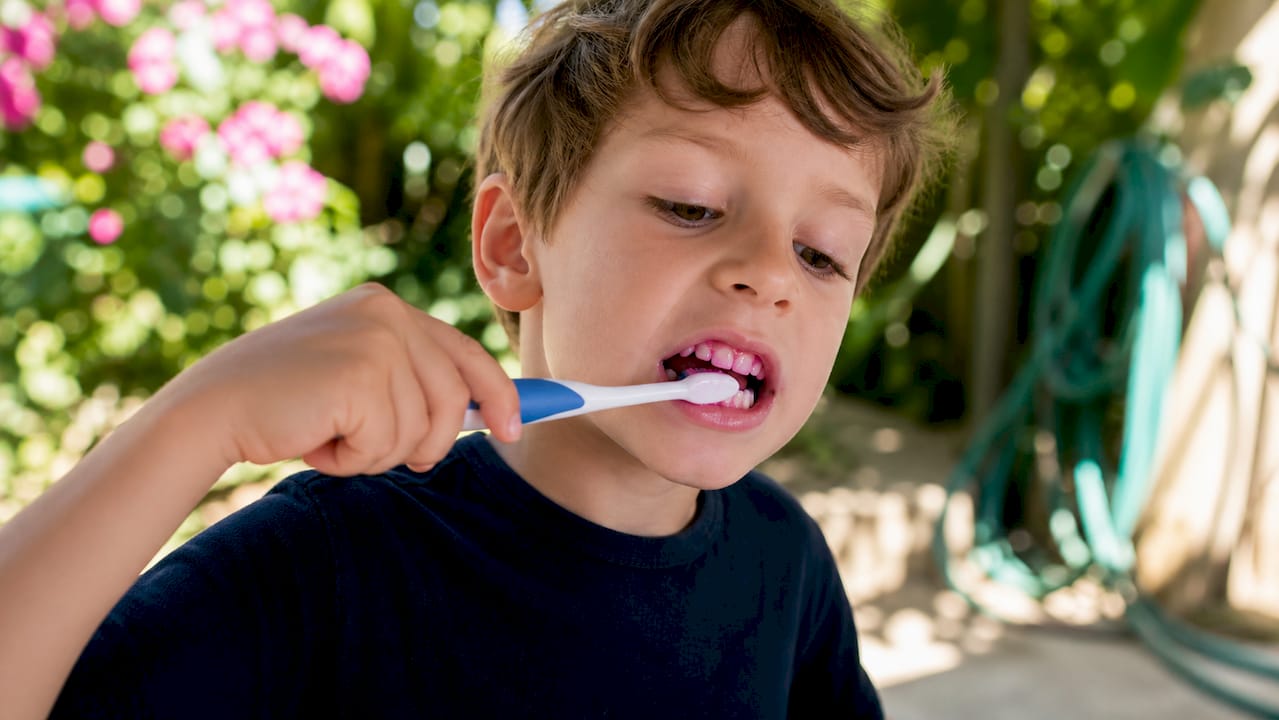
For children, this feedback is particularly powerful. Abstract instructions like “brush the back teeth better” are hard to follow. Seeing a bright pink stain on a molar makes the problem concrete and the correction obvious. Pairing tablets with a motivating brushing routine can accelerate habit formation significantly.
Orthodontic patients benefit for a different reason. Brackets and wires create dozens of small surfaces and gaps where plaque accumulates in ways that a standard brushing motion misses entirely. The PMC clinical trial showed that home use of disclosing tablets, beyond what clinicians demonstrate chairside, produced measurably better plaque control. Chairside-only demonstrations tend to have smaller long-term effects because the feedback loop ends when the appointment does.
Over time, consistent periodic use can help build what might be called “muscle memory mapping,” where brushers internalize which areas need extra attention and adjust their technique without needing a tablet every time.
Are disclosing tablets safe? Ingredients, allergy cautions, and supervision
Most commercial disclosing tablets sold in the U.S. use vegetable-based or food-grade dyes and are considered safe for general use when used as directed. That said, a few practical rules apply to everyone.
Safety checklist:
- Do not swallow the tablet or the dye-colored saliva; spit carefully after coating your teeth
- Supervise children under six; very young children who cannot reliably spit should not use chewable tablets
- Check the ingredient label if you have known allergies to food dyes, artificial colorants, or specific plant-derived pigments
- Protect clothing and countertops before use; the dye stains fabric and porcelain sinks
- Apply a thin layer of lip balm or petroleum jelly around the lips and corners of the mouth before use to prevent skin staining, as Royal Devon NHS guidance recommends
When to consult a dentist or physician before use: If you have a history of allergic reactions to dyes or colorants, active oral sores or ulcers, or any concern about a child accidentally swallowing the product, speak with a dental professional first.
Pro Tip: Apply petroleum jelly around your lips before chewing the tablet. It takes ten seconds and prevents the most common complaint: a stained mouth that takes hours to fade.
Step-by-step: how to use disclosing tablets with your brushing routine
The Leeds Teaching Hospitals NHS Trust provides a clinic-tested sequence that works well for both adults and supervised children.
- Prepare your space. Lay a dark towel near the sink and apply petroleum jelly around your lips. Wear an old shirt or protect your clothing.
- Do an initial brush (optional but recommended). Brush normally first. This lets you use the tablet to check how effective your brushing actually was, rather than just showing you a full mouth of plaque.
- Chew the tablet. Place it between your back teeth, crush it, and mix the dye with your saliva.
- Coat all tooth surfaces. Use your tongue to spread the dye-saliva mixture over every surface, front and back, for approximately one minute.
- Spit carefully. Spit into the sink slowly to avoid splashing. Rinse once, gently.
- Inspect your teeth. Use a mirror and good lighting. Note every stained area, paying special attention to blue or purple zones if you are using a two-tone tablet.
- Re-brush the stained areas. Focus your toothbrush on every colored spot until the dye is gone. This targeted re-brushing is where the real technique improvement happens.
- Rinse and re-inspect. A final rinse and check confirms you have cleared the stained plaque.
Before vs. after brushing: Using a tablet before any brushing shows your baseline plaque load, which is useful the first time you try them. Using one after brushing, as described above, shows how well your current technique performs. For most people, the after-brushing approach delivers more actionable information.
Recommended starting cadence: Daily for the first three to seven days, then weekly or once every two weeks as a maintenance check.
Pro Tip: If the dye stains your sink, clean it immediately with a mild bathroom cleaner. Leaving it for even a few hours makes it significantly harder to remove.
Who benefits most from disclosing tablets, and who should be cautious?
Groups that gain the most:
- Children ages six and up who are learning independent brushing technique
- Orthodontic patients in the first months of treatment, when bracket-area plaque control is most critical
- Caregivers and parents coaching a child’s brushing routine
- Adults starting a new oral hygiene routine or recovering from a period of poor dental health
- Older adults or people with limited hand dexterity who need visual confirmation that their brushing is reaching all surfaces
Groups that should use caution or consult a clinician first:
- Children under six who cannot reliably spit
- Anyone with a known allergy to food dyes or artificial colorants
- People with active oral wounds, ulcers, or post-surgical sites in the mouth
- Individuals with dental restorations such as crowns or veneers, since dye interpretation around restorations may be less reliable; a clinical guide on restorations and surface dyes explains how surface chemistry differs on restored teeth
Clinicians commonly recommend disclosing tablets for orthodontic patients during the early months of treatment, precisely because the visual feedback accelerates the habit changes that bracket-area hygiene demands.
How often should you use disclosing tablets?
Frequency depends on where you are in your brushing journey. Three practical cadences cover most situations.
Initial training period (days 1–7): Daily use during the first week builds rapid awareness of your personal trouble spots. Most people discover within two or three sessions that they consistently miss the same areas, typically the inner surfaces of lower front teeth and the gumline on back molars.
Maintenance phase: Once your technique has improved, weekly or once-every-two-weeks checks are enough to confirm you are staying on track. Daily long-term use offers diminishing returns once the habit is established.
Specific trigger use: Use a tablet after orthodontic adjustments, after starting a new toothbrush or brush head, or whenever you feel uncertain about your coverage. This ad-hoc approach keeps the tool relevant without making it a daily obligation.
For a child learning to brush independently, a practical plan might look like this: daily for the first week, then every Sunday for the first month, then once a month as a spot-check. For an adult with braces in month one of treatment, daily use for the first week then weekly for the first three months aligns with the clinical evidence showing the greatest plaque index improvements at the one and three-month marks. For a busy adult maintaining an established routine, a dental cleaning checklist used alongside a fortnightly tablet check covers both structure and accountability.
What disclosing tablets won’t do, and how to handle common pitfalls
Limitations:
- Tablets do not remove plaque. They only reveal it. The brushing still has to happen.
- They cannot dissolve or loosen hardened tartar (calculus). Once plaque mineralizes, only a professional cleaning can remove it.
- Staining in deep pits, fissures, or beneath restorations may not accurately reflect plaque presence in those areas.
- Persistent staining after thorough re-brushing is a signal that tartar has formed and a professional cleaning is overdue.
Practical precautions:
- Spit carefully and avoid splashing dye-colored saliva onto clothing or counters
- Rinse the sink immediately after use with a mild cleaner
- For skin staining around the mouth, wash with mild soap and warm water right away; most dye fades within a few hours
- Fabric staining from disclosing dye responds best to immediate cold-water rinsing followed by a standard laundry pre-treatment
When to see a dentist: if you notice staining that does not clear after careful re-brushing, or if you see consistent staining in the same areas despite weeks of improved technique, schedule a professional cleaning. That pattern indicates tartar buildup that no amount of brushing will resolve.
For families managing at-home dental care kits for children, disclosing tablets fit naturally into a supervised routine alongside age-appropriate brushes and fluoride toothpaste.
What does the research say about disclosing tablets and brushing effectiveness?
The strongest clinical evidence comes from a randomized trial in orthodontic patients. The study divided participants into three groups: group A received chairside instruction only (n=16), group B received instruction plus a chairside disclosing demonstration (n=17), and group C received instruction plus disclosing tablets to use at home (n=15). At both the one-month and three-month follow-ups, group C showed significantly lower plaque index scores than groups A and B (p<0.05).
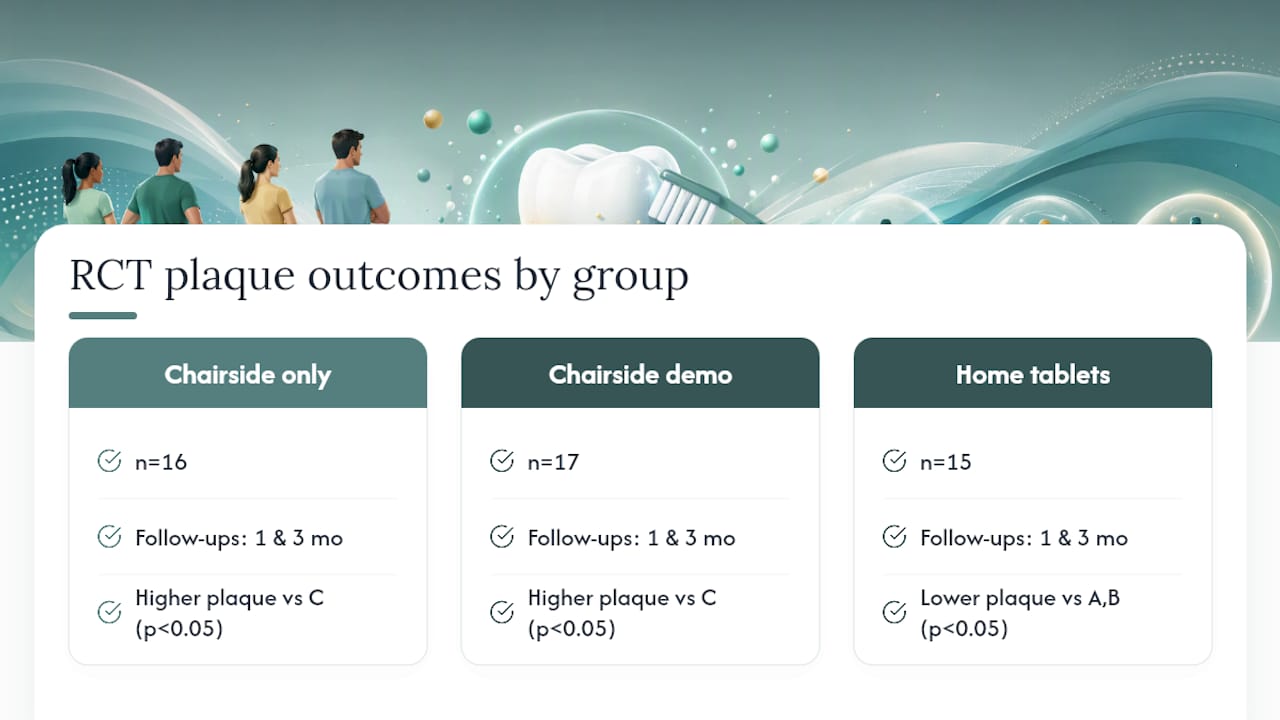
The key finding is that home use outperformed clinic-only demonstrations. This makes intuitive sense: a single chairside demonstration creates awareness once, while daily at-home use creates a feedback loop that repeats until the habit is internalized.
The evidence base has limits. Most studies use small samples and focus on orthodontic populations, so the results may not generalize perfectly to all adults. Mixed results appear in studies that rely solely on chairside disclosure without follow-up home use. For readers who want to review the primary literature, the full study is available at PubMed Central (PMC7018494).
Alternatives to tablets: gels, swabs, chairside disclosure, and tech-based feedback
Chewable tablets are not the only format. Several alternatives suit different ages, preferences, and clinical settings.
Common alternatives:
- Disclosing gels: Applied with a cotton swab or fingertip, gels work well for toddlers and young children who cannot chew tablets reliably. They offer more controlled application.
- Disclosing mouthwashes: Less common in the U.S. market but available; useful for people who prefer a rinse format or have difficulty chewing.
- Disclosing toothpastes: Some products combine a mild abrasive with a temporary dye so that brushing and disclosure happen simultaneously.
- Chairside disclosure: Dental professionals apply a disclosing solution during a cleaning appointment to show patients their plaque distribution in real time. Effective for education but limited to the appointment window.
- Tech-based feedback: Electric toothbrushes with pressure sensors and coverage tracking apps can complement disclosure agents by providing real-time mechanical feedback. Used together, a disclosing tablet reveals where plaque is, and a brush with coverage feedback helps confirm you are reaching those areas on subsequent sessions.
For toddlers or anyone who cannot chew, a gel or swab format applied by a caregiver is the safer and more practical choice. For adults who want the most detailed plaque map, two-tone tablets remain the most informative single-use option.
Why disclosing tablets deserve a regular spot in your routine
There is a gap between what most people believe about their brushing and what a disclosing tablet reveals. Most adults assume they are brushing adequately. The tablet almost always proves otherwise, at least in the first few uses. That gap is not a failure; it is information, and information is what changes behavior.
What strikes me most about the clinical evidence is not that disclosing tablets work, but that home use works better than clinic demonstrations. A dentist showing you your plaque once a year is far less effective than you seeing it yourself three times a week for a month. The feedback loop is the mechanism, and tablets are the only low-cost, at-home tool that creates it reliably.
The conventional wisdom treats disclosing tablets as a novelty for children. That framing undersells them. Adults with braces, adults who have never had a cavity but have never actually confirmed their brushing covers all surfaces, and anyone who has been told by a hygienist that they have “plaque buildup” without understanding where it comes from, all stand to benefit from a week of daily tablet use. The visual evidence is harder to ignore than verbal advice, and the effective oral care habits that result tend to stick.
Y-brush: a faster way to close the gap between brushing and clean teeth
Disclosing tablets show you where plaque hides. Y-brush gives you a brushing tool designed to reach those spots faster. Y-brush’s patented Y-shaped brush head covers all tooth surfaces simultaneously, delivering a complete clean in 20 seconds through sonic vibrations, compared with the two-minute manual standard that research shows 90% of people never actually reach. For anyone who has used a disclosing tablet and found the same missed areas session after session, the issue is often coverage geometry, not effort. Y-brush addresses that directly.
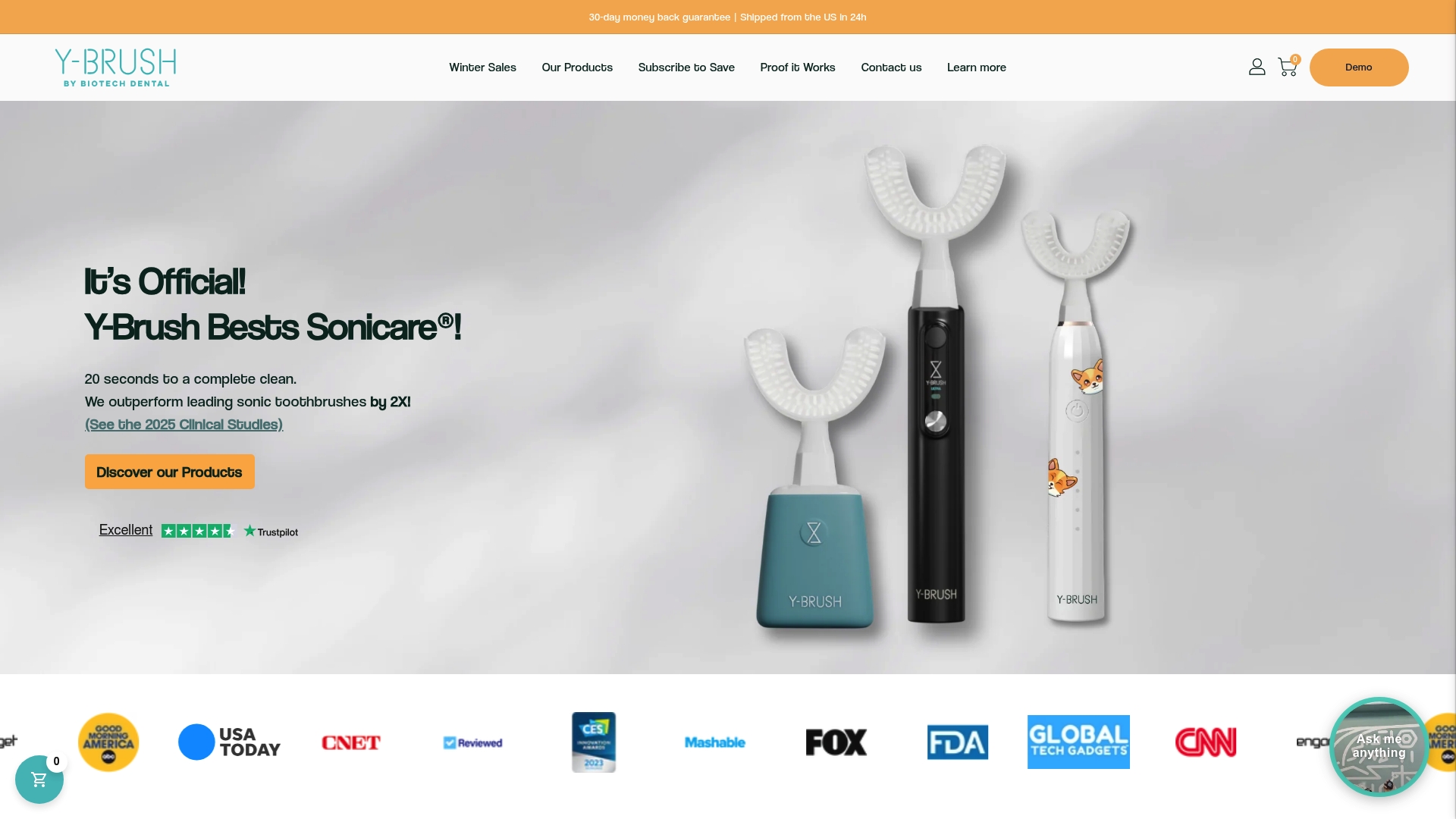
Adults and parents who want a brushing tool that complements the feedback from disclosing tablets can explore the Y-brush Halo and its subscription plans at Y-brush. Replacement heads ship on a regular schedule so coverage quality stays consistent over time.
Sources
This article is general information, not a substitute for advice from a qualified doctor. Consult a qualified healthcare professional about your own circumstances before acting on anything here.


