


A solid oral health workflow comes down to two non-negotiable steps: brushing twice daily and cleaning between your teeth once a day. The standard version takes about two minutes per session; the fast variant, using Y-brush’s patented 20-second clean, fits even the most compressed morning schedule.
- Full routine (2 minutes): Best for adults with a few extra minutes and anyone managing gum sensitivity or active dental concerns.
- Fast variant (20 seconds): Designed for busy mornings, travel, or nights when the kids have already pushed bedtime past its limit.
- Family option: The Y-brush lineup, including the Y-Brush Essential Sonic Toothbrush, Y-Brush DuoBrush, and Y-Brush KidsBrush, covers adults and children ages 4–12 with the same 20-second sonic approach.
Table of Contents
- What does a practical daily oral health workflow look like?
- Why does each step in the routine actually matter?
- How do you choose and maintain the right toothbrush?
- How does Y-brush fit into your daily routine?
- What should you check before buying a toothbrush or subscription?
- Key Takeaways
- The gap between knowing and doing
- Y-brush makes the 20-second routine possible
- Useful sources
What does a practical daily oral health workflow look like?
Morning routine
Standard (2 minutes):
- Rinse with water to loosen overnight debris.
- Apply a pea-sized amount of fluoride toothpaste to a soft-bristled brush.
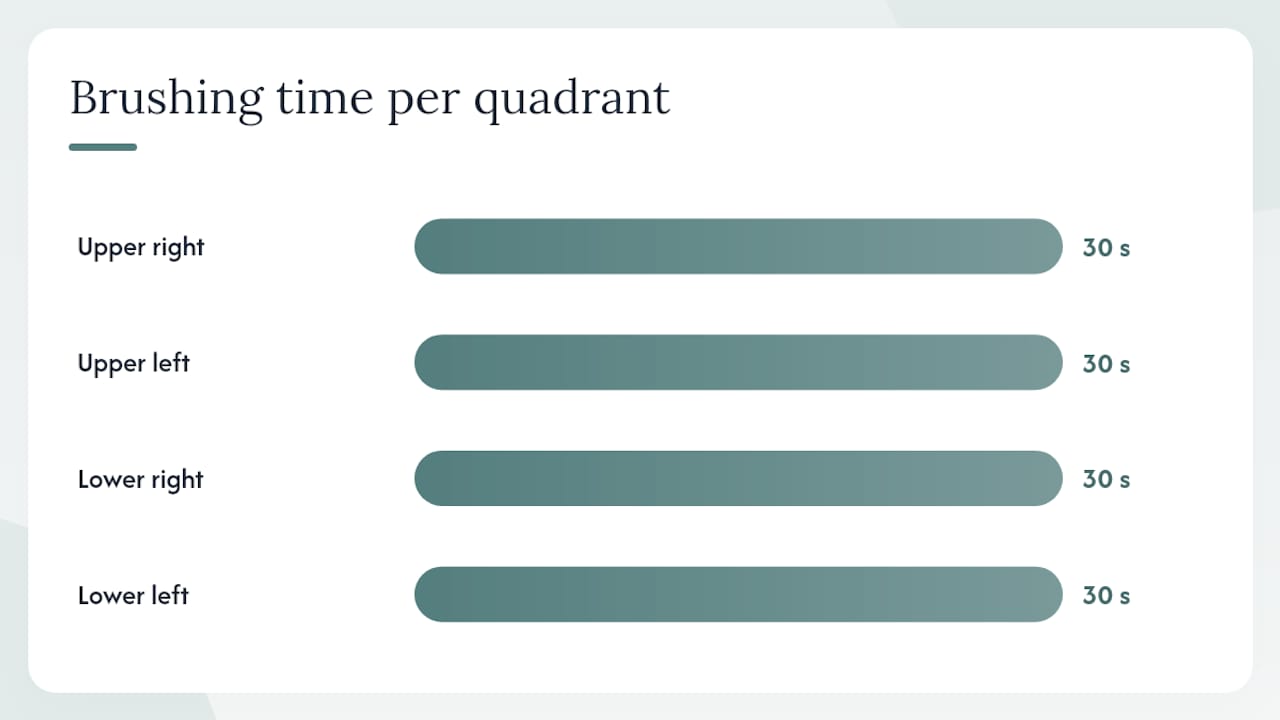
- Brush for two minutes, spending roughly 30 seconds on each quadrant.
- Spit out excess toothpaste. Do not rinse with water right away — letting fluoride remain on your teeth extends its protective effect, per NHS guidance.
- Skip mouthwash here; use it after lunch instead so it does not wash away the fluoride your toothpaste just deposited.
Fast variant (20 seconds with Y-brush):
- Apply toothpaste to the Y-shaped brush head.
- Place the head over your teeth and let the sonic vibrations do the work for 20 seconds.
- Spit. No rinse needed.
Evening routine
The evening session matters most because saliva flow drops overnight, leaving teeth more vulnerable to acid.
- Floss or use an interdental brush before brushing. Flossing first dislodges debris that brushing then sweeps away. Use about 18 inches of floss, wrapping it in a “C” shape around each tooth and sliding gently under the gumline.
- Brush for two minutes (or 20 seconds with Y-brush).
- Scrape your tongue. Harvard Health recommends tongue scraping as a standard step to reduce bacterial load.
- Spit; do not rinse.
Kids’ variant (ages 4–12)
Supervise brushing until around age 8. Use a brush head sized for a child’s mouth, a rice-grain amount of fluoride toothpaste for children under 3, and a pea-sized amount for ages 3–12. The Y-brush KidsBrush applies the same 20-second sonic method with a head sized for smaller mouths, which makes the routine far less of a battle at bedtime. For more family-specific tips, the Y-brush oral care guide for families covers age-by-age adaptations.

Travel and irregular schedules
Pack a travel-sized fluoride toothpaste and your Y-brush. The 20-second clean requires no special setup, so even a 30-second bathroom stop covers brushing. Carry a small floss pick or interdental brush for interdental cleaning on the go.
Pro Tip: Pair your brushing habit with an existing cue, such as the coffee maker finishing its cycle in the morning or the kids’ bedtime story ending at night. Habit stacking is one of the most reliable ways to make a routine stick without relying on willpower.
Why does each step in the routine actually matter?
Consistency is the single most important factor in preventing oral disease. The best tool is the one you will actually use every day, not the theoretically superior one sitting unused on the shelf.
The ADA recommends twice-daily brushing with fluoride toothpaste and daily interdental cleaning. Those two steps together address the two main surfaces where plaque accumulates: the exposed tooth face and the tight contact points between teeth that a brush cannot reach. Toothbrush bristles alone cannot clean effectively between teeth, which is why interdental cleaning is a separate, non-optional step.
The time gap is real. Most people significantly underestimate how long they have been brushing. Built-in timers on electric brushes measurably increase actual brushing duration compared with manual brushing without a timer.
When flossing is difficult due to dexterity or tight contacts, water flossers are a useful supplement for removing food debris. They are not a full replacement for string floss, though, because they are less effective at removing the biofilm that forms along the gumline.
| Step | Why it matters | Authority |
|---|---|---|
| Twice-daily brushing | Removes plaque before it hardens into tartar | ADA |
| 2-minute duration | More plaque removed vs. shorter sessions; 30 sec per quadrant | ADA |
| Daily interdental cleaning | Clears plaque from surfaces bristles cannot reach | ADA / Cleveland Clinic |
| No-rinse after brushing | Preserves fluoride concentration on enamel | NHS |
| Tongue scraping | Reduces bacterial load and freshens breath | Harvard Health |
| Mouthwash timing | Use after lunch, not after brushing, to protect fluoride | NHS |
How do you choose and maintain the right toothbrush?
Manual vs. electric: what the evidence shows
Electric toothbrushes help users reach the recommended brushing duration and can remove plaque more effectively for many people because they automate motion and include built-in timers. Manual brushes work well when used correctly, but most people do not use them correctly for long enough.
| Criterion | Manual brush | Powered brush |
|---|---|---|
| Built-in timer | No | Yes (most models) |
| Plaque removal | Effective with proper technique | Effective with less technique required |
| Dexterity needs | Higher | Lower |
| Consistency support | Relies on user | Automated motion helps |
| Cost over time | Lower upfront | Replacement heads ongoing |
What to look for when buying:
- Soft bristles. The ADA recommends soft bristles for most adults to protect gums and enamel.
- A head size that fits your mouth and lets you reach back molars.
- A built-in timer or pairing with a timer app if choosing manual.
- For users with arthritis or limited grip strength, a powered brush with a wider handle reduces strain. The Y-brush guide on electric toothbrushes for seniors covers dexterity-related considerations in detail.
Replacement schedule and maintenance
Replace brush heads regularly, or sooner when bristles visibly splay. Frayed bristles clean less effectively and can irritate gums. Store brushes upright in open air; avoid closed containers that trap moisture and encourage bacterial growth. Rinse the head thoroughly after each use. For travel, a ventilated cap is fine for short trips.
For kids, check bristle condition more frequently since children often press harder than adults.
How does Y-brush fit into your daily routine?
Y-brush’s patented Y-shaped head covers all tooth surfaces simultaneously, delivering a full-mouth sonic clean in about 20 seconds for both arches. That addresses the most common real-world problem: people know they should brush for two minutes, but the typical brush session runs under one minute.
Y-brush model overview:
- Y-Brush Essential Sonic Toothbrush: The core adult model. Place, activate, 20 seconds, done.
- Y-Brush DuoBrush: Designed for extra coverage, useful for adults who want a dual-action clean or couples sharing a charging base.
- Y-Brush KidsBrush (ages 4–12): Same sonic technology with a child-sized head and a 20-second run time that makes brushing feel less like a chore for both arches.
How to use Y-brush:
- Apply a pea-sized amount of fluoride toothpaste across the bristles of the Y-shaped head.
- Place the head over your upper and lower teeth, ensuring full contact.
- Activate and hold for 20 seconds total or follow the model’s guided cycle.
- Spit. No rinse.
- Follow with interdental cleaning and, in the evening, tongue scraping.
Pro Tip: Reserve the full 2-minute manual or standard electric session for days after heavy staining foods (coffee, red wine, berries) or when your dentist has flagged an area of concern. Y-brush’s 20-second clean handles daily maintenance; the longer session handles targeted follow-up.
Consult your dentist for personalized advice, especially if you have active gum disease, sensitivity, or orthodontic hardware; following OSHA dental-office safety recommendations can also help maintain a safe and effective oral health environment.
What should you check before buying a toothbrush or subscription?
Use this checklist before purchasing any brush or signing up for a refill plan:
- ADA Seal: — Look for the ADA Seal of Acceptance on toothpaste and brush packaging as a baseline quality signal.
Shopping red flags: Brushes marketed with clinical claims but no ADA Seal, replacement heads that are hard to source or priced inconsistently, and bristles described as “firm” or “hard” for everyday use. For a broader checklist, the Y-brush oral hygiene checklist covers daily and monthly checkpoints in one place.
Key Takeaways
A consistent twice-daily brushing routine combined with daily interdental cleaning is the most effective preventive dental care process available to adults and parents, regardless of which brush they use.
| Point | Details |
|---|---|
| Brush twice daily | Two minutes per session (30 sec per quadrant) or 20 seconds with Y-brush’s sonic method. |
| Clean between teeth daily | String floss, interdental brushes, or water flossers — choose what you will actually use consistently. |
| Replace brush heads every 3–4 months | Frayed bristles reduce cleaning effectiveness; check kids’ heads more frequently. |
| Consistency beats perfection | The method you perform every day outperforms the theoretically superior method you skip. |
| Y-brush for fast daily maintenance | The Y-Brush Essential, DuoBrush, and KidsBrush deliver a full-mouth clean in 20 seconds, supporting adherence for busy schedules. |
The gap between knowing and doing
Most adults know the two-minute rule. Very few hit it consistently. That gap is not a motivation problem — it is a design problem. Routines that ask too much of a tired parent at 10 PM or a rushed adult at 7 AM will fail, regardless of how well-intentioned they are.
The workflows in this article are built around that reality. A 20-second sonic clean is not a shortcut; it is a realistic answer to the fact that an imperfect routine performed daily beats a perfect one performed twice a week. The same logic applies to interdental cleaning: a water flosser used every night is more valuable than string floss used occasionally. Dental professionals have said this for years, and the evidence backs it up.
Where Y-brush fits is straightforward: it removes the time barrier that causes most people to underbrush. Pair it with nightly flossing and a fluoride toothpaste, and you have a dentist-backed routine that takes under five minutes total.
Y-brush makes the 20-second routine possible
Busy schedules should not mean compromised oral health. Y-brush was built specifically for adults and parents who know they should brush longer but consistently fall short. The patented Y-shaped head delivers a full-mouth sonic clean in 20 seconds — no technique required, no timer needed, no excuses left.
The Y-Brush Essential Sonic Toothbrush is the starting point for adults. Parents can add the Y-Brush KidsBrush for children ages 4–12, and the Y-Brush DuoBrush for extended coverage. Replacement heads ship on a subscription cadence aligned to the 3–4 month replacement window, so you never have to remember to reorder. Visit y-brush.co to browse models, check subscription options, and find additional oral care resources.
Useful sources
- American Dental Association: Home Oral Care Recommendations — backs twice-daily brushing, two-minute duration, and timer guidance.
- ADA: Toothbrushes — soft bristle recommendation and 3–4 month replacement schedule.
- ADA MouthHealthy: Brushing Your Teeth — brushing technique and ADA Seal guidance.
- Cleveland Clinic: Oral Hygiene Best Practices — interdental cleaning technique, consistency as the primary prevention factor, and water flosser notes.
- Cleveland Clinic: How to Remove Plaque — electric brush adherence and plaque removal evidence.
- Y-brush: What Is Interdental Cleaning? — methods and tips for readers who want a deeper interdental cleaning guide.


