


TL;DR:
- Smile confidence is the ability to show your natural smile effortlessly, affecting both your self-perception and social interactions.
- Practices like jaw relaxation, oral hygiene, and mirror exercises can help reduce self-monitoring and build genuine smiling habits.
Smile confidence is the ability to show your natural smile without self-monitoring or holding back. It sits at the intersection of oral health, psychology, and social behavior, and it influences how you feel about yourself and how others respond to you. Here are three things you can try right now:
- Jaw-relax reset: Drop your jaw slightly, let your tongue rest on the roof of your mouth, and take one slow breath before smiling. This releases the tension that makes smiles look forced.
- Oral-hygiene check: Spend 60 seconds assessing your brushing routine. Consistency here removes a common source of smile-related self-consciousness.
- Mirror micro-practice: Stand in front of a mirror and smile naturally for 20–30 seconds without judging the result. Repetition reduces the self-monitoring reflex.
The sections below cover why smile confidence matters, the science behind it, and a practical plan to build it.
Table of Contents
- What is smile confidence, and how do you recognize it?
- How smile confidence shapes your wellbeing and relationships
- The science behind smiling: Duchenne smiles and the facial-feedback hypothesis
- How oral health and dental appearance affect smile confidence
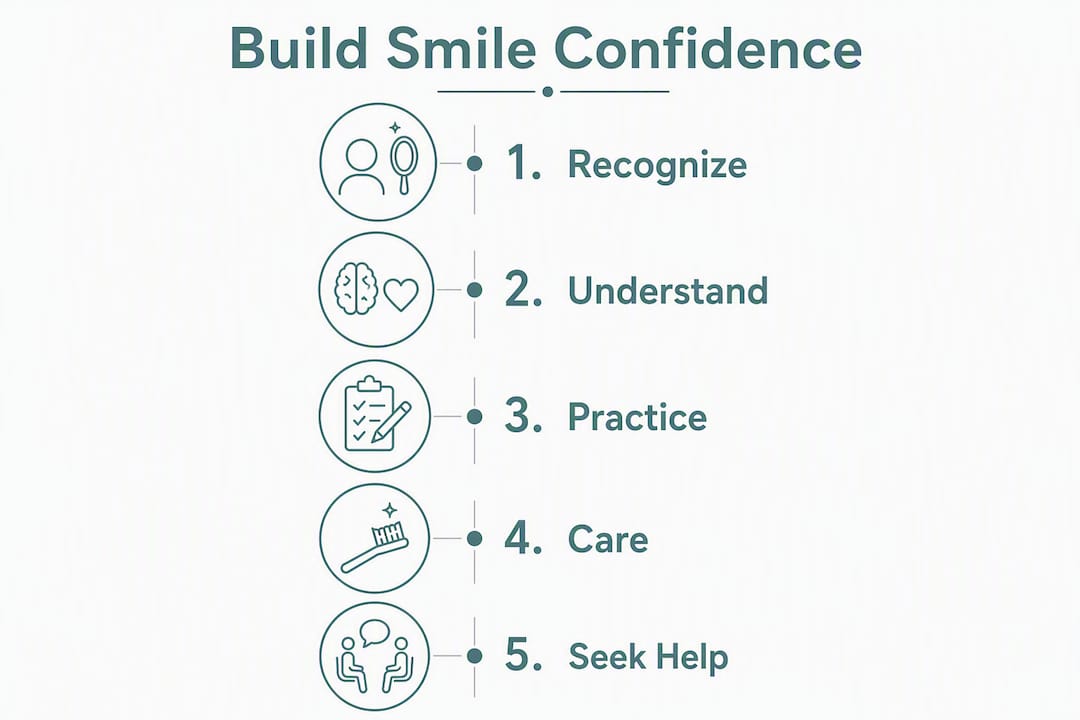
- How to build smile confidence: a practical, step-by-step plan
- When should you see a dentist vs. a therapist?
- Common myths about smile confidence
- Key Takeaways
- A practitioner’s perspective on building smile confidence
- Consistent oral care supports every step of this process
- Useful sources for further reading
What is smile confidence, and how do you recognize it?
Smile confidence is not the same as general self-esteem, though the two overlap. General self-esteem reflects how you value yourself across many domains: work, relationships, appearance, and competence. Smile confidence is narrower. It refers specifically to your ease with showing your smile, your willingness to do so spontaneously, and the absence of the self-monitoring loop that makes people cover their mouths, turn away, or suppress a laugh.
You can recognize it in a few behavioral patterns. Someone with strong smile confidence makes natural eye contact when they smile, their jaw is relaxed rather than tight, and the timing is spontaneous rather than performed. They are not calculating whether their teeth look right before they react to something funny. The smile happens first; the thought comes later, if at all.
Cultural context shapes what “confident smiling” looks like. In the United States, broad, teeth-showing smiles are strongly associated with warmth and openness. In some East Asian and Northern European cultures, a more restrained smile carries equal social weight. Smile confidence, properly understood, is not about matching a cultural template. It is about the absence of inhibition within your own social context, whatever that looks like.
How smile confidence shapes your wellbeing and relationships
The stakes here are real. Smiling triggers the release of dopamine, serotonin, and oxytocin, three neurochemicals that reduce perceived stress and reinforce positive mood. The effect is not purely social; it is physiological. When you smile, your body responds as though something good is happening, which can actually make something good more likely to happen.
The social effects are equally concrete. Emotional mimicry research shows that when you smile at someone, they tend to mirror it automatically, and that mirroring produces positive feelings in them that they then associate with you. The result is a measurable increase in perceived trustworthiness and approachability. This is not a soft, feel-good claim; it is a mechanism with documented behavioral consequences, including greater willingness to share resources and cooperate in experimental tasks.
The professional implications follow directly:
- First impressions form within seconds, and a genuine smile is one of the strongest positive signals available in that window.
- People who smile confidently in interviews are rated as more competent and warmer simultaneously, a combination that is otherwise difficult to project.
- In ongoing professional relationships, consistent, natural smiling correlates with being seen as more approachable and easier to work with.
The personal relationship effects are just as significant. Suppressing a smile in social settings creates a subtle barrier. Others read the restraint, often unconsciously, as discomfort or disinterest. Over time, that pattern can reduce the quality and frequency of social connection.
The science behind smiling: Duchenne smiles and the facial-feedback hypothesis
Two concepts anchor the research on smile confidence: the Duchenne smile and the facial-feedback hypothesis.
A Duchenne smile engages both the zygomatic major muscle (which pulls the corners of the mouth up) and the orbicularis oculi (which creates the characteristic crinkling around the eyes). Non-Duchenne smiles activate only the mouth. The distinction matters because observers detect the difference reliably, even without being told what to look for. Research published in PMC confirms that Duchenne smiles increase the perceived credibility of a person’s words, while non-Duchenne smiles do not produce the same effect. Separately, studies show that Duchenne smiles are rated higher on both warmth and competence, while posed smiles increase perceived warmth but do not move the needle on competence.

The facial-feedback hypothesis proposes that the physical act of smiling sends signals back to the brain that influence emotional state. Kraft and Pressman’s 2012 research found that participants who held a Duchenne smile during a stressful task recovered from that stress faster than those who held a neutral expression. The mechanism appears to involve reduced cortisol response and faster return to baseline heart rate.
One important caveat: the facial-feedback hypothesis has faced replication challenges, and the effect size varies across studies. The relationship between smiling and mood is real but not a simple on/off switch. What the evidence does support consistently is that habitual smiling, especially genuine Duchenne smiling, correlates with better mood regulation and stronger social outcomes over time.
How oral health and dental appearance affect smile confidence
Oral health is one of the most direct, modifiable inputs to smile confidence. The issues that most commonly affect it include tooth discoloration, visible gaps or spacing irregularities, gum recession or inflammation, and missing teeth. These are clinical concerns, not vanity. When someone avoids smiling because of how their teeth look, the downstream effects on social connection and self-perception are measurable.
Treatment categories range from preventive to restorative:
- Preventive hygiene (consistent brushing, flossing, and regular dental visits) is the foundation. Routine preventive care, defined as two or more dental visits per year, correlates with higher self-reported confidence compared with people who visit less frequently or not at all.
- Whitening addresses discoloration and is one of the most common entry points for people seeking a confidence improvement.
- Orthodontics (clear aligners or traditional braces) corrects spacing and alignment over months to years.
- Restorative work (crowns, implants, veneers) addresses structural issues and missing teeth.
Cosmetic improvements can produce meaningful quality-of-life gains. Some studies report 30–50% improvement in validated quality-of-life questionnaires following cosmetic dental treatment. That is a clinically significant range. But the same evidence base makes clear that cosmetic changes are not a guaranteed fix for underlying psychological barriers to smiling.
| Oral Health Status | Self-Confidence Rating |
|---|---|
| Completely satisfied with smile | 93% rate confidence as excellent/very good |
| Not satisfied with smile | 30% rate confidence as excellent/very good |
| Two or more dental visits per year | Higher self-confidence vs. infrequent visitors |
Source: Cigna Dental DNA survey
How to build smile confidence: a practical, step-by-step plan
Building smile confidence works best as a layered process, starting with the lowest-effort changes and adding complexity as each layer becomes habitual.
- Hygiene audit (Day 1). Review your current brushing and flossing routine honestly. Are you brushing for the recommended two minutes? Most people are not. Closing this gap removes a concrete source of self-consciousness before you work on anything behavioral.
- Mirror micro-practice (Days 2–7). Spend 20–30 seconds each morning smiling at your reflection without evaluating the result. The goal is repetition, not perfection. This reduces the self-monitoring reflex that makes smiles feel unnatural in public.
- Jaw-relaxation reset (ongoing). Before entering a social situation, drop your jaw slightly, place your tongue on the roof of your mouth just behind your front teeth, and exhale slowly. This is the pre-smile reset that practitioners consistently recommend for reducing the “forced” look.
- Staged social exposures (Week 2 onward). Start with low-stakes interactions: smile at a cashier, a neighbor, or a colleague in passing. Gradually increase the stakes as the behavior becomes automatic.
- Combine oral care with psychological work. If anxiety or body-image concerns are driving the avoidance, psychological support often improves outcomes more than cosmetic treatments alone. Cognitive behavioral therapy (CBT) techniques, particularly exposure-based approaches, are well-suited to this type of avoidance behavior.
- Maintenance habits. Consistent daily brushing, regular preventive dental visits, and brief daily mirror practice sustain the gains. None of these require large time investments.
Pro Tip: The tongue-position cue in step 3 does more than relax the jaw. Resting the tongue on the palate naturally lifts the cheeks slightly and engages the orbicularis oculi, the eye muscle that distinguishes a Duchenne smile from a posed one. Practitioners report that patients who learn this cue see faster visible improvement than those who focus only on the mouth.

When should you see a dentist vs. a therapist?
The decision is not always either/or, but the starting point matters.
See a dentist first if: you are avoiding smiling because of a specific, visible dental issue (discoloration, a gap, a missing tooth, visible gum problems). A dentist can give you a realistic scope of treatment, estimated timelines, and cost ranges. Useful questions to bring: What is causing this issue? What are my treatment options, from least to most invasive? What is a realistic timeline and cost range for each?
See a therapist first if: you avoid smiling even when you know your teeth are healthy, or if the avoidance is part of a broader pattern of social anxiety or body-image concerns. A therapist trained in CBT or exposure therapy can help you identify the avoidance cycle and interrupt it. Useful questions: Do you use exposure-based approaches for appearance-related anxiety? How many sessions does this typically take?
See both when: a real dental issue exists AND anxiety has grown around it beyond what the dental fix will resolve. Combining dental care with psychological work produces better long-term outcomes than either approach alone, particularly for people whose avoidance has become habitual over years.
Common myths about smile confidence
Myth 1: You need perfect teeth to smile confidently. The evidence does not support this. Smile confidence correlates more strongly with the absence of self-monitoring than with dental perfection. Many people with objectively imperfect teeth smile freely and are perceived as warm and trustworthy. Many people with cosmetically ideal teeth still hide their smiles.
Myth 2: Cosmetic dentistry alone will fix the problem. Cosmetic improvements can meaningfully raise quality-of-life scores, but changing teeth is often overestimated as a cure for social anxiety. If the avoidance behavior is deeply ingrained, the dental change may not transfer to behavioral change without deliberate psychological work alongside it.
Myth 3: Smile confidence is something you either have or you don’t. It is a learnable behavior pattern. The research on exposure therapy, habit formation, and facial-feedback mechanisms all point to the same conclusion: consistent, low-stakes practice produces real change. The timeline is weeks to months, not years.
Myth 4: Forcing a smile is pointless. Posed smiles do not carry the same social weight as Duchenne smiles, but the act of practicing smiling, even consciously, builds the neural and muscular familiarity that makes genuine smiles easier to access. The practice is not the destination; it is the path to the destination.
Key Takeaways
Smile confidence is a learnable skill rooted in reduced self-monitoring, consistent oral hygiene, and deliberate behavioral practice, not dental perfection.
| Point | Details |
|---|---|
| Definition | Smile confidence means smiling without self-monitoring, distinct from general self-esteem. |
| Neurochemical effect | Smiling triggers dopamine, serotonin, and oxytocin, reducing stress and reinforcing positive mood. |
| Oral health link | 93% of people satisfied with their smile rate their self-confidence as excellent or very good, vs. 30% who are not satisfied. |
| Science of genuine smiles | Duchenne smiles (eye muscles engaged) rate higher on both warmth and competence than posed smiles. |
| Y-brush role | Consistent daily brushing with Y-brush’s 20-second clean addresses the hygiene gap that underlies much smile-related self-consciousness. |
A practitioner’s perspective on building smile confidence
The most common pattern in people working to build smile confidence is not a lack of motivation. It is a mismatch between what they expect to fix the problem and what actually moves the needle. Many people arrive convinced that one dental procedure will resolve years of avoidance. Sometimes it does. More often, the avoidance behavior has become automatic, and the dental change, while genuinely helpful, does not automatically transfer to behavioral change.
What tends to work is smaller and less dramatic than people expect. A consistent jaw-relax reset before social situations. A two-week streak of mirror practice. A preventive dental visit that removes a specific worry. These micro-wins compound. The person who starts smiling at cashiers in week two is not the same person who was covering their mouth in week one, even if nothing about their teeth has changed yet.
The other thing worth saying plainly: the self-monitoring loop is the real obstacle for most people, not the teeth themselves. Reducing that loop, through exposure, through habit, through whatever combination of dental and psychological support fits the individual, is the actual work. The smile follows.
Consistent oral care supports every step of this process
A clean, healthy mouth removes one of the most common psychological barriers to smiling freely. Y-brush was built for exactly this: a complete, plaque-free clean in 20 seconds, using a patented Y-shaped brush head and sonic vibrations that cover all surfaces simultaneously. For the 90% of people who do not brush for the recommended two minutes, this is a practical solution that fits into real daily routines without requiring a behavioral overhaul.
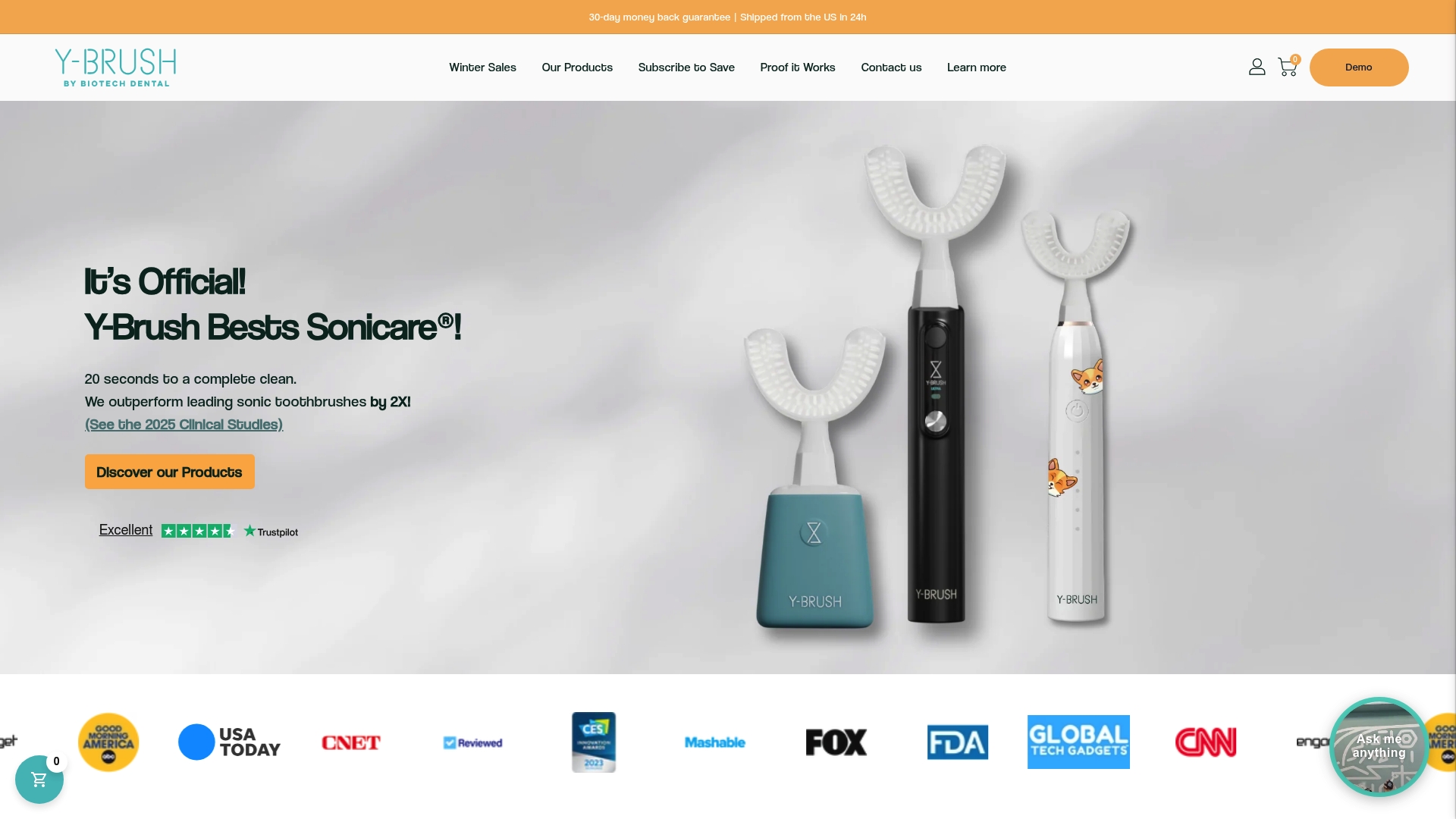
Before investing in cosmetic treatments, it is worth evaluating whether your daily hygiene routine is as consistent as it could be. A reliable brushing habit is the lowest-cost, highest-return starting point for smile confidence, and it supports every other step in the process described above. The Y-brush Essential Sonic Toothbrush is available now for U.S. readers looking to close that gap.
Useful sources for further reading
- Face Value and Cheap Talk: How Smiles Affect Credibility — PMC: Peer-reviewed study on how Duchenne vs. non-Duchenne smiles affect perceived credibility and behavioral trust decisions.
- The Science of Smiling and Trust — National Geographic: Accessible overview of emotional mimicry research and how smiling influences social trust.
- Behind the Smile: Oral Health and Self-Esteem — Cigna Dental DNA: Survey data linking oral health satisfaction and preventive care frequency to self-reported confidence levels.


