


TL;DR:
- Most people brush for less than a minute, but two-minute brushing remains crucial for effective plaque removal. Whole mouth toothbrushes clean multiple teeth simultaneously but often lack clinical effectiveness, especially near the gum line. Proper technique, timing, and supplementary flossing are essential for optimal oral health, regardless of device type.
Most people brush for under a minute, even though dentists recommend a full two minutes for effective plaque removal. A whole mouth toothbrush promises to fix this gap by cleaning all your teeth simultaneously, typically in 30 seconds or less. The appeal is obvious. But before you swap out your regular brush, it’s worth understanding exactly what these devices can and cannot do. This guide covers the design, clinical realities, expert insights, and practical tips you need to make a smart decision about whole mouth dental hygiene.
Table of Contents
- Key Takeaways
- How whole mouth toothbrushes work
- Clinical efficacy: what research actually shows
- Why brushing time and technique still matter
- Choosing the right whole mouth toothbrush
- Practical tips for using whole mouth brushes effectively
- My take on convenience versus clinical reality
- Try Y-Brush for whole mouth cleaning done right
- FAQ
Key Takeaways
| Point | Details |
|---|---|
| Design matters for fit | U-shaped mouthpiece brushes may not fit every arch shape, leaving zones uncleaned. |
| Clinical results are mixed | Studies show many whole mouth brushes fall short on plaque removal, especially near the gum line. |
| Brushing time still matters | Even with fast-clean claims, two minutes of contact time remains the gold standard for oral health. |
| Best use cases exist | Children and people with limited dexterity gain real benefit from whole mouth brush designs. |
| Technique completes the job | No device replaces consistent pressure, proper positioning, and regular flossing. |
How whole mouth toothbrushes work
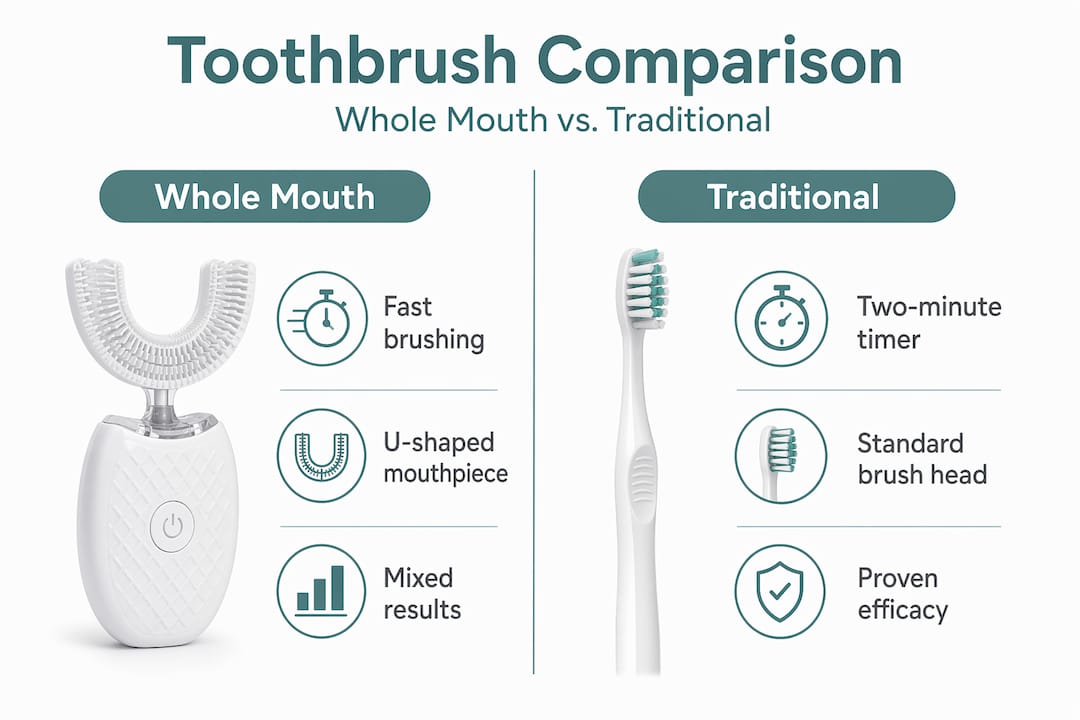
A whole mouth toothbrush, sometimes called a full mouth toothbrush or mouthpiece brush, is designed around a U-shaped tray that mirrors the curve of your dental arch. You bite down into the tray, and the bristles on both the inner and outer sides brush multiple teeth at once. Most models add an electric mechanism to drive the cleaning action.
The main electric mechanisms you’ll find across these devices include:
- Vibration-based motors that oscillate the bristle tray at low to moderate frequencies
- Sonic technology that uses high-frequency sound waves to agitate plaque and debris between bristles and tooth surfaces
- LED light therapy integrated into some models for additional antibacterial support
Brushing time claims range from 20 seconds to about one minute, compared to the standard two-minute recommendation for manual and traditional electric brushes. The only U-shaped brush with ADA Seal of Acceptance is the Autobrush, which pairs sonic vibration with red and blue light therapy and has clinical trial data backing its claims. Most other devices on the market have not reached that bar.
| Feature | Whole mouth toothbrush | Traditional electric toothbrush |
|---|---|---|
| Brushing time claim | 20 to 60 seconds | 2 minutes recommended |
| Coverage method | Simultaneous multi-tooth | Quadrant by quadrant |
| Pressure control | Typically none | Often built-in sensor |
| Timer/pacer | Rarely included | Standard in quality models |
| Fit variation | One-size tray | Not a fit concern |
Pro Tip: Before buying any electric whole mouth brush, check whether it has earned any independent clinical validation. Marketing claims and third-party clinical data are very different things.
Understanding how toothbrush design affects oral care helps you evaluate these claims with the right framework rather than relying on packaging alone.
Clinical efficacy: what research actually shows
This is where the gap between marketing and reality becomes most visible. Evidence on U-shaped whole-mouth brushes is mixed, with many dentists pointing out that these devices struggle to remove plaque reliably, particularly at the gum line and in the tight spaces between teeth.
The core problem is mechanical. Some whole mouth brushes rely primarily on vibration rather than true mechanical scrubbing action, which reduces their effectiveness against the biofilm that causes gum disease and cavities. Vibration alone moves fluid and debris but does not deliver the consistent bristle-to-surface pressure that proper plaque disruption requires.
“The gum line and interproximal areas are exactly where decay and periodontal disease begin. Devices that miss those zones systematically are not just less effective. They are creating a false sense of security.” — dental professional perspective cited in clinical commentary on U-shaped brushes
Fit is a second major limitation. A one-piece mouthpiece may not match every arch shape, particularly for people with narrow arches, crowded teeth, or irregular spacing. When the tray doesn’t seat properly, entire zones go unbrushed without the user realizing it.
That said, whole mouth designs offer real advantages for specific populations. U-shaped brushes can benefit children and individuals with limited dexterity by removing the coordination barrier that makes thorough brushing difficult. For a child who resists brushing or an adult with motor challenges, a device that simplifies the mechanics has genuine value, even if it doesn’t outperform a well-used traditional electric brush.

For a deeper look at plaque removal effectiveness across brush types, the complete plaque removal guide provides a solid reference point.
Why brushing time and technique still matter
Speed is appealing. But the science behind dental hygiene is clear: brushing for a full two minutes is clinically backed as the minimum needed for adequate fluoride uptake and meaningful plaque control. Cutting that time down, even with a device covering more teeth at once, does not automatically replicate those outcomes.
Here’s what proper brushing technique actually involves, regardless of the device you use:
- Divide your mouth into four quadrants. Upper right, upper left, lower right, lower left. Each gets dedicated attention.
- Spend at least 30 seconds per quadrant. Quad-pacer timers in electric brushes signal every 30 seconds to move to the next zone, improving balance and preventing over-brushing in one area.
- Maintain consistent pressure. Too light and you miss plaque. Too heavy and you risk enamel wear and gum recession.
- Cover all surfaces. Outer, inner, and chewing surfaces all need contact. Whole mouth brushes that focus only on outer and inner surfaces can miss occlusal (chewing) zones.
- Don’t rush the rinse. Spit, but avoid immediately rinsing with water. Letting fluoride toothpaste remain on enamel increases its protective effect.
Many quality electric toothbrushes use a two-minute timer combined with a quadrant pacer as a standard feature, precisely because clinical data supports their role in improving compliance and cleaning consistency. A whole mouth toothbrush that promises 30-second cleans should be assessed against this benchmark honestly.
Pro Tip: If you use a whole mouth brush as your primary device, set a separate two-minute timer and run two to three back-to-back cycles instead of stopping at the device’s default session. You will get closer to the clinical minimum.
Choosing the right whole mouth toothbrush
Not every mouth cleaning brush is right for every person. Matching the device to your anatomy, habits, and oral health goals makes a significant difference in how well it performs.
When evaluating your options, consider these factors:
- Arch fit. Try the tray against your teeth before committing. If it rocks, gaps, or feels uneven, the coverage will reflect that.
- Bristle type. Soft bristles are universally recommended by dentists. Avoid any device with medium or firm bristle arrays that contact the gum line without pressure control.
- Cleaning motion. Sonic or oscillating mechanisms outperform basic vibration for plaque removal. Look for devices that specify their frequency in hertz.
- Timer inclusion. A device with no timer removes a key safeguard for adequate brushing duration.
- Intended user. A children’s whole mouth toothbrush will have a smaller tray, softer bristles, and gentler frequency settings. Adult models are not appropriate for small mouths.
| Situation | Best choice |
|---|---|
| Adult with normal arch | Timed electric brush or Y-brush with sonic mechanism |
| Child aged 4 to 12 | Children’s whole mouth toothbrush with timer |
| Limited hand dexterity | Whole mouth brush for simplified motion |
| Implants or dental work | Consult dentist; see implant care guidance |
| Wants fastest clean | Sonic whole mouth toothbrush with 20-second cycle |
Effective brushing depends on pressure, coverage, and consistent motion, not just the shape of the brush. Choosing based on those criteria produces better outcomes than choosing on speed claims alone.
It’s also worth reading about automatic vs. manual toothbrushes to understand where powered whole mouth devices sit in the broader spectrum of oral care tools.
Practical tips for using whole mouth brushes effectively
Even the best compact mouth toothbrush only delivers results when used correctly. These steps help you get more out of the device you have.
- Read the manual before first use. Each device has specific instructions for tray placement, session duration, and toothpaste loading. Most users skip this and develop poor habits from day one.
- Do not cut the brushing session short. Even if your device signals a 20-second complete cycle, run it for at least two full minutes total. Faster brushing claims must be assessed against standard timing protocols to confirm surfaces are not being neglected.
- Floss every day without exception. No whole mouth cleaning device, regardless of how well it fits, reaches the contact points between teeth. Interdental cleaning remains non-negotiable.
- Check for missed zones weekly. Use a disclosing tablet once a week to reveal where plaque is accumulating. If consistent spots show up, adjust your tray position or supplement with a traditional brush for those areas.
- Schedule professional cleanings twice a year. Home tools handle daily maintenance. Professional instruments remove calcified deposits that no toothbrush can address.
Pro Tip: Apply a small amount of toothpaste to both the inner and outer bristle rows of a U-shaped tray, not just the outer surface. Many users apply paste only to one side and wonder why their mouth doesn’t feel as clean after brushing.
Brushing devices that integrate timing, pressure control, and ergonomic fit achieve the best plaque removal in clinical trials. Use that as your checklist when evaluating whether your current routine is actually working.
My take on convenience versus clinical reality
I’ve reviewed a lot of oral care technology, and the pattern I see with whole mouth toothbrushes is consistent. The devices that disappoint are the ones people buy because they want a shortcut. The devices that actually improve someone’s oral health are the ones bought because the person genuinely needs a simpler mechanism to be consistent.
Those are two very different motivations, and they produce very different outcomes.
What I’ve found is that marketing in this category often runs far ahead of the clinical evidence. A device claiming to replace two minutes of brushing in 20 seconds is a compelling pitch. But automated brushes require controlled, dentist-recommended motions to approach manual brushing effectiveness. That’s not a small asterisk. That’s the whole story.
My honest recommendation: treat a whole mouth brush as a tool in your routine, not a replacement for it. Use it as your primary device if it genuinely helps you be more consistent. But keep flossing. Keep tracking time. And check your work with a disclosing tablet periodically. The fundamentals haven’t changed just because the brush shape has.
— Joris
Try Y-Brush for whole mouth cleaning done right
If you’re ready to move beyond conventional brushing without sacrificing clinical effectiveness, Y-Brush has engineered products specifically for this challenge.
The Y-Brush Essential Sonic Toothbrush delivers a complete clean in 20 seconds using sonic technology and an ergonomic tray designed to fit the natural curve of adult dental arches. For younger brushers, the Y-Brush KidsBrush simplifies oral care for children aged 4 to 12 with a smaller, gentler tray. The Y-Brush Ultra adds enhanced features for users who want a full oral care solution built for daily performance. Each model combines the speed of whole mouth coverage with the clinical design principles that actually produce a plaque-free smile.
FAQ
What is a whole mouth toothbrush?
A whole mouth toothbrush is a U-shaped or mouthpiece-style brush that cleans multiple teeth simultaneously by surrounding both the inner and outer tooth surfaces at once, typically powered by vibration or sonic technology.
Do whole mouth toothbrushes actually remove plaque effectively?
Evidence is mixed. Many U-shaped brushes underperform at the gum line and between teeth, while devices using sonic mechanisms and proper fit tend to perform closer to traditional electric brushes.
How long should you brush with a whole mouth toothbrush?
Dentists recommend a minimum of two minutes of brushing for adequate plaque control and fluoride uptake, regardless of what speed claims the device makes.
Are whole mouth toothbrushes good for kids?
Yes, a children’s whole mouth toothbrush can simplify brushing for children by removing the coordination barrier, though parents should still monitor coverage and supplement with flossing.
Can a whole mouth toothbrush replace flossing?
No. No whole mouth cleaning device reaches the contact points between teeth. Daily flossing or interdental cleaning remains an essential part of complete oral care.


