


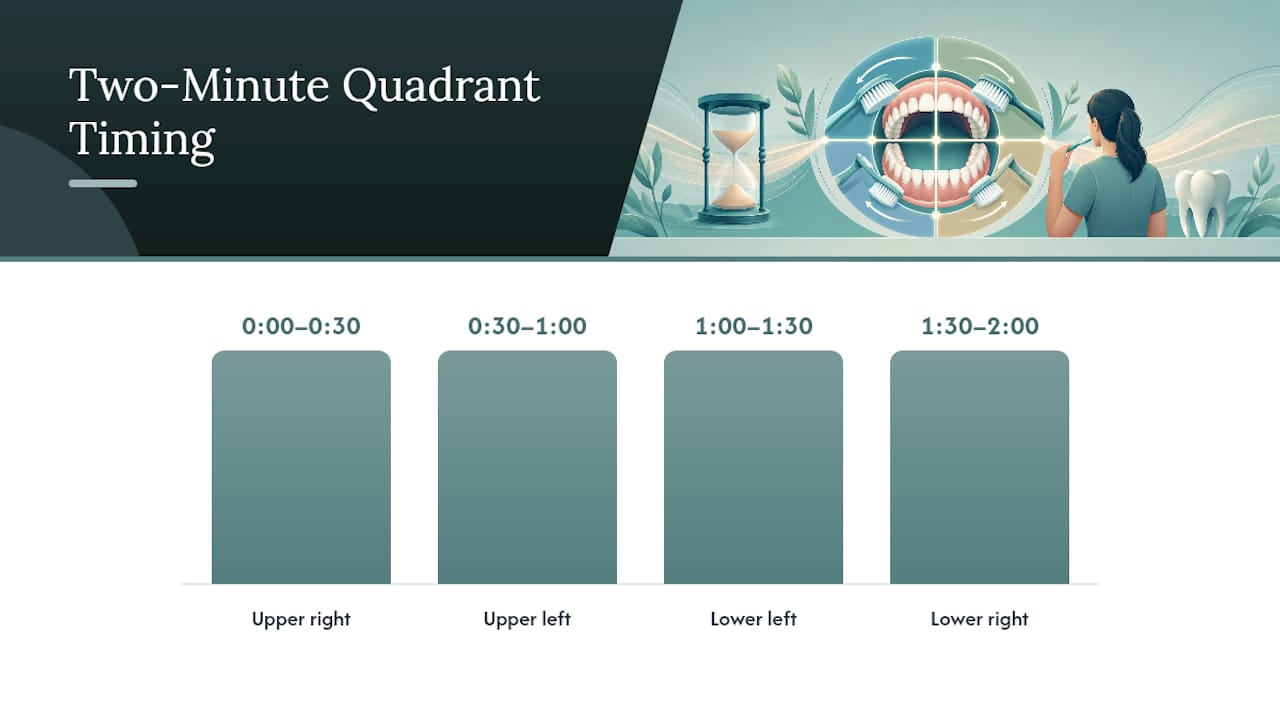
Divide your mouth into four quadrants (upper right, upper left, lower left, lower right) and spend about 30 seconds cleaning each one, angling the brush at 45 degrees toward your gumline with short, gentle strokes. That adds up to the full two minutes dentists recommend, and it stops you from spending 90 seconds on your front teeth and 10 seconds on everything else. It’s less a trick and more a built-in timer for your mouth.
TL;DR:
- Brushing each quadrant for about 30 seconds ensures complete coverage of outer, chewing, and inner surfaces, reducing missed areas and plaque buildup.
- Maintaining a 45-degree angle toward the gumline with small, controlled motions is key to cleaning effectively and preventing enamel or gum damage.
- Using a soft-bristled brush and avoiding excessive pressure helps prevent gum recession and enamel wear, especially when reaching back molars.
- For those who struggle with consistent two-minute brushing, devices that clean all four quadrants at once can provide a practical alternative.
- Establishing a fixed routine and timing, such as with a built-in timer or consistent starting point, significantly improves long-term plaque control.
Table of Contents
- How Do You Brush Your Teeth Using the Quadrant Method?
- What’s the Right Angle and Motion for Each Quadrant?
- When Should You Brush and Should You Rinse After?
- What Mistakes Ruin the Quadrant Method (and How to Fix Them)?
- What About Devices That Clean All Four Quadrants at Once?
- Why Consistency Beats a Perfect Two-Minute Session
- A Faster Route If Two Minutes Never Happens
- Sources
- FAQ
How Do You Brush Your Teeth Using the Quadrant Method?
Pick a starting point and stick with it. Most people find it easiest to go clockwise: upper right, upper left, lower left, lower right. The direction doesn’t matter nearly as much as the consistency. Your mouth learns a pattern the same way your hands learn a route to work, and once that pattern is set, you stop missing the same spots every time.
Here’s the sequence broken into four 30-second blocks:
- Upper right quadrant (0:00 to 0:30). Start on the outer surfaces of your back molars and work forward, then brush the chewing surfaces, then tilt the brush to hit the inner surfaces facing your tongue.
- Upper left quadrant (0:30 to 1:00). Repeat the same outer, chewing, inner sequence, mirrored on the other side.
- Lower left quadrant (1:00 to 1:30). Same order, but for lower front teeth, turn the brush vertically and use short up and down strokes to clean the inside surfaces, since that angle fits the tight space better than a horizontal sweep.
- Lower right quadrant (1:30 to 2:00). Close out the routine the same way you started, keeping the outer, chewing, inner order.
That outer, chewing, inner sequence matters more than people realize. Skipping straight to the surfaces you can see in the mirror, and ignoring the tongue-side surfaces, is one of the most common reasons plaque builds up along the gumline even in people who brush “long enough.” Dividing the mouth into four quadrants and spending roughly 30 seconds on each is specifically designed to force that full coverage instead of leaving it to chance.
Timing yourself matters just as much as the pattern. A phone timer works, but most electric toothbrushes now include a built-in two-minute timer that pulses or beeps every 30 seconds, which lines up almost perfectly with a quadrant switch. If you’d rather not watch a clock, a two-minute song (or half of one you know well) does the same job without feeling clinical.
Pro Tip: Try running through the whole four-quadrant sequence once without toothpaste. It sounds odd, but practicing the motion without foam in your mouth makes it much easier to feel where you’re rushing or skipping a surface, and to notice any spot that feels tender or bleeds.
What’s the Right Angle and Motion for Each Quadrant?
The angle does most of the work. Point the bristles at a 45-degree tilt toward your gumline rather than straight across your teeth. That angle lets the bristle tips slide just under the gumline where plaque collects, instead of skating across the flatter part of the tooth where it’s easier to see but less likely to build up.
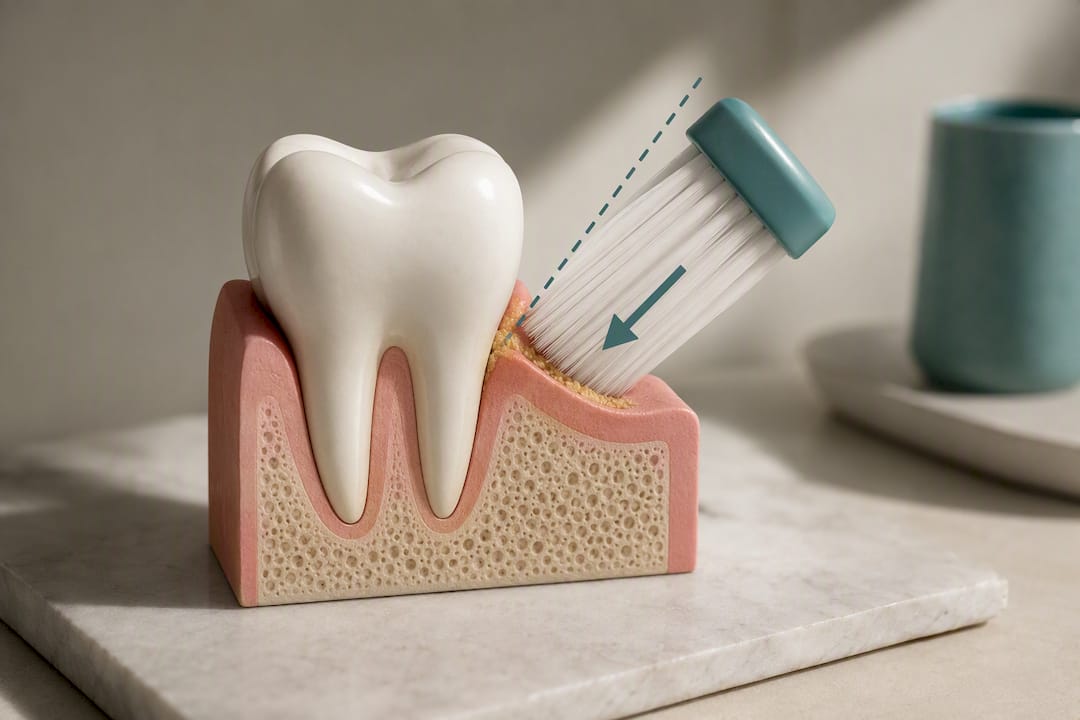
From there, the motion is short and controlled rather than a wide back-and-forth scrub. This borrows the core elements of the Modified Bass technique, which dentists have used as a teaching model for decades: small vibrating or circular motions at the gumline, then a gentle roll upward or downward to sweep debris off the chewing surface.
Within each quadrant, you’re covering three distinct surfaces:
- Outer surfaces facing your cheeks, where most people naturally spend the most time.
- Chewing surfaces on top of your molars, where grooves trap food particles.
- Inner surfaces facing your tongue or palate, the most commonly neglected zone in the whole mouth.
For the inside of your lower front teeth, turn the brush vertically and use the narrow tip or heel of the brush head. That vertical angle clears the tight, curved space far better than a flat horizontal stroke ever will. And when you reach your back molars, don’t stop at the visible surface. Wrap the brush head slightly around the back wall of the last molar. That’s the single most overlooked spot in most people’s routine, and it’s exactly where cavities tend to start.
Pressure is where most people sabotage themselves. Bearing down harder doesn’t clean better. Excess force pushes bristles away from the gumline instead of into it, and over months and years it can wear away enamel and push gum tissue back, which is a bigger long-term problem than a little leftover plaque. Use a soft-bristled brush with a small head that can maneuver around back teeth, and swap it out every three to four months or sooner if the bristles start to splay.
When Should You Brush and Should You Rinse After?
The ADA recommends brushing twice daily for two minutes with fluoride toothpaste, and brushing last thing before bed matters more than people assume. Saliva production drops overnight, so whatever plaque is sitting on your teeth at bedtime has hours to work uninterrupted while your mouth’s natural defenses are at their lowest.
Timing around food and drink matters too, particularly anything acidic like citrus, soda, or wine.
- Wait about an hour after acidic foods or drinks before brushing, since acid temporarily softens enamel, and brushing too soon can abrade that softened surface before saliva has a chance to neutralize it.
- After brushing, spit out the excess toothpaste but skip the vigorous water rinse. A thin layer of fluoride left behind continues protecting your enamel for longer than most people realize, and rinsing it away right after brushing cancels out part of the benefit.
- Anchor the habit to something you already do every day, like right after your morning coffee (once you’ve waited out the acid window) and right before you turn off the bedroom light.
What Mistakes Ruin the Quadrant Method (and How to Fix Them)?
Even a well-designed routine falls apart under a few habits, most of them born from rushing rather than not knowing better.
- Brushing too hard. Fix it by loosening your grip. If your knuckles are white, you’re using force instead of angle to do the cleaning.
- Skipping the back molars. Fix it by consciously wrapping the brush head around the last tooth in each quadrant before moving on.
- Ignoring inner surfaces. Fix it by always brushing in the same outer, chewing, inner order every single quadrant, so it becomes automatic rather than optional.
- Rushing the whole thing. Fix it with a visible timer, since most people who “already brush two minutes” are closer to one when they actually time it.
For people with limited dexterity, sensory sensitivities, or a neurodivergent processing style, a few small adjustments make the same method far more workable. A tactile or vibrating timer can replace a ticking clock that’s hard to track. Simplifying the cue to just “outer, top, inner” for each quadrant, said out loud or pictured as a checklist, reduces the mental load of remembering the full sequence. Practicing the motion without toothpaste, mentioned earlier, also helps build muscle memory without the added sensory input of foam and flavor.
Bring in a dentist or hygienist if you notice bleeding that doesn’t resolve after a week of gentler brushing, ongoing pain, or a spot you genuinely can’t figure out how to reach. Those aren’t quadrant-method problems. They’re signs worth a professional look.
What About Devices That Clean All Four Quadrants at Once?
Manual quadrant brushing works, but it depends on you following the sequence every single time, twice a day, for two minutes. Some people manage that consistently. Many don’t. That’s the entire reason mouthpiece-style rapid brushes exist: devices shaped to fit around the full arch of teeth so bristles contact several surfaces across all four quadrants at the same time, rather than one section at a time.
For someone who consistently rushes a manual brush, or who struggles with the fine motor coordination the quadrant method assumes, a device like this removes the sequencing step entirely. That’s a real trade-off worth naming honestly: you gain simplicity and speed, but you’re relying on the device’s design to reach the same surfaces a well-executed manual routine would cover intentionally. If you want to understand how an all-teeth-at-once toothbrush compares to manual quadrant brushing in practice, that’s worth reading before you decide which approach fits your routine.
Why Consistency Beats a Perfect Two-Minute Session
Most oral health advice fixates on technique, but the harder problem is showing up the same way every single day. A flawless 45-degree Modified Bass motion executed once a week loses to an average routine done correctly twice daily, every day, without fail.
The quadrant method’s real value isn’t the angle or the stroke type. It’s that it turns an abstract two-minute goal into four small, repeatable tasks your brain can actually track. Pick one starting quadrant and never change it. That single decision does more for your long-term plaque control than any brush upgrade will.
— Joris
A Faster Route If Two Minutes Never Happens
Some people will read all of this and still not brush for two full minutes, night after night, and that’s worth being honest about rather than lecturing away. If quadrant brushing consistently loses to a rushed morning or an exhausted bedtime, a mouthpiece-style device is a legitimate different route to the same outcome.
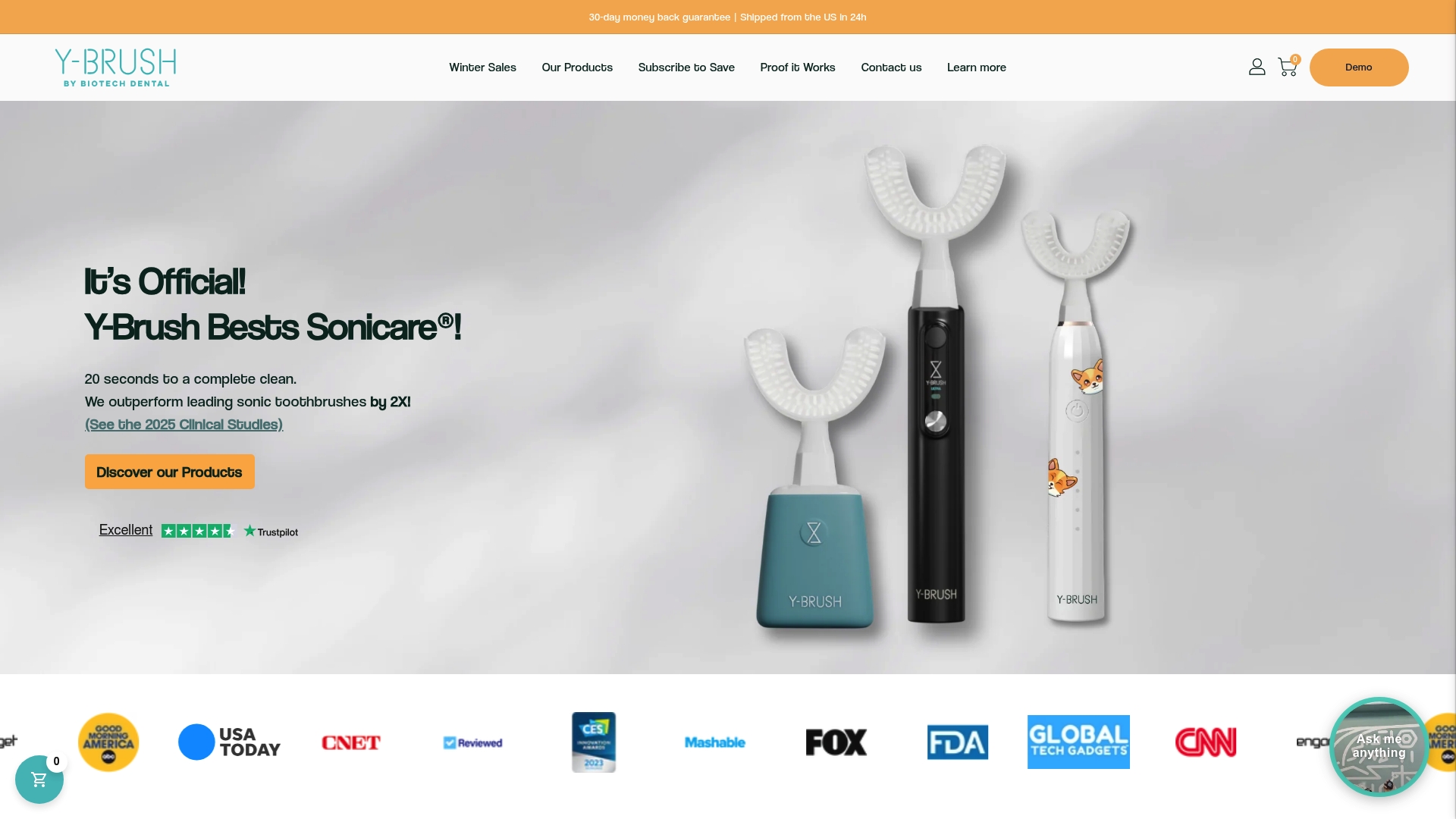
Some mouthpiece-style electric toothbrushes use a Y-shaped head to clean the full mouth in about 20 seconds via sonic vibration, rather than working through four quadrants in sequence. Such designs claim to remove plaque more effectively than leading sonic toothbrushes and may come with warranties and subscription plans. If a full manual routine consistently doesn’t happen, that’s a meaningfully different bet than trying to force a habit that isn’t sticking.
The lineup includes the Core Plan at $29.90 per quarter, the Pro Plan at $49.90 per quarter, and the Pro+2 Plan at $69.90 per quarter, each bundling the toothbrush with recurring replacement heads. If you want to see the full range of toothbrushes and replacement brush heads before deciding, that catalog page breaks down every option currently available.
Sources
For the quadrant timing and technique behind this guide, Harvard Health’s brushing breakdown covers the 30-second-per-quadrant logic in full. The NHS guide to keeping teeth clean backs the surface-coverage and soft-bristle guidance, while ADA resources on toothbrushes and technique confirm the twice-daily, two-minute standard. For angle and pressure specifics, the Naterova DH team’s guidance on gentle brushing strokes offers a useful outside perspective.
- What’s the right way to brush your teeth? - Harvard Health
- Consensus / clinical guidance on toothbrushing frequency and fluoride retention - PMC
- Brushing your teeth - Mayo Clinic Q&A
- ADA resources on toothbrushes and technique
FAQ
How Do You Brush Your Teeth Using the Quadrant Method?
Split your mouth into four sections (upper right, upper left, lower left, lower right) and spend about 30 seconds on each, covering the outer, chewing, and inner surfaces in that order. That routine totals roughly two minutes, which lines up with what dentists recommend for a full clean.
What Is the 3-3-3 Brushing Method?
There’s no single agreed-upon definition of a “3-3-3” brushing rule in clinical dental guidance. If you’ve seen it referenced online, it’s likely a informal shorthand rather than a standard endorsed by dental organizations, so it’s worth treating it as a personal mnemonic rather than an established technique.
What Is the 2-2-2 Rule in Dentistry?
This isn’t a formally recognized dental guideline either, and definitions of it vary depending on where you encounter it. The consistent, professionally backed rule is simpler: brush twice a day for two minutes each time, which is the standard the ADA and NHS both point to.
How Do Neurodivergent People Brush Their Teeth Effectively?
Simplified cues, tactile or vibrating timers, and shorter practice runs without toothpaste all help make the quadrant sequence easier to follow for people with sensory sensitivities or attention differences. Breaking the routine into the same three-step surface order every time (outer, chewing, inner) reduces the decision-making load compared to an unstructured brushing pattern.
Is a Mouthpiece-Style Toothbrush a Good Alternative to Manual Quadrant Brushing?
It can be, particularly for people who consistently struggle to complete a full two-minute manual routine. Y-Brush’s Y-shaped head is designed to clean across all four quadrants simultaneously in about 20 seconds, and plans start with the Core Plan at $29.90 per quarter.


