


Clinical plaque tests confirm certain electric toothbrushes remove substantially more plaque than manual brushing, with randomized trials reporting reductions in the low to mid twenties percent range. That gap depends heavily on which technology you’re using and whether you’re actually brushing for the full two minutes. The good news: you don’t have to take a lab’s word for it. A simple at-home plaque test, explained below, lets you check your own results.
TL;DR:
- The most effective electric toothbrush technologies can reduce plaque by around 21% to 24% compared to manual brushing, based on clinical measurements.
- Proper brushing duration, ideally two minutes, significantly influences the benefits, regardless of the device used.
- At-home plaque tests using disclosing agents or fluorescence can help identify technique issues and track improvements over time.
- Consistent testing and adjustments are essential for managing plaque buildup, especially near the gumline, between teeth, and on molars.
- Devices like Y-Brush target common brushing gaps by cleaning each tooth in about 20 seconds, benefiting those with limited dexterity or poor adherence to routine.
Table of Contents
- What the Electric Toothbrush Plaque Test Reveals in Clinical Trials
- How Do Plaque Tests Actually Work?
- How to Run Your Own Electric Toothbrush Plaque Test
- Reading Your Results: What to Fix First
- Where Y-Brush Fits in the Plaque-Test Picture
- Three Things Worth Remembering
- Why Testing Beats Trusting Marketing Claims
- Try the Test, Then Try Y-Brush
- Sources
- FAQ
What the Electric Toothbrush Plaque Test Reveals in Clinical Trials
Researchers rarely settle for asking people whether their teeth “feel clean.” They stain the plaque, photograph it, and measure it in percentages. That’s what makes the clinical record on electric toothbrushes worth trusting, and it’s also why the results aren’t identical across every study.
The strongest recent data comes from a randomized crossover trial using digital plaque image analysis (DPIA), a method that stains plaque with fluorescein and photographs it under ultraviolet light so software can calculate exactly what percentage of the tooth surface is covered. In that trial, an oscillating-rotating electric toothbrush reduced overall plaque by about 21% in the afternoon and about 24% in the morning compared to a manual toothbrush, measured across repeated sessions in the same participants. A crossover design like this one has each participant use both brush types, which cancels out individual differences in mouth shape, saliva, and diet that could otherwise skew the numbers.
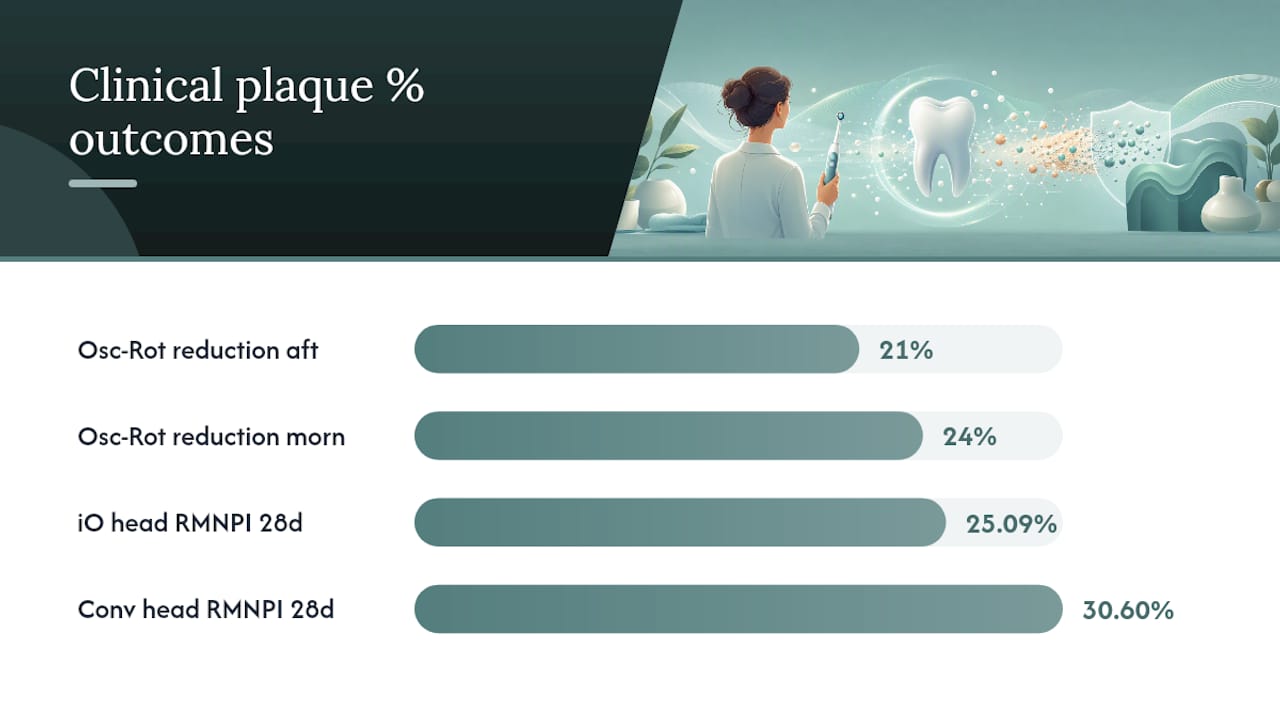
Other trials point in the same direction, though the size of the benefit shifts with the technology. A randomized-controlled home-use study comparing an Oral-B iO microvibration brush head against a conventional oscillating-rotating head found lower plaque index scores after 28 days of normal home use. Measured using RMNPI, a plaque index scale, the iO head scored 25.09% versus 30.60% for the conventional head, a statistically significant difference (p = 0.029). Broader clinical reviews back the general pattern: powered brushing tends to outperform manual brushing for plaque and gum health, though the size of that edge varies by study design and follow-up length.
Not every device wins against every comparison, and honesty here matters more than marketing. A randomized crossover RCT that included a Y-shaped automatic toothbrush found it removed significantly more plaque than no brushing at all, using the Full Mouth Plaque Score (FMPS) as the measurement standard. In that same trial, though, it scored lower than 120 seconds of correctly performed manual brushing, with a measured difference of 36.9 points (95% CI 29.6 to 44.1, p < 0.0001) favoring the full two-minute manual session.
A few terms show up across these studies worth knowing before you read anything else on this topic:
- DPIA (Digital Plaque Image Analysis): fluorescein staining plus UV photography, quantified by software rather than a human eye.
- FMPS (Full Mouth Plaque Score): an examiner-scored index covering every tooth surface, used to compare brushing methods head-to-head.
- RMNPI: a plaque index variant used in multi-week home-use trials to track changes over time.
- Crossover design: every participant tries every brushing method, which controls for individual variation better than comparing separate groups.
The takeaway isn’t “electric always wins.” It’s that specific electric technologies, tested against specific baselines, produce measurable and repeatable reductions, while brushing duration remains a variable nobody’s toothbrush can fix on its own.
How Do Plaque Tests Actually Work?
A plaque test doesn’t tell you anything you couldn’t see under the right conditions. It just makes the invisible visible.
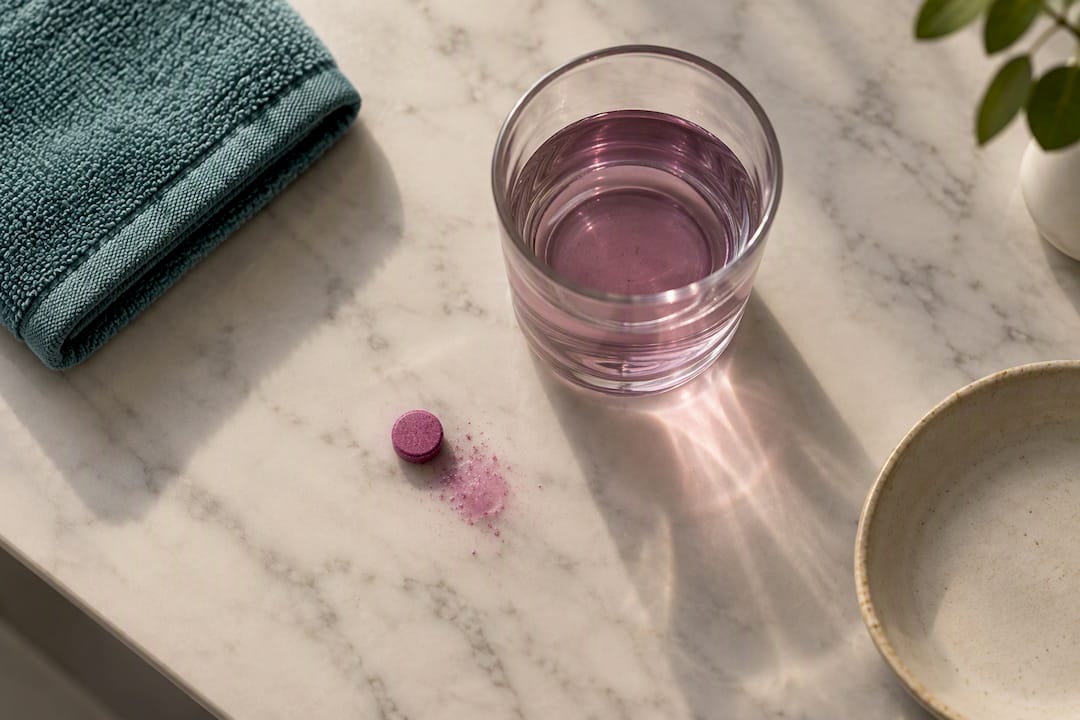
Disclosing tablets are the tool most people can buy at a drugstore. You chew one, and a dye binds to the sticky biofilm coating your teeth, turning it red, blue, or purple depending on the brand, while clean enamel stays its normal color. MedlinePlus describes this as one of the two standard home methods, alongside fluorescent solutions that require a black light. Under UV light, fluorescent plaque disclosing agents make biofilm glow bright yellow-orange, which is more precise for photography but less convenient without the right light source.
Clinics and research labs use a more rigorous version of the same idea: DPIA, the method behind the 21.2% and 23.5% figures cited above. Instead of eyeballing a stain, a camera captures the fluoresced surface and software calculates the exact percentage of tooth surface covered. That’s why DPIA numbers carry more weight in scientific comparisons than a quick look in a bathroom mirror.
What a positive stain tells you is limited but useful. It confirms soft, recently formed biofilm is present, typically clustered near the gumline, between teeth, or on chewing surfaces. It does not detect tartar, which is hardened, mineralized plaque that no home test or toothbrush removes. If your stain pattern doesn’t budge after weeks of improved brushing, that’s often a sign of tartar buildup rather than a brushing failure.
A few precautions matter before you try this yourself. Disclosing dye can temporarily stain lips, tongue, and grout lines around old fillings, and it can cling stubbornly to braces or retainers, so people with orthodontic hardware should expect extra rinsing time.
Pro Tip: Do your plaque test at night rather than before a meeting or date. The dye fades with normal eating and drinking, but give it a few hours just in case.
How to Run Your Own Electric Toothbrush Plaque Test
You need almost nothing to run a version of the same test researchers use, just simplified for a bathroom sink instead of a lab.
Materials:
- A disclosing tablet or fluorescent plaque-light kit
- A mirror (or your phone’s front camera)
- A phone camera for before-and-after photos
- Floss or an interdental brush
Step-by-step protocol:
- Brush normally, exactly as you would on any regular day. Don’t overcompensate.
- Chew or apply the disclosing agent according to the package instructions, then rinse gently, not aggressively.
- Photograph your teeth under good lighting. This is your baseline, the honest snapshot of what your normal routine misses.
- Inspect the stained areas closely. Note whether plaque clusters along the gumline, between teeth, or on back molars.
- Re-brush only the stained zones, focusing on angle and dwell time rather than speed.
- Disclose again, or simply rinse and photograph a second time to see what came off.
Run this weekly, or immediately after switching toothbrushes or techniques, so you can compare results under similar conditions. Kaiser Permanente’s health guidance specifically recommends weekly checks for people wearing braces or anyone whose hygiene routine has recently slipped.
| What to log | Why it matters |
|---|---|
| Date and time of test | Lets you compare results under consistent conditions |
| Stained zones (gumline, interdental, molars) | Shows exactly where your technique is failing |
| Before/after photos | Gives you a visual record, not just a memory |
| Brushing time that day | Connects results to duration, the single biggest variable |
A meaningful improvement looks like a visibly smaller stained area on your second photo, or a shift from continuous red lines along the gumline to isolated spots. If nothing changes after several honest attempts, the problem may not be technique at all.
Reading Your Results: What to Fix First
Where the dye shows up tells you exactly what to change next, and that’s the entire point of running the test in the first place.
Gumline staining almost always means the brush head isn’t angled toward the gum margin at roughly 45 degrees. Interdental staining between teeth signals that neither your brush nor your flossing routine is reaching those contact points, since no toothbrush head, electric or manual, cleans between teeth the way floss or an interdental brush does. Posterior occlusal staining, on chewing surfaces of back molars, usually points to rushed brushing that skips the hardest-to-reach zone in the mouth.
Fix the highest-impact issue first. Adjust your angle, ease up on pressure if you’re pressing hard enough to flatten the bristles, and extend your brushing time to the full two minutes before you test again. Give any single change about a week before re-testing, since a single session tells you almost nothing about a habit.
Device features matter most in the areas manual technique struggles with. Oscillating or micro-vibrating heads reach marginal and approximal surfaces, the tight spaces near the gum and between teeth, more consistently than a static manual stroke. But if your stain pattern shows plaque everywhere, not just in hard-to-reach zones, technique is still your limiting factor, not your hardware.
Pro Tip: If the same spot stains red test after test despite correct angle and full brushing time, stop assuming it’s a technique problem. That’s often tartar, and only a dental hygienist’s tools can remove it.
See a dentist if you notice bleeding gums during testing, a stain pattern that never improves despite weeks of correct technique, or visible hardened deposits near the gumline. A plaque test is a feedback tool, not a diagnostic one, and it can’t tell you if gum disease has already started.
Where Y-Brush Fits in the Plaque-Test Picture
Y-Brush’s patented Y-shaped head is built around a different premise than most electric brushes: instead of asking you to guide a round head across every surface for two full minutes, it surrounds each tooth with bristles simultaneously and delivers a full clean in about 20 seconds through sonic vibration. That matters because the research above keeps circling back to the same weak point in most routines, brushing time. Most people brush under a minute when two minutes is the standard.
The honest context: a randomized crossover RCT that included a Y-shaped automatic toothbrush found it removed significantly more plaque than no brushing at all, but scored lower than a full 120 seconds of correct manual brushing in that trial’s FMPS measurements. That’s a meaningful nuance, not a disqualifier. For someone who reliably brushes a careful two minutes twice a day, manual technique may already be doing the job. For the much larger group who don’t, a fast, consistent method may outperform an inconsistent “ideal” one in practice.
You can test this yourself using the exact protocol above: run a baseline plaque test with your current routine, switch to Y-Brush for a week, then disclose and photograph again under the same conditions. This tends to fit best for:
- People who consistently brush under two minutes despite good intentions
- Users with limited hand mobility or dexterity
- Parents managing brushing time for kids who won’t sit still
Replacement heads and quarterly plans keep the comparison fair over time, since worn bristles skew results regardless of the brush type.
Three Things Worth Remembering
Electric toothbrushes show real, measurable plaque reductions in controlled trials, not just marketing claims. The DPIA crossover data alone puts that reduction in the 21% to 24% range for one well-studied technology. But two variables decide whether you personally see that benefit: the specific device technology and whether you’re actually brushing long enough to let it work.
- Plaque tests are feedback tools, not verdicts. Use them to catch and correct a habit, not to diagnose a disease.
- Run a one-week test: baseline photo, disclose, correct the worst zone, re-test at the same time each day.
- Interdental cleaning and regular dental visits stay essential no matter which brush you choose. No test replaces either one.
Why Testing Beats Trusting Marketing Claims
Most people never question whether their toothbrush is actually working. They assume clean feels clean, and that assumption is exactly what plaque tests are designed to challenge. The research summarized above proves electric toothbrushes can outperform manual brushing by a meaningful margin, but it also proves that outcome isn’t automatic. Technology helps most when it compensates for a habit you already know is weak, whether that’s rushing, skipping the gumline, or brushing for 40 seconds instead of 120.
I’d rather see someone run the disclosing-tablet test once a month than buy three different toothbrushes hoping one magically fixes their technique. The evidence rewards curiosity over brand loyalty. Try the protocol, look at your own results, and adjust based on what you actually see, not what a package promises. If a stain pattern won’t budge, that’s your cue to call a dentist, not to buy another gadget.
— Joris
Try the Test, Then Try Y-Brush
If you’ve run the plaque test above and noticed your gumline or back molars staining red no matter how carefully you brush, the honest fix might be less about willpower and more about how much time you’re actually spending. Y-Brush is built for exactly that gap, delivering a full clean in about 20 seconds through its Y-shaped head, so consistency stops depending on how rushed your morning is.
Y-Brush offers three plans through its toothbrush and plan collection: the Core Plan at $29.90 per quarter, the Pro Plan at $49.90 per quarter, and the Pro+2 Plan at $69.90 per quarter, each built around regular brush and refill delivery. If you want to run a fair A/B comparison using the protocol from this article, keep the conditions identical: same disclosing method, same time of day, before-and-after photos for both your current brush and Y-Brush. Swap in a fresh replacement brush head before you start testing, since worn bristles on either device will distort your results. Browse the full toothbrush and brush head lineup to find the setup that matches your routine, then run your own week-long test and see what the stain pattern tells you.
This article is general information, not a substitute for advice from a qualified doctor. Consult a qualified healthcare professional about your own circumstances before acting on anything here.
FAQ
Do electric toothbrushes break up plaque?
Yes. Sonic and oscillating-rotating electric toothbrushes use rapid vibration or rotation to disrupt and lift soft plaque biofilm from tooth surfaces more effectively than a static manual stroke in several randomized trials. They don’t remove hardened tartar, which requires professional cleaning.
What kills plaque in teeth?
Nothing “kills” plaque exactly. Mechanical brushing and interdental cleaning physically disrupt and remove the bacterial biofilm before it hardens into tartar. Consistent two-minute brushing combined with daily flossing remains the most reliable combination for keeping soft plaque from accumulating.
What is the best electric toothbrush for removing plaque and tartar?
No electric toothbrush removes tartar, since tartar is mineralized and requires professional scaling. For plaque, trial data shows oscillating-rotating and microvibration technologies produce measurable reductions, while Y-Brush’s Y-shaped head is designed to deliver a full clean in about 20 seconds for people who struggle to brush the full two minutes.
Is an electric toothbrush better for plaque than a manual one?
In most controlled trials, yes, with reductions in the low to mid twenties percent range for specific technologies measured by digital plaque image analysis. The exception is a full, correctly performed 120 second manual brushing session, which outperformed a Y-shaped automatic brush in one specific crossover trial, meaning technique and duration remain critical variables regardless of device.
How often should I run an at-home plaque test?
Weekly checks are a reasonable default, and clinicians often recommend that frequency specifically for people with braces or a recently lapsed routine. Testing right after you change toothbrushes or technique gives you the clearest before-and-after comparison.


