


Yes, an electric toothbrush can safely clean your tongue when you use a soft or extra-soft head and light pressure. The motion matters more than the tool: gentle strokes from the middle of the tongue toward the front reduce bad breath without irritating the tissue. Stop and switch methods if you notice soreness, bleeding, or persistent discoloration.
TL;DR:
- Using an electric toothbrush with a soft or extra-soft head and light pressure can safely clean the tongue, but technique and gentle strokes are more important than the tool.
- Short, consistent passes from the middle to the front of the tongue, done twice daily, improve breath and reduce tongue coating more effectively than lengthy, aggressive sessions.
- Mechanical tongue cleaning, whether with a scraper or a brush, consistently lowers bacteria and sulfur compounds, but technique and habit formation influence long-term success.
- Replacing worn brush heads and monitoring oral tissue health are essential to avoid soreness, bleeding, or irritation during tongue cleaning.
- Combining daily tongue cleaning with a proper brushing routine enhances overall oral health, with dedicated tools like scrapers or specialized toothbrushes offering different benefits.
Table of Contents
- Why Cleaning Your Tongue Actually Matters
- Is an Electric Toothbrush Effective and Safe on the Tongue?
- Step-by-Step: How to Clean Your Tongue With an Electric Toothbrush
- Tongue Scraper vs. Toothbrush: Which Should You Use?
- How Often Should You Clean Your Tongue?
- Risks, Common Mistakes, and How to Avoid Them
- Where Y-Brush Fits Into a Safe Tongue-Cleaning Routine
- What the Research Actually Tells You to Prioritize
- A Faster Way to Build the Whole Routine
- Sources
- FAQ
Why Cleaning Your Tongue Actually Matters
The bacteria living in tongue coating produce volatile sulfur compounds, or VSCs, which are the main chemical culprits behind bad breath. That coating is not just cosmetic residue. It is a biofilm, similar to plaque, that builds up in the crevices of the tongue’s surface and keeps producing odor compounds as long as it sits there.
The evidence for cleaning it off is stronger than most people assume. A systematic review and meta-analysis found that adding mechanical tongue cleaning to regular toothbrushing significantly reduced both VSC levels and visible tongue coating compared with brushing teeth alone. A separate systematic review of controlled trials reached a similar conclusion, though it noted the research base is still thinner than it should be.
What is not settled is the fine print: exactly how often, for how long, and with which tool produces the best long-term result. The short-term signal is consistent. The long-term optimization playbook is still being written.
Is an Electric Toothbrush Effective and Safe on the Tongue?
Electric toothbrushes have a well-earned reputation for outperforming manual brushing on teeth, largely because sonic vibrations dislodge plaque more consistently than a hand-driven stroke. The tongue is a different surface entirely. It is soft, spongy, and covered in papillae, tiny projections that trap bacteria in ways smooth tooth enamel never does.
That texture difference is why bristles do not always behave the same way on the tongue as they do on teeth. A Cleveland Clinic breakdown of tongue scraping points out that bristled brush heads were built for enamel, and many people with heavy coating find a dedicated scraper more comfortable and thorough. Clinical trial data backs a “your mileage may vary” conclusion rather than a clean winner. Research comparing mechanical tongue cleaning methods shows no tool consistently beats another when the technique is correct.
Safety comes down to a short list of rules. Skip firm or medium bristles in favor of soft or extra-soft heads. Keep the pressure light. Go slow near the back of the tongue, since that is where the gag reflex tends to fire. Used this way, an electric toothbrush is a legitimate, evidence-supported option for daily tongue cleaning. It is just not automatically the best tool for every mouth.

Step-by-Step: How to Clean Your Tongue With an Electric Toothbrush
Set yourself up before you start. Grab a brush head with soft or extra-soft bristles, rinse it under warm water, and make sure you have a mirror and decent light so you can actually see what you are doing.
- Extend your tongue slightly, just enough to see the middle and back sections in the mirror.
- Start at the middle of the tongue, not the very back. Going straight for the rear is the fastest way to trigger a gag reflex.
- Use short, gentle strokes moving toward the front of the mouth, letting the vibration do the work instead of pressing down.
- Repeat two to four passes, working slightly farther back each time as your tolerance allows.
- Rinse both your mouth and the brush head when you are done.
Frequency beats intensity here. Short, consistent passes done up to twice a day, aligned with your morning and evening brushing, do more for breath and tongue coating than one long, aggressive session ever will.
Pro Tip: Hold the toothbrush by your fingertips instead of gripping it like a hammer. That lighter grip naturally caps how much pressure you can apply, which is exactly what soft tongue tissue needs.
Tongue Scraper vs. Toothbrush: Which Should You Use?
The two tools solve the same problem through different mechanics. A scraper physically lifts the coating off the surface in one motion. An electric toothbrush’s bristles agitate and dislodge debris through vibration, which cleans more gradually but reaches into surface grooves a flat scraper edge can miss.
The trial data leans slightly toward scrapers for one specific outcome: immediate reduction in hydrogen sulfide readings right after cleaning, according to research on mechanical tongue cleaning and oral malodor. But that same research points to technique, specifically wiping from back to front rather than side to side, as the variable that actually drives results. Tool choice is secondary.
Use this as a rough guide for picking between them:
- Reach for a scraper if your tongue coating is thick, or if brushing consistently triggers your gag reflex.
- Stick with your electric toothbrush for daily maintenance if you want one tool and one routine instead of two separate steps.
- Switch to a scraper temporarily if you notice your usual brushing pass is not clearing visible coating anymore.
- Combine both occasionally: brush daily, scrape on days when coating looks heavier than usual.
Neither tool wins outright. The one you will actually use every day is the one worth choosing.
How Often Should You Clean Your Tongue?
A practical target for tongue cleaning is to include it regularly as part of your brushing routine in the morning and at night. Consistency does more here than duration. Cleveland Clinic newsroom guidance on tongue brushing notes that short, repeated passes beat one long marathon session, both for effectiveness and for avoiding irritation.
Pay attention to how your tongue looks over time. A thin white film is common and usually harmless. Persistent white or black discoloration, sores, unexplained pain, or bleeding that sticks around for more than two weeks is different. Cleveland Clinic’s guidance on tongue changes recommends stopping mechanical cleaning and getting evaluated by a dental professional if any of those signs persist.
Risks, Common Mistakes, and How to Avoid Them
Most tongue-cleaning injuries trace back to three habits: hard bristles, heavy pressure, or diving straight for the back of the tongue on the first pass. Any one of those can leave the surface raw or set off a gag reflex strong enough to make you avoid tongue cleaning altogether.
The fix is simple and it is the same advice dental professionals give for managing gag reflex during brushing: soft or extra-soft bristles only, a fingertip grip instead of a full-fist hold, and short strokes that ease backward gradually instead of attacking the whole tongue at once. If you ever see blood or feel soreness that lasts past the session, stop and give the tissue a day to recover.
Brush head condition matters too. A worn-down head with splayed bristles is rougher on tissue than a fresh one, so replacing heads on schedule and rinsing your tool after every use keeps the whole routine safer.
Pro Tip: If your electric toothbrush has a pressure sensor, pay attention to it during tongue cleaning too, not just on teeth. The same threshold that protects your gums applies to tongue tissue.

Where Y-Brush Fits Into a Safe Tongue-Cleaning Routine
Good tongue care does not happen in isolation. It works best as one habit inside a complete oral care routine, alongside proper tooth brushing technique covered in our guide to brushing teeth properly.
Y-Brush was built around a simple observation: most people know they should brush for two full minutes, yet the typical session runs under one. That gap between what dental guidance recommends and what people actually do is exactly the problem a faster, more consistent routine needs to solve. Applying that same principle to tongue cleaning, short and repeated passes done consistently, matters more than one long, perfect session. Anyone building tongue cleaning into an existing routine can find more background in our piece on the role of tongue cleaning in oral health.
What the Research Actually Tells You to Prioritize
The conventional wisdom on tongue cleaning treats it as a tool debate: scraper versus brush, one correct winner declared. That framing misses what the trial data actually shows. Technique, specifically gentle pressure and back-to-front direction, moves the needle more than which device sits in your hand.
Here is where I think most guidance undersells the point: consistency is the variable people are most likely to get wrong, not tool choice. A scraper used once a week will lose to an imperfect toothbrush pass done every morning and every night. The habit beats the hardware.
If you already own an electric toothbrush, you do not need a second gadget to start cleaning your tongue properly. You need to slow down, lighten your grip, and stop treating the tongue like an afterthought tacked onto the end of a rushed thirty-second brush. Fix the behavior first. Worry about the tool second.
— Joris
A Faster Way to Build the Whole Routine
Tongue cleaning only pays off when it is paired with brushing that actually covers your teeth properly, and that is the piece most people shortchange. Y-Brush’s patented Y-shaped head is built to deliver a complete clean in 20 seconds using sonic vibration, so the two-minute habit dental guidance recommends stops being the step people skip.
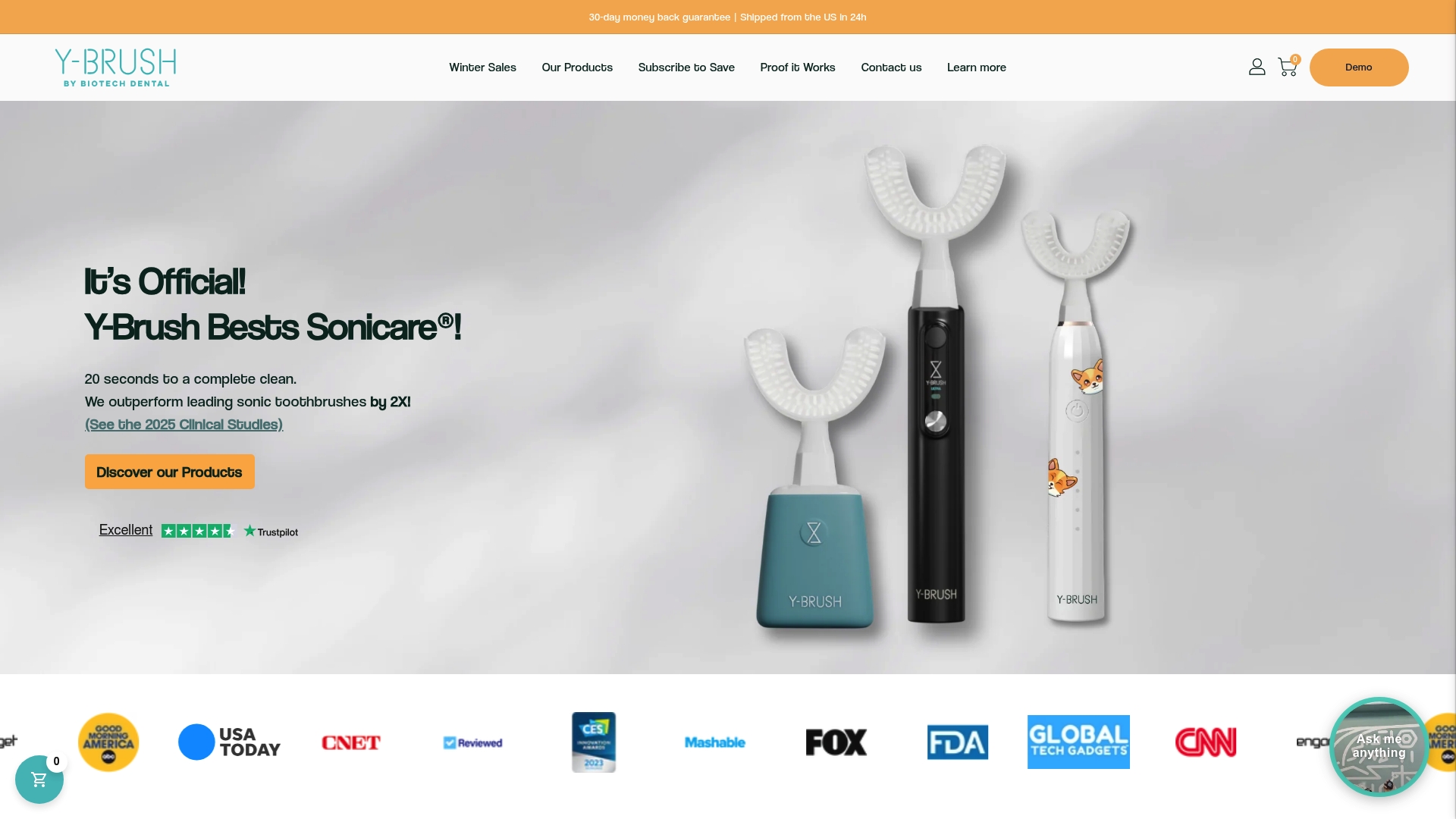
The lineup runs through three plans built around that idea: the Core Plan at $29.90 per quarter, the Pro Plan at $49.90 per quarter, and the Pro+2 Plan at $69.90 per quarter, each pairing a toothbrush with a recurring supply of replacement brush heads so you are never brushing with a worn-out head. None of that replaces careful tongue cleaning. It just means the teeth half of your routine takes less willpower to do right, every single day. If you are dealing with a specific tongue or gum condition, check with a dental professional before changing your routine. Otherwise, browse the toothbrush and plan options to see which fits your routine.
Sources
- Toothbrushing versus toothbrushing plus tongue cleaning in reducing halitosis and tongue coating: a systematic review and meta-analysis
- The Effect of Mechanical Tongue Cleaning on Oral Malodor and Tongue Coating — PMC
This article is general information, not a substitute for advice from a qualified doctor. Consult a qualified healthcare professional about your own circumstances before acting on anything here.
FAQ
How Do I Clean My Tongue With a Toothbrush?
Extend your tongue slightly, start at the middle rather than the back, and use short, gentle strokes moving toward the front. Repeat two to four passes with a soft or extra-soft brush head, then rinse your mouth and the brush.
How Do You Get Rid of Tongue Buildup?
Regular mechanical cleaning, whether with a soft-bristled electric toothbrush or a scraper, breaks up the bacterial coating that causes buildup. Research on mechanical tongue cleaning shows this reduces both visible coating and the compounds behind bad breath, though thick or persistent buildup may respond better to a scraper.
Is Tongue Scraping Good for Gut Health?
The evidence connecting tongue scraping to digestive or gut health outcomes is not established in the clinical research reviewed here. What is well supported is its effect on oral bacteria and breath odor, which is a separate benefit from any gut-related claim.
Do Dentists Recommend Brushing Your Tongue?
Yes. Cleveland Clinic guidance recommends gentle tongue brushing or scraping as part of a daily oral care routine, with a caution against excessive pressure. Dental professionals generally see it as a helpful addition to brushing, not a replacement for it.
Can an Electric Toothbrush Clean the Tongue as Well as a Manual One?
Electric toothbrushes can clean the tongue effectively when used with a soft head and light pressure, and studies comparing tools have not found a consistent overall winner when technique is correct. Devices like Y-Brush, designed around fast and thorough coverage for teeth, can be incorporated into the same routine as a gentle tongue pass.


