


For most people, a sonic toothbrush is the smarter buy: it delivers strong, clinically supported plaque removal, works gently on sensitive gums, and comes at a lower cost than true ultrasonic devices. Sonic brushes use mechanical bristle movement plus fluid dynamics to dislodge plaque; true ultrasonic devices rely on high-frequency acoustic energy that can act beyond the bristle tips. If you have healthy gums and want proven results without a premium price tag, sonic is the practical choice. If you have specific periodontal concerns, talk to your dentist before choosing either.
TL;DR:
- Clinical evidence shows no consistent, significant difference in plaque removal or gingivitis reduction between sonic and ultrasonic toothbrushes.
- Sonic brushes are effective for everyday cleaning and are generally more affordable, but they don’t replace flossing in tight spaces.
- Most consumer “ultrasonic” devices are hybrids combining sonic bristle motion with ultrasonic energy, not pure ultrasonic tools.
- User comfort, routine consistency, and device feel are more important factors in choosing a toothbrush than marginal differences in technology.
- Devices like Y-brush are designed to improve routine compliance by offering rapid, full-mouth cleaning in about 20 seconds, especially for those struggling with longer brushing times.
Table of Contents
- Sonic Vs Ultrasonic Toothbrush: What Sets Sonic Technology Apart
- Sonic Vs Ultrasonic Toothbrush: How True Ultrasonic Devices Work
- What Clinical Research Actually Shows About Sonic and Ultrasonic Performance
- Matching the Right Toothbrush Technology to Your Situation
- How to Choose Between Sonic and Ultrasonic Without Getting Fooled
- Where a 20-Second Approach Fits Into the Technology Debate
- The Real Question Isn’t Sonic or Ultrasonic. It’s Whether You’ll Actually Brush.
- Try Y-brush If Consistency, Not Mechanism, Is Your Real Obstacle
- Sources
- FAQ
Sonic Vs Ultrasonic Toothbrush: What Sets Sonic Technology Apart
A sonic toothbrush moves its bristle head side to side at extremely high speed, typically somewhere in the range marketed as tens of thousands of movements per minute. That rapid sweeping motion does two things at once. It physically scrubs plaque off the tooth surface, and it agitates saliva and toothpaste into a fast moving fluid that reaches slightly past where the bristles actually touch. Dental researchers call this second effect microstreaming, and it’s the reason sonic brushes can clean a bit of the space between teeth even though the bristles themselves never get there.
Manufacturers love to advertise vibration counts, sometimes citing high numbers of movements per minute. Those figures describe bristle oscillations, not an independent measure of cleaning power, so a bigger number on the box doesn’t automatically mean a better clean. What matters more is consistent technique: two minutes, twice a day, with light pressure so the bristles can flex and do their job instead of being crushed against the tooth.
In practice, sonic brushing feels like a light buzzing hum against the teeth and gums, a sensation most people adapt to within a few days. The sensation is strong enough to feel effective without being unpleasant for the average mouth, which is a big part of why sonic brushes have become the default recommendation for general use.
Where sonic brushes tend to shine:
- Everyday plaque control for people with average brushing habits and no major gum sensitivity
- Users who want a gentler feel than oscillating-rotating heads while still getting a strong, felt clean
- Anyone switching from a manual toothbrush who wants an easier transition than a more intense powered device
- Households on a budget, since sonic technology is widely available at accessible price points
The main limitation is reach. Sonic brushes clean effectively at and slightly beyond the bristle line, but they aren’t a substitute for flossing or interdental cleaning when it comes to tight contact points between teeth.
Sonic Vs Ultrasonic Toothbrush: How True Ultrasonic Devices Work
True ultrasonic operates on a different physical principle entirely, and the terminology gets murky fast. A genuinely ultrasonic device produces acoustic waves above 20 kHz, the technical threshold that separates ultrasonic frequencies from audible sound. Some consumer products claim frequencies in the megahertz range, which implies a piezoelectric crystal generating vibration rather than a motor moving bristles back and forth.
At that frequency, the theoretical mechanism shifts from scrubbing to acoustic microstreaming and cavitation, tiny bubbles forming and collapsing in the fluid around the teeth, which can disrupt the biofilm that holds plaque together. This is the appeal ultrasonic marketing leans on: cleaning action that supposedly reaches into pockets and between teeth without needing direct bristle contact.
Here’s the catch. Very few consumer toothbrushes sold as “ultrasonic” are pure ultrasonic devices with no moving bristles. Most combine a sonic-range mechanical motion with an added ultrasonic element, making them hybrids rather than true ultrasonic tools. A 2020 review in Dent J found that these hybrid designs, pairing bristle contact with acoustic energy, may offer the best of both approaches, since direct bristle contact still does much of the heavy lifting for biofilm removal even when ultrasonic elements are present.
What to know before trusting an “ultrasonic” label:
- Ask whether the device has moving bristles at all, or whether it relies purely on acoustic energy
- Look for an actual frequency specification in kHz or MHz rather than a vague claim of “ultrasonic power”
- Understand that a hybrid device isn’t inferior. It may perform as well as or better than a pure ultrasonic tool
- Be skeptical of any brush that uses “ultrasonic” as a marketing word without publishing verifiable specs
User experience differs too. True ultrasonic devices often feel quieter and produce a subtler vibration than sonic brushes, since there’s no large mechanical sweep happening. Some users find this underwhelming at first, expecting a stronger sensation to signal a stronger clean. That expectation isn’t well-supported. Feeling more vibration doesn’t necessarily mean more plaque removal, and the honest read on ultrasonic marketing is that specification transparency still lags well behind the confidence of the sales copy.
What Clinical Research Actually Shows About Sonic and Ultrasonic Performance
Here’s the finding that surprises most shoppers: no major systematic review has found a consistent, clinically meaningful winner between sonic and ultrasonic toothbrushes. The differences that show up in individual trials are frequently small enough that a shopper choosing based on brand loyalty or comfort is making just as defensible a decision as one chasing a marketing claim.
The Cochrane review on powered toothbrushes is the strongest evidence anchor here, and it draws a clear line in one place while staying agnostic in another. Powered toothbrushes as a category reduce plaque and gingivitis more effectively than manual brushing. But among powered types, the review does not strongly favor any single mode, sonic, oscillating-rotating, or otherwise.
That pattern holds up across more specific comparisons:
- The 2020 Dent J review concluded that ultrasonic and sonic brushes both remove plaque effectively, with differences that were not statistically significant across many of the studies examined.
- A 2021 narrative review comparing sonic and oscillating-rotating heads found both improved plaque and gingival index scores versus baseline, with no consistent superiority for one mode across the body of trials.
- A systematic review published in JADA noted that some individual trials show modest advantages for specific powered modes on specific outcomes, like fewer bleeding sites, but flagged that funder bias is common in this research space and that statistically significant results are often clinically small.
That last point deserves attention because it explains a lot of confusing marketing. A manufacturer-funded trial can find a statistically significant difference between two brush types and technically be telling the truth. Statistical significance just means the result probably wasn’t due to chance in that specific sample. It says nothing about whether the difference is big enough to matter for your gums over a year of daily use. A 2% relative reduction in plaque index that reaches statistical significance in a well-powered study is not the same as a brush that will visibly change your dental checkups.
Consumer Reports reached a similar conclusion after its own testing and expert interviews: there’s no consistent universal winner between sonic and rotating-oscillating brushes, and comfort, head shape, and consistent use matter more in practice than the underlying mechanism. Independent testers consistently emphasize that the best brush is the one a person will actually use correctly, twice a day, without skipping quadrants or rushing through it in 45 seconds.
How to read “no clear winner” as a practical shopper:
- Don’t pay a large premium for ultrasonic technology expecting a dramatically better clinical outcome
- Prioritize a brush design, grip, and sound level you’ll tolerate every single day
- Treat manufacturer clinical claims with mild skepticism unless the study is independently published and the difference is described in absolute, not just relative, terms
- Remember that brushing technique and duration still outweigh the mechanism choice for most people
The CDC’s oral health guidance reinforces this from a public health angle: device choice is secondary to brushing quality, frequency, and consistency. That’s not a dismissal of the technology question. It’s a reminder that the biggest gains in oral health come from habits, not hardware.
Matching the Right Toothbrush Technology to Your Situation
Evidence aside, some users have needs specific enough that the choice tilts clearly one way. Here’s how to think through it.
-
Sensitive gums or early periodontal concerns. Sonic brushes with a soft bristle setting and a low-intensity mode tend to be gentler and more adjustable than devices marketed as high-power ultrasonic. If you have diagnosed gum recession or periodontitis, ask your dentist before switching technologies, since individual sensitivity varies more than any general rule can capture.
-
Braces, implants, or restorations. Reach around brackets and wires matters more than raw power here. A sonic brush with a compact head designed for orthodontic use, paired with a water flosser for interdental cleaning, generally outperforms relying on acoustic reach alone to clean around hardware. Implants call for particular care with pressure, since overly aggressive brushing near the gumline can irritate healing tissue.
-
Limited dexterity or caregiver-assisted brushing. A powered brush with a wide, easy-grip handle and a simple two-minute timer reduces the technique burden substantially. This matters more for outcomes than whether the underlying technology is sonic or ultrasonic, since the biggest risk in this group is incomplete coverage, not insufficient power.
-
Kids and brushing-reluctant users. Consistency is the entire game here. A brush that’s fast, tolerable, and simple to use correctly will outperform a more “advanced” one that gets used incorrectly or resented. This is often where a hybrid or adjunct approach, like combining a fast primary clean with occasional water flosser use, closes gaps that neither device alone would catch.
-
General healthy adults with no specific conditions. This is the group where the clinical evidence genuinely shows no meaningful difference between technologies. Pick based on comfort, price, and whether you’ll actually use it every day.
How to Choose Between Sonic and Ultrasonic Without Getting Fooled
Run any toothbrush candidate through this checklist before buying.
- Evidence claims: Does the company cite a specific, named, published study, or just a vague reference to “clinical testing”? Ask for the actual paper.
- Frequency specs: If it’s marketed as ultrasonic, does the listing state an actual frequency in kHz or MHz? Vague claims like “ultrasonic power” without a number are a red flag.
- ADA Seal: Products carrying the American Dental Association Seal of Acceptance have met a baseline standard for safety and efficacy claims. Its absence doesn’t mean a brush is bad, but its presence is a useful trust signal.
- Replacement head availability and cost: Check whether heads are sold individually, in multi-packs, or only through a subscription, and compare the ongoing cost, not just the handle price.
- Battery life: Most quality sonic brushes run two to three weeks per charge with daily use. Devices that need daily charging usually signal an older battery design.
- Warranty and return policy: A company confident in its device typically backs it with a real warranty and a workable return window, not just a 14-day no-questions-asked policy buried in fine print.
Pro Tip: Call or message the company’s support line before buying and ask one direct question: “What is the exact frequency and mechanism of this brush?” A vendor that can answer precisely is usually more trustworthy than one that repeats marketing copy back at you.
Testing in person, where possible, beats any spec sheet. Hold the brush, turn it on, and check whether the vibration intensity feels tolerable against your palm before committing. Many retailers and manufacturers also offer trial periods specifically because comfort is so individual.

Where a 20-Second Approach Fits Into the Technology Debate
The sonic versus ultrasonic conversation assumes people are already brushing for the full recommended two minutes. Most aren’t. The gap between recommended brushing time and actual brushing time is one of the most consistent findings in oral health behavior research, and it matters more than most people realize when comparing devices on paper.
The best toothbrush technology in the world doesn’t help if it’s only used for 45 seconds a day. Compliance, not raw mechanism, is where most people are actually losing ground on plaque control.
Y-brush was built around that exact gap. Its patented Y-shaped brush head is designed to clean all tooth surfaces at once using sonic vibrations, aiming for a complete clean in about 20 seconds rather than the two minutes a traditional brush head requires to cover the same ground. That’s not a claim that speed replaces the value of proper technique. It’s a recognition that a fast, easy-to-complete routine gets followed consistently, while a demanding one often gets shortened. For more on why traditional duration recommendations exist and how they interact with a faster method, see the breakdown of the 20-second brushing method and the case for full two-minute brushing.
Weigh a time-focused solution like this against your own clinical picture. If you have specific periodontal concerns, follow your dentist’s guidance on brushing duration and technique first, and treat any device, sonic, ultrasonic, or Y-shaped, as a tool that supports that guidance rather than replaces it.

The Real Question Isn’t Sonic or Ultrasonic. It’s Whether You’ll Actually Brush.
The evidence in this space is remarkably consistent in what it doesn’t say. No systematic review hands a clean victory to ultrasonic over sonic, or vice versa. What the research does support, repeatedly, is that the brush people actually use correctly and consistently outperforms the one with the more impressive spec sheet sitting half charged in a drawer.
Where conventional buying advice falls short is in treating this like a horsepower comparison. It isn’t. The Cochrane review draws a real, defensible line between powered and manual brushing. It draws no such line between powered technologies. Shoppers who spend an extra $100 chasing a marginal, possibly nonexistent clinical edge are solving the wrong problem.
If you take one thing from this comparison, let it be this: prioritize a device whose feel, size, and routine you’ll stick with every single day, then treat frequency specs and acoustic claims as secondary. Consistency beats mechanism almost every time the research has actually measured it.
— Joris
Try Y-brush If Consistency, Not Mechanism, Is Your Real Obstacle
If the checklist above left you thinking “I know what I should do, I just never actually do it for two full minutes,” Y-brush was built for exactly that gap. Its patented Y-shaped head surrounds your teeth to clean all surfaces in about 20 seconds using sonic vibration, so the technology debate becomes secondary to a routine you’ll actually finish every morning and night.
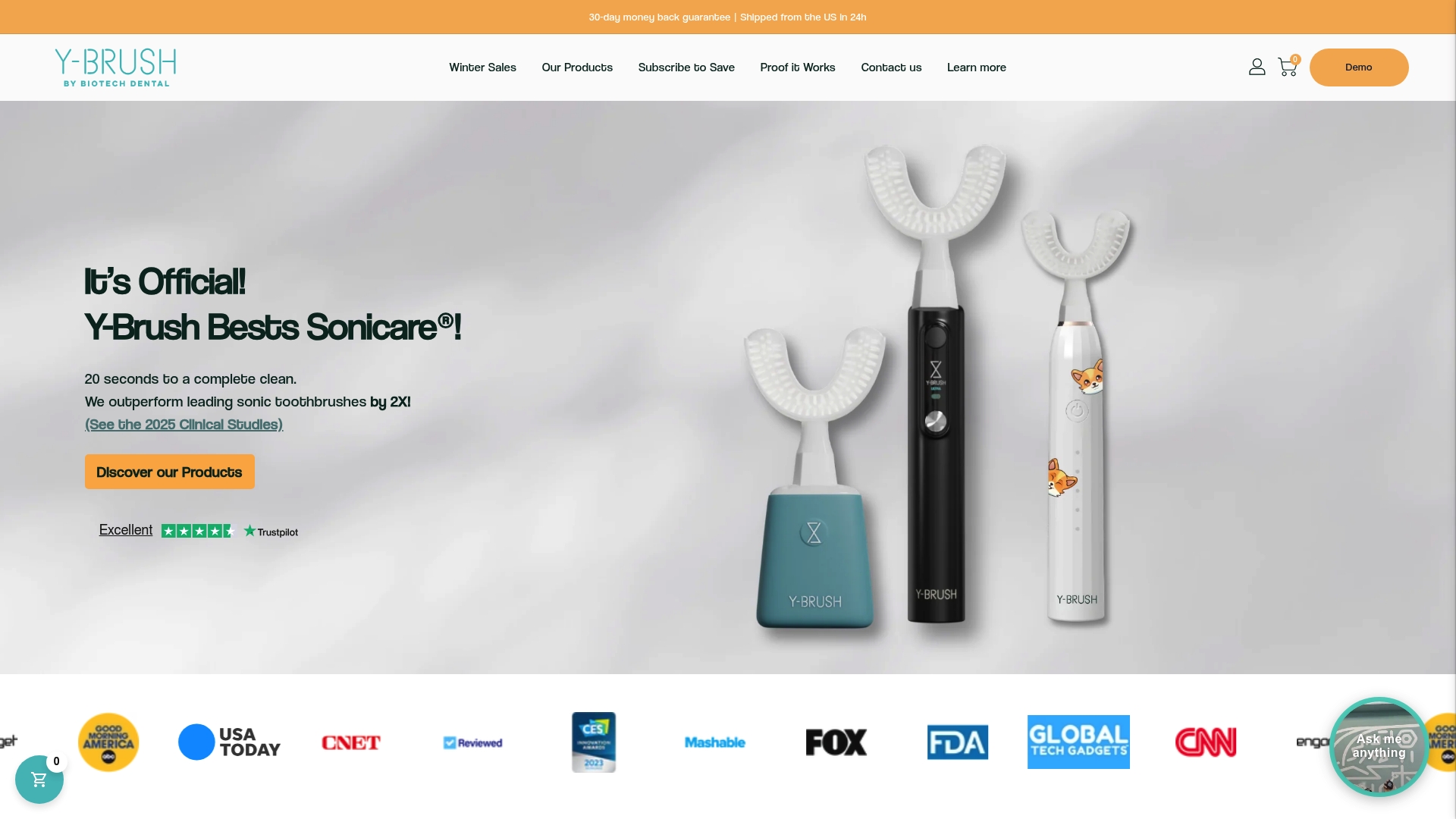
Y-brush fits busy adults, parents managing a household’s morning routine, and anyone who has started and abandoned a two-minute brushing habit more times than they’d like to admit. Compare it against the checklist from this guide: ask about frequency and mechanism, check replacement head costs, and look at warranty terms. Y-brush backs its toothbrushes with a subscription-based lifetime warranty and offers several plans covering ongoing brush head refills so you’re not stuck sourcing replacements separately. Browse the full toothbrush lineup and plans to see which one matches your household’s needs, or check the complete product and brush head catalog if you’re comparing replacement costs across options.
This article is general information, not a substitute for advice from a qualified doctor. Consult a qualified healthcare professional about your own circumstances before acting on anything here.
Sources
- Dental Plaque Removal by Ultrasonic Toothbrushes (Dent J 2020)
- Which Kind of Electric Toothbrush Is Better: Rotating or Sonic? - Consumer Reports
- Different types of powered toothbrushes for plaque control and healthy gums - Cochrane
FAQ
Do dentists recommend ultrasonic toothbrushes?
Dentists generally recommend powered toothbrushes over manual ones, since the Cochrane review found powered brushing reduces plaque and gingivitis more effectively. Most dentists don’t specifically push ultrasonic over sonic, since the evidence doesn’t show one powered mode is consistently better than another.
Are ultrasonic toothbrushes actually better?
Not consistently. The 2020 Dent J review found ultrasonic and sonic brushes both remove plaque effectively, with differences that weren’t statistically significant across many studies. Hybrid designs combining bristle motion with acoustic energy may perform best of all.
Do dentists prefer Oral-B or Sonicare?
Preferences vary by individual dentist and patient needs rather than following a clear brand consensus, since Consumer Reports found no universal winner between the underlying rotating and sonic mechanisms these brands use. Comfort, head design, and whether a patient uses the brush consistently tend to matter more than the brand name.
What is the downside of a sonic toothbrush?
Sonic brushes clean effectively at and slightly beyond the bristle line, but they don’t fully replace flossing for tight contact points between teeth. Some users also find the vibration intensity uncomfortable at first, though most adjust within a few days of daily use.
How much does a Y-brush cost?
Y-brush offers three plans covering the toothbrush and ongoing brush head refills: the Core Plan at $29.90 per quarter, the Pro Plan at $49.90 per quarter, and the Pro+2 Plan at $69.90 per quarter. Full details are available on the toothbrush and plans page.


