


TL;DR:
- Automatic toothbrushes remove more plaque and reduce gingivitis better than manual brushes.
- Built-in timers, quadrant pacers, and pressure sensors enhance brushing consistency and safety.
- For busy adults, the best options are ADA-certified models with essential features for effective, effortless care.
Most people genuinely believe they brush well enough. They pick up a manual toothbrush, scrub for 45 seconds, and move on with their day. But Cochrane reviews show that automatic toothbrushes deliver 11 to 21% more plaque removal and reduce gingivitis by 6 to 11% compared to manual brushing. That gap is not a minor detail. It represents the difference between genuinely clean teeth and teeth that look clean but still carry plaque in the places that matter most. For busy adults who want real results without spending extra time, automatic toothbrushes offer a clinically proven path forward.
Table of Contents
- What is an automatic toothbrush?
- Automatic vs manual toothbrushes: Evidence and efficiency
- Top features that maximize brushing efficiency
- Comparing technologies: Oscillating-rotating vs. sonic vs. ultrasonic
- Ultra-efficient options and safety advice
- Fresh perspective: What really matters for busy users
- Find your perfect automatic toothbrush: Solutions for busy lives
- Frequently asked questions
Key Takeaways
| Point | Details |
|---|---|
| Superior plaque removal | Automatic toothbrushes remove significantly more plaque than manual brushes, helping you achieve a healthier smile. |
| Time-saving features | Built-in timers and pacers make brushing faster and more efficient for busy schedules. |
| Certified for safety | ADA Seal models ensure proven safety and effectiveness in oral care. |
| Technology differences | Oscillating-rotating brushes edge out sonic/ultrasonic for plaque and gum health, though technique matters most. |
| Expert guidance | App-connected and guided models help reinforce good habits, making thorough brushing effortless. |
What is an automatic toothbrush?
An automatic toothbrush, commonly called an electric toothbrush, uses a built-in electric motor to move bristles rapidly and consistently. Unlike a manual toothbrush, which depends entirely on the user’s hand motion and technique, an automatic model does much of the mechanical work for you. This distinction matters more than most people realize, because even well-intentioned manual brushers tend to miss the same spots every single time.
According to Wikipedia’s overview, automatic toothbrushes operate via electric motors producing rapid bristle movements, and they fall into three main categories: oscillating-rotating, sonic, and ultrasonic. Each type delivers motion differently and at different speeds.
Here is a quick breakdown of the three main types:
- Oscillating-rotating: Bristles spin in small circles and alternate direction, scrubbing plaque off each tooth individually. Oral-B is the most recognized brand in this category.
- Sonic: Bristles vibrate at high frequency, typically 30,000 to 40,000 strokes per minute, creating fluid dynamics that help dislodge plaque beyond the bristle tips. Philips Sonicare is the leading example.
- Ultrasonic: Operates at frequencies above 20,000 Hz, potentially disrupting bacterial cell walls. The evidence base here is still developing compared to the other two types.
For busy adults, the automatic toothbrush guide explains how these models also come loaded with practical features like timers, pressure alerts, and app connectivity. These additions are not gimmicks. They directly address the habits that lead to incomplete brushing. If you have ever wondered why choose an automatic toothbrush over a manual one, the answer starts with consistency and ends with measurable results.
“The best toothbrush is the one you use correctly and consistently. Automatic models are engineered to make that easier, regardless of how rushed your morning routine is.”
Automatic vs manual toothbrushes: Evidence and efficiency
Understanding the types is one thing. Seeing the data side by side makes the case undeniable. The research on automatic vs manual hygiene consistently points in one direction, and it is not toward the manual brush.
The Cochrane reviews represent the gold standard in dental research analysis, pooling data from dozens of clinical trials. Their findings show 11% more plaque removal in the short term and 21% more over the long term, with gingivitis reduction of 6% short-term and 11% long-term. Individual studies go even further, with some showing powered brushes reduce plaque by 44 to 60% compared to manual alternatives.
| Feature | Automatic toothbrush | Manual toothbrush |
|---|---|---|
| Plaque removal | Up to 21% more (long-term) | Baseline |
| Gingivitis reduction | Up to 11% more (long-term) | Baseline |
| Brushing consistency | Motor-driven, reliable | Dependent on user technique |
| Built-in timer | Yes (most models) | No |
| Pressure control | Sensor-equipped models | None |
| Recommended for busy users | Yes | Requires discipline |
The electric toothbrush benefits become even clearer when you consider how the average person actually brushes. Studies consistently show that most adults brush for under one minute, far short of the dentist-recommended two minutes. An automatic toothbrush with a built-in timer removes that guesswork entirely.
Here is how efficient brushing with an automatic toothbrush works in practice:
- Place the brush head on the first tooth surface. Let the motor do the work. No scrubbing motion required.
- Move slowly from tooth to tooth. The goal is to guide the brush, not power it yourself.
- Follow the quadrant pacer signal. Most models alert you every 30 seconds to move to the next section of your mouth.
- Stop when the 2-minute timer signals. You have covered all four quadrants evenly without thinking about it.
- Rinse and store. The entire process is complete, thorough, and consistent every single time.
Compared to the manual toothbrush experience, this structured approach eliminates the two biggest problems: rushing through certain areas and applying uneven pressure. The result is a cleaner mouth with less effort.

Top features that maximize brushing efficiency
Evidence is compelling, but the specific features built into modern automatic toothbrushes are what translate that evidence into daily results. According to Wirecutter’s expert review, the key features to prioritize are a 2-minute timer, a quadrant pacer, a pressure sensor, and the ADA Seal of Acceptance.
Here is what each feature actually does for you:
- 2-minute timer: Ensures you brush for the clinically recommended duration. Most people underestimate how long two minutes feels, and the timer removes that uncertainty.
- Quadrant pacer: Divides your mouth into four equal sections and signals every 30 seconds to move on. This prevents the common habit of spending 90% of your time on easily accessible front teeth.
- Pressure sensor: Alerts you when you are pressing too hard. Over-brushing is a real problem that causes gum recession and enamel wear over time. A sensor protects you from doing damage while trying to do good.
- ADA Seal of Acceptance: The American Dental Association awards this seal only to products with clinically proven safety and effectiveness. It is the clearest signal that a toothbrush has been independently verified.
- Multiple cleaning modes: Sensitive, whitening, and gum care modes allow you to customize the experience based on your specific needs on any given day.
| Feature | Benefit for busy adults | Impact level |
|---|---|---|
| 2-minute timer | Removes guesswork, ensures full clean | High |
| Quadrant pacer | Distributes time evenly across all areas | High |
| Pressure sensor | Prevents gum and enamel damage | Medium-High |
| ADA Seal | Confirms clinical safety and efficacy | High |
| Cleaning modes | Personalizes experience | Medium |
Pro Tip: When shopping for an automatic toothbrush, treat the ADA Seal as a non-negotiable baseline. Features like app connectivity and multiple modes are valuable, but safety certification is what ensures those features work without causing harm. Read more about effective brushing tips and efficient brushing steps to get the most from your brush.
For those interested in what drives these features at a deeper level, advanced toothbrush technology is evolving rapidly, with AI-assisted tracking now available in premium models.
Comparing technologies: Oscillating-rotating vs. sonic vs. ultrasonic
With features covered, the next question is which underlying technology performs best. This is where most buyers get confused, and where the research offers some genuinely useful clarity.
A recent study published in Nature found that oscillating-rotating brushes show the greatest plaque and gingivitis reduction compared to sonic models in head-to-head clinical trials. That finding aligns with the broader Cochrane analysis, which has consistently ranked oscillating-rotating technology at the top for measurable outcomes.
| Technology | Strokes per minute | Plaque removal ranking | Best for |
|---|---|---|---|
| Oscillating-rotating | 8,000 to 9,000 | Highest (clinical evidence) | Thorough plaque removal |
| Sonic | 30,000 to 40,000 | High | Gum health, sensitive teeth |
| Ultrasonic | 1.6 million+ | Emerging evidence | Bacterial disruption |
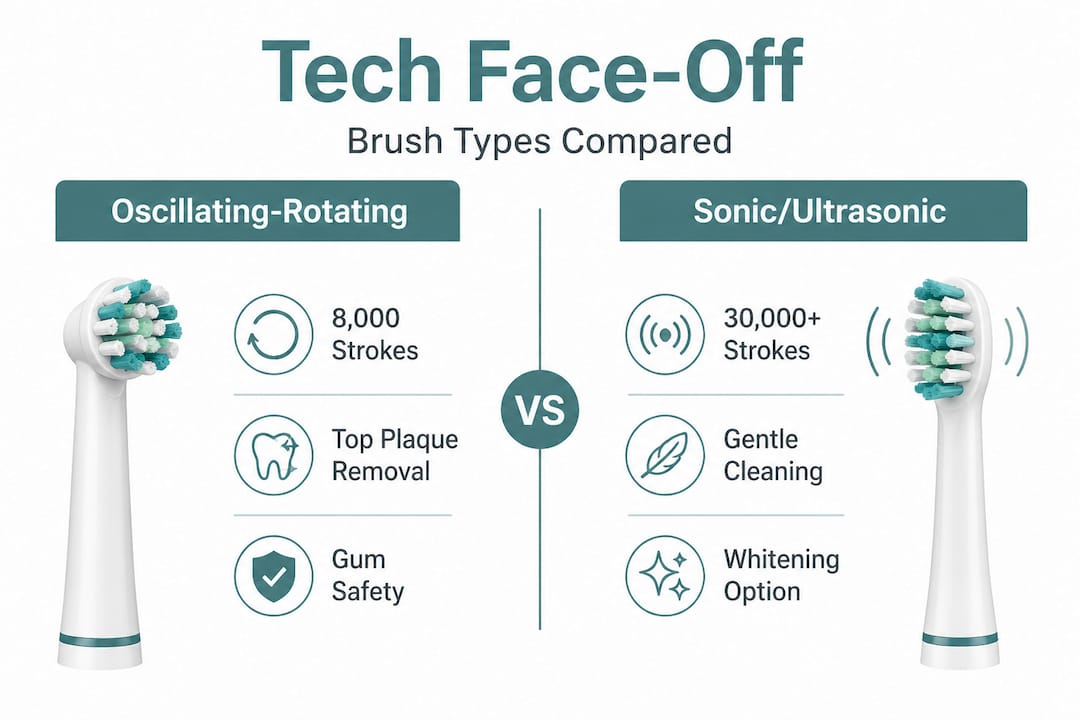
However, the same Cochrane research adds an important nuance: the differences between oscillating-rotating and sonic may lack clinical significance for most users. In practical terms, both technologies outperform manual brushing by a wide margin, and the gap between them is small enough that other factors, particularly technique and consistency, often matter more.
Here is what that means for your decision:
- Choose oscillating-rotating if you want the technology with the most robust clinical evidence behind it and prioritize maximum plaque removal.
- Choose sonic if you have sensitive gums, prefer a gentler vibration sensation, or want a brush that feels less intense during use.
- Approach ultrasonic with curiosity but caution. The technology is genuinely interesting, but the evidence base is thinner, and most dentists still recommend sticking with proven options.
Pro Tip: App-based guidance features, like those found in the Oral-B iO series, can significantly improve brushing consistency for busy users. When you cannot rely on habit alone, real-time feedback fills the gap. Explore toothbrush design innovations and review choosing an automatic toothbrush to match technology to your lifestyle.
Ultra-efficient options and safety advice
For adults who want the absolute fastest brushing experience, a newer category of automatic toothbrushes has emerged: U-shaped mouthpiece brushes. These models fit over all teeth simultaneously and claim to clean the entire mouth in as little as 20 to 30 seconds.
According to Livestrong’s expert roundup, U-shaped brushes are promising for ultra-efficiency but are less established compared to standard electric toothbrushes. Established brands like Oral-B and Philips Sonicare remain the benchmark for proven performance.
Key points to know about U-shaped and ultra-fast models:
- Speed advantage: Designed to clean all surfaces simultaneously, reducing total brushing time dramatically.
- Coverage approach: The mouthpiece design targets outer, inner, and chewing surfaces at the same time, unlike sequential brushing.
- Evidence gap: Most U-shaped models do not yet carry ADA acceptance, meaning their clinical effectiveness has not been independently verified to the same standard.
- Best use case: Ideal for users who genuinely will not brush otherwise due to time constraints, but should be paired with regular dental checkups.
Safety remains the most important consideration when exploring newer technologies. The efficient brushing advice from dental professionals consistently emphasizes one principle: a faster brush that you actually use beats a superior brush that stays in the drawer.
Pro Tip: If you are considering a U-shaped or ultra-fast model, check whether it carries ADA acceptance or has been reviewed by a licensed dentist before purchasing. Innovation is exciting, but your gum health is not a testing ground for unverified technology.
Fresh perspective: What really matters for busy users
Most buying guides focus on specs. Stroke counts, battery life, app ratings. Those details matter at the margins, but they are rarely what separates good oral health from poor oral health for busy adults.
The real differentiator is consistency. A brush you use every day for 90 seconds outperforms a premium model you use three times a week for the full two minutes. The Cochrane data confirms this: the differences between oscillating-rotating and sonic technologies are clinically small. What is not small is the difference between brushing regularly and brushing sporadically.
This is where automatic toothbrushes genuinely earn their value for time-pressed adults. The built-in timer removes the mental effort of tracking time. The quadrant pacer removes the decision-making about where to brush next. The pressure sensor removes the risk of doing damage when you are rushing. All of these features work together to make good brushing nearly automatic, which is exactly what busy lives require.
The uncomfortable truth that most reviews skip over is this: the best toothbrush is not the one with the highest plaque-removal score in a lab. It is the one that fits your routine so naturally that you never skip it. That is why features like steps for efficient brushing and guided modes matter more for real-world outcomes than raw technology comparisons.
We would also argue that the rise of ultra-fast models like Y-Brush reflects something important: the oral care industry is finally acknowledging that asking people to stand still for two minutes twice a day is a design problem, not a discipline problem. Meeting users where they are, rather than where dentists wish they were, is the approach that actually improves public oral health.
Find your perfect automatic toothbrush: Solutions for busy lives
Everything covered in this article points toward one practical conclusion: the right automatic toothbrush can genuinely transform your oral health without demanding more of your time.
Y-Brush has built its entire product line around this reality. The Y-Brush Essential Sonic delivers clinically effective sonic cleaning with the features busy adults need most: a built-in timer, gentle pressure feedback, and a design that makes consistent brushing effortless. For those who want maximum coverage in minimum time, the Y-Brush DuoBrush offers a dual-action approach that cleans more surface area per stroke. Both models reflect the evidence-backed principles discussed throughout this article. Ready to make the switch? Visit the brush smarter page to find the right fit for your routine.
Frequently asked questions
How much time can automatic toothbrushes save compared to manual ones?
Automatic toothbrushes with built-in 2-minute timers and quadrant pacers guide you through a complete brush efficiently, eliminating the guesswork that leads most people to stop too early. The time saved comes not from brushing faster, but from brushing smarter with no wasted effort.
Do automatic toothbrushes actually clean better than manual ones?
Yes. Cochrane reviews confirm automatic toothbrushes remove up to 21% more plaque and reduce gingivitis up to 11% more than manual brushes, with results improving the longer you use them consistently.
Are U-shaped automatic toothbrushes safe and effective?
U-shaped brushes offer genuine speed advantages but lack the established evidence of standard electric models. Prioritizing ADA-accepted options from established brands remains the safest choice until more clinical data is available.
What features should busy adults look for in an automatic toothbrush?
Focus on models with a 2-minute timer, quadrant pacer, and pressure sensor, plus the ADA Seal of Acceptance. These four elements cover time management, coverage, safety, and verified effectiveness in one package.
How important is ADA certification for automatic toothbrushes?
ADA certification is a strong indicator of independently verified safety and clinical effectiveness. According to Wirecutter’s expert analysis, the ADA Seal confirms a product has met rigorous standards for plaque removal and gingivitis reduction, making it a reliable filter when comparing options.
Recommended
- Automatic toothbrush: Why choose it? – Y-Brush USA
- The Ultimate Guide to Automatic Toothbrushes: Revolutionizing Oral Car – Y-Brush USA
- Do Automatic Toothbrushes Clean Better Or Just Faster? – Y-Brush USA
- Top Tips for Effective Tooth Brushing: A Guide to a Brighter Smile – Y-Brush USA
- Igiene Orale EasyFarma: Spazzolini Elettrici, Fili Interdentali, Spazzolini da denti, Sbiancanti e Dentifrici.
- Oral-B iO Series 10 Ηλεκτρική Οδοντόβουρτσα euragora.gr


