


Sharing a toothbrush is a habit worth breaking. The American Dental Association and the CDC both advise against it, since bristles carry bacteria, viruses, and blood from gum tissue that a brush head can pass to the next user. Healthy adults face a small but real risk from a one-off borrow; immunocompromised people, young children, and anyone with active gum disease face something closer to a genuine hazard. The rest of this guide covers exactly which germs travel, how contamination happens, and what to do instead.
TL;DR:
- Sharing a toothbrush can transfer cavity bacteria, gum disease pathogens, cold sore viruses, and, in rare cases, blood-borne viruses like hepatitis B and C.
- The risk is lowest for healthy adults but significantly increases for immunocompromised individuals, people with active gum disease, or those undergoing medical treatments.
- Toothbrush contamination occurs through the formation of bacterial biofilms and moisture retention, especially when stored improperly or in shared holders.
- Regularly replacing brushes every three to four months, rinsing thoroughly after use, and storing brushes upright reduces microbial buildup more effectively than disinfection alone.
- Cumulative exposure from household sharing raises long-term risks, especially for children; only dedicated brushes and strict hygiene habits provide reliable prevention.
Table of Contents
- What Germs Can Spread When You Share a Toothbrush
- Who Faces the Real Danger From Toothbrush Sharing
- How a Toothbrush Actually Gets Contaminated
- Borrowing Once vs. Sharing Regularly vs. Kissing
- Cleaning, Storage, and Replacement That Actually Work
- No Toothbrush? Safer Short-Term Options
- Common Myths About Sharing a Toothbrush
- What Repeated Sharing Does Over Time
- What Dental and Health Authorities Actually Recommend
- Why Individual Brush Habits Matter More Than People Think
- Keep Everyone’s Brush Separate Without the Hassle
- Sources
What Germs Can Spread When You Share a Toothbrush
A toothbrush head is a warm, damp surface that gets used twice a day and rarely dries all the way. That combination makes it an efficient carrier for whatever happens to be living in someone’s mouth. Peer-reviewed contamination studies indexed on NCBI/PMC have found oral bacteria like Streptococcus mutans and Porphyromonas gingivalis colonizing bristles within days of normal use, along with detectable traces of viruses including herpes simplex and rhinovirus.
The bigger concern is bloodborne exposure. Brushing routinely nicks inflamed or bleeding gums, and a shared brush can carry that blood, along with hepatitis B or hepatitis C in rare but documented circumstances. Health authorities describe this as a plausible, cautious risk rather than a common outcome, since transmission depends on active bleeding from both users and a fairly short window between uses.
Statistic callout: Reviews cataloged on NCBI/PMC have identified dozens of distinct bacterial and viral species surviving on used toothbrush heads, spanning everyday oral flora to opportunistic pathogens.
What can actually move from one brush to another:
- Cavity-causing bacteria (S. mutans) — contributes to tooth decay in the new user.
- Gum-disease bacteria (P. gingivalis) — linked to periodontal inflammation.
- Cold sore virus (herpes simplex) — can trigger an outbreak in someone newly exposed.
- Common cold virus (rhinovirus) — spreads respiratory infection during illness.
- Blood-borne viruses (hepatitis B/C) — a low-probability but serious risk when gums bleed.
Who Faces the Real Danger From Toothbrush Sharing
A healthy adult’s immune system handles most of what lands on a borrowed brush without incident. That changes fast for certain groups. People undergoing chemotherapy, organ transplant recipients on immunosuppressants, and anyone with uncontrolled diabetes have a reduced ability to fight off bacteria that a healthy mouth would clear on its own. Active oral infections, like an untreated abscess or bleeding gums, raise the stakes for everyone nearby, not just the person with the infection.
- Immunocompromised individuals and cancer patients
- Transplant recipients on immunosuppressive drugs
- People with poorly managed diabetes
- Anyone with active gum disease or mouth sores
Pro Tip: If you’re caring for someone in a high-risk group, give every toothbrush its own labeled holder, even in a single bathroom. A five-second glance should tell you whose brush is whose.
How a Toothbrush Actually Gets Contaminated
Bacteria don’t just sit on the bristles. They form a biofilm, a sticky microbial layer, that clings to bristle bases and, according to ADA guidance, migrates into the junction where a replaceable head meets the handle. Rinsing under the tap barely touches that seam.
Moisture is the other half of the problem. A brush stored upright in open air dries out and starves bacteria of the damp environment they need; one stuffed into a closed travel case or crammed into a shared cup with three other brushes stays wet far longer. Shared holders also let bristles touch, and every flush sends a fine aerosol across the bathroom that can land on nearby brush heads.
- Air-dry brushes upright instead of capping them
- Give each person a separate holder or slot
- Never swap brush heads between handles, even briefly
- Keep brushes a few feet from the toilet bowl when possible
Borrowing Once vs. Sharing Regularly vs. Kissing
A single emergency borrow from a healthy partner carries a lower risk than making it a routine, but “lower” isn’t “zero.” Dentists interviewed by SELF note that brushing does something kissing doesn’t: it physically abrades gum tissue, creating small entry points that let microbes settle deeper than saliva contact alone would allow.
If it already happened, don’t panic, but don’t compound it either.
- Rinse the brush and your mouth thoroughly with water
- Swish an antiseptic mouthwash for added protection
- Skip reusing that same brush again until it’s disinfected
- Watch for cold sores or gum irritation over the next few days
Cleaning, Storage, and Replacement That Actually Work
Most of the risk reduction here isn’t complicated. It’s consistency.
- Rinse after every use under running water and shake off excess liquid before storing.
- Store upright and uncovered so the head dries completely between uses; a closed cap traps moisture.
- Never share a holder cup where bristles from different brushes can touch.
- Replace every three to four months, or sooner if bristles fray, and always after a cold, flu, or mouth infection.
- Label brushes in shared bathrooms, especially for kids or roommates.
Disinfection has real limits. A soak in a 50/50 white vinegar and water solution for about ten minutes can reduce bacterial load, but it isn’t a substitute for regular replacement, and boiling can warp bristles without sterilizing the handle junction. Quick rinses under hot water do almost nothing; contamination studies on NCBI/PMC found that heat exposure alone left measurable bacterial colonies intact.
Statistic callout: The same PMC review found that brushes stored in closed, unventilated containers retained higher microbial counts than those left to air-dry upright, reinforcing storage as one of the cheapest, most effective interventions available.
No Toothbrush? Safer Short-Term Options
Forgetting a toothbrush on a trip or at a friend’s house doesn’t mean you have to reach for theirs.
- Rub a pea-sized amount of toothpaste on a clean finger and go over your teeth and gums
- Floss if you have it, since it clears the debris a brush would otherwise handle
- Swish an antiseptic mouthwash for a minute
- Chew sugar-free gum to boost saliva flow and rinse the mouth naturally
Pro Tip: If you truly have no other option in an emergency, a 50/50 white vinegar soak for ten minutes cuts down microbial load on someone else’s brush, but treat it as a last resort, not a green light. Romantic partners occasionally sharing toothpaste tubes is a different, lower-stakes scenario than a caregiver managing supplies for a vulnerable patient, where separate everything is worth the extra step.
Common Myths About Sharing a Toothbrush
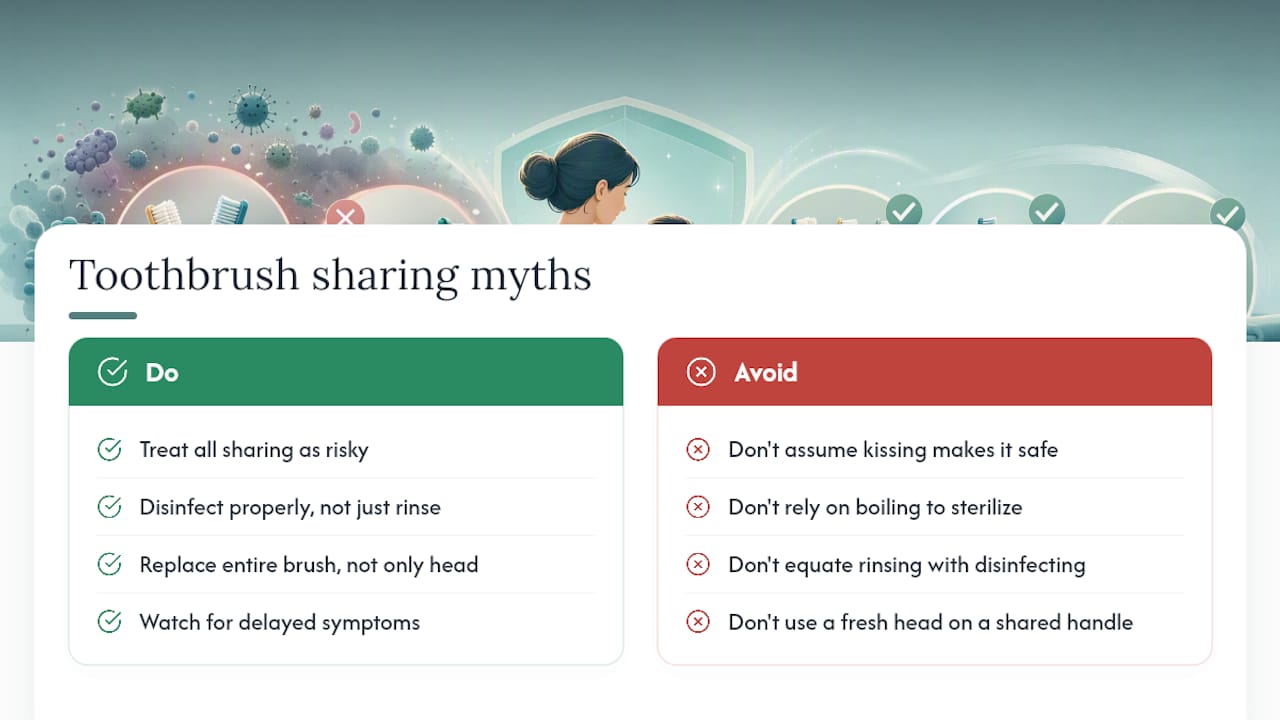
“If we’re already kissing, sharing a brush changes nothing.” Wrong. Kissing exposes you to saliva; brushing drives microbes into gum tissue through the small abrasions brushing itself creates, according to dentists cited by SELF. The mechanism matters as much as the exposure.
“Boiling a toothbrush sterilizes it.” Boiling water can warp bristles and the plastic handle before it kills everything hiding in the head-to-handle junction, so it’s an unreliable fix at best.
“A quick rinse under the faucet is basically the same as disinfecting.” It isn’t. Rinsing removes visible debris, not the biofilm layer clinging to bristle bases.
“Only people with visible illness carry contagious germs.” Herpes simplex virus, in particular, can shed from the mouth without an active cold sore present, which is part of why guidance treats all sharing as a risk, not just sharing with someone who’s obviously sick.
“New brush heads on the same handle are automatically clean.” Even with a fresh head, the shared handle’s internal mechanism can harbor residue from the previous user’s toothpaste slurry and saliva, per ADA guidance on handle junctions.
“If nobody gets sick right away, it was fine.” Some consequences, like gum disease progression or a dormant viral exposure, take weeks or longer to show up, so an absence of immediate symptoms proves very little.
What Repeated Sharing Does Over Time
A single lapse is one thing. A household habit of swapping brushes, using one “family brush,” or storing several heads in a communal cup builds a different kind of risk, one that compounds with every use.

Gum disease bacteria like P. gingivalis don’t just cause a single infection and stop. They contribute to chronic periodontal inflammation, which research increasingly connects to cardiovascular and metabolic health beyond the mouth. Repeated exposure to a partner’s or family member’s oral bacteria through shared brushes can shift a person’s own oral microbiome over time, potentially making them more susceptible to decay or gum inflammation they wouldn’t otherwise have developed.
For couples or families that have shared brushes for years without an obvious problem, the risk isn’t necessarily that something dramatic happens overnight. It’s cumulative exposure: more opportunities for a bacterial strain to take hold, more chances for a viral particle to catch someone at a vulnerable moment, like right after a dental cleaning or during a stretch of poor sleep when immunity dips. Children in households with casual toothbrush sharing are particularly worth watching, since their oral microbiomes are still developing and early colonization with cavity-causing bacteria has been linked to a higher lifetime cavity rate.
None of this means occasional sharing guarantees harm. It means the math gets worse the longer the habit continues, which is exactly why replacing the habit, rather than managing around it, is the more durable fix.
What Dental and Health Authorities Actually Recommend
The guidance here is consistent rather than scattered across conflicting advice. The ADA states plainly that toothbrushes should not be shared, framing it as a straightforward exchange of bodily fluids and microorganisms between users. The CDC echoes this in its infection-control guidance, pairing the no-sharing rule with practical handling advice: rinse after use, store upright, and replace on a regular schedule.
Cleveland Clinic adds useful context on why saliva-based transmission through a shared brush can be more efficient than casual contact, since brushing pushes microbes against and sometimes into gum tissue rather than leaving them on the surface. Together, these sources point to the same bottom line: individual brushes, consistent replacement, and sensible storage aren’t overcautious habits. They’re the baseline every major dental and health authority actually recommends.
Why Individual Brush Habits Matter More Than People Think
The evidence here points to a simple truth: prevention is mostly about removing the opportunity for sharing to happen at all, not relying on willpower in the moment someone forgets their brush. A household where every person has their own dedicated handle and an easy way to swap in a fresh head removes the temptation entirely. That’s the habit-design problem worth solving, more than any single disinfection trick. Genuine hygiene improvement comes from friction-free routines, not heroic effort, which is why the design of the toothbrush itself, not just the advice around it, deserves more attention than it usually gets.
— Joris
Keep Everyone’s Brush Separate Without the Hassle
The easiest way to eliminate sharing risk is to make sharing unnecessary in the first place. Y-brush’s individual-handle system, paired with a subscription refill plan, means every person in a household gets their own dedicated handle and a steady supply of replacement heads without anyone needing to remember to buy them.
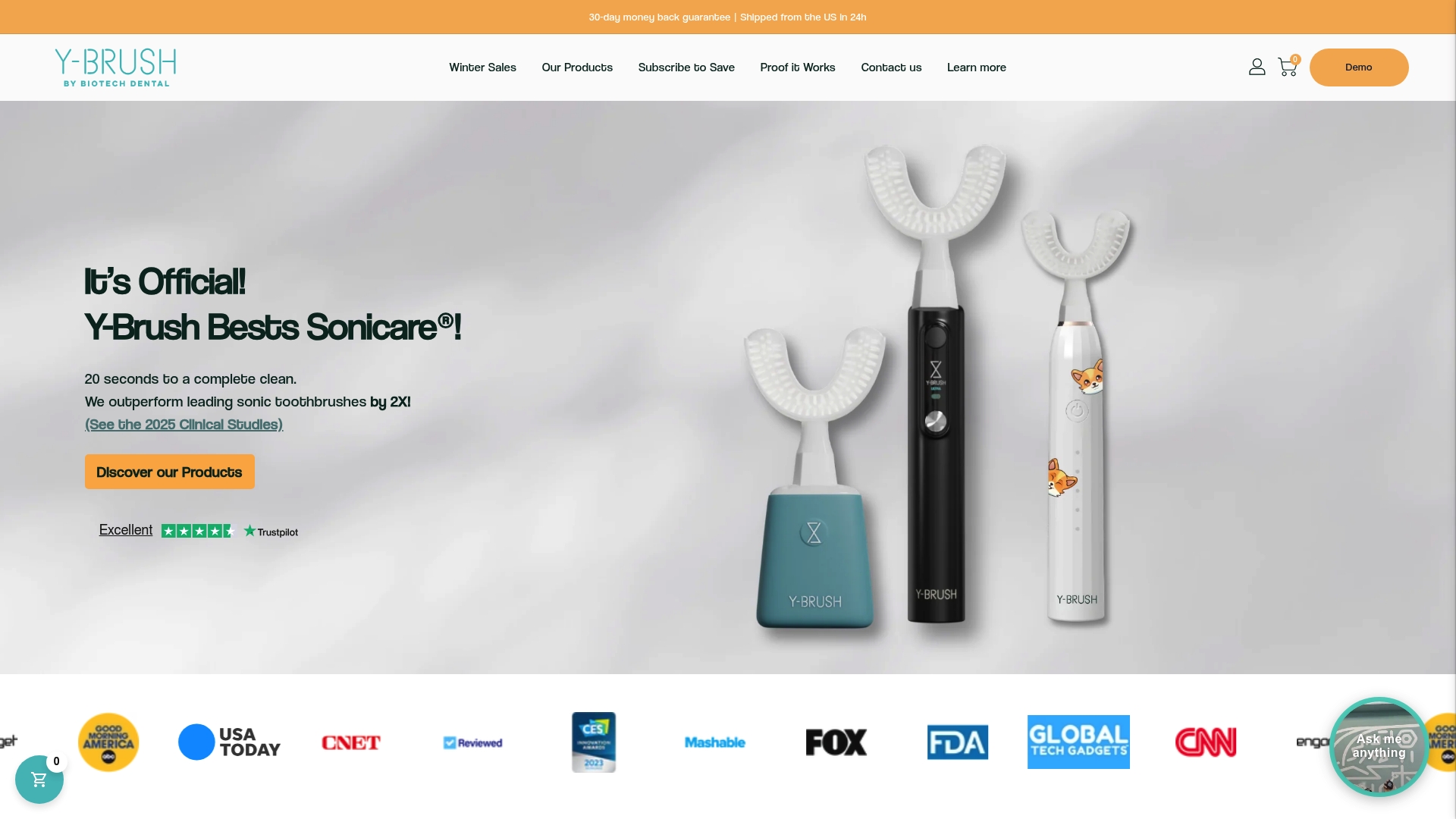
For families juggling multiple bathrooms or kids who lose track of whose brush is whose, that structure removes the daily decision point where sharing tends to happen. The Y-Brush Essential Sonic Toothbrush gives each adult their own handle, while the Y-Brush KidsBrush Sonic Electric Toothbrush is sized for children ages 4 to 12, so nobody in the house has a reason to reach for someone else’s brush. Check the current lineup and set up a refill plan that keeps fresh heads coming automatically.
This article is general information, not a substitute for advice from a qualified doctor. Consult a qualified healthcare professional about your own circumstances before acting on anything here.
Sources
- Toothbrushes | ADA
- Microbial contamination of toothbrushes and implications (PMC article)
- Does saliva have health risks? | Cleveland Clinic Health Essentials
- How Bad Is It to Borrow My Partner’s Toothbrush From Time to Time? | SELF


