


A clean electric toothbrush is one that removes plaque and protects gum tissue in a short, reliable session, not one that simply runs longer. The best evidence points to head coverage and validated cleaning cycles as the real markers of performance, with Y-Brush’s design built around that principle with a shorter cleaning cycle. Clinical research consistently favors powered brushing over manual brushing for plaque and gum health, though the size of that advantage depends heavily on head design and fit.
TL;DR:
- Effective electric toothbrushes focus on head coverage and validated cleaning cycles rather than brushing duration alone.
- Oscillating-rotating and sonic brushes outperform manual brushes mainly when their head design ensures contact with marginal and interproximal areas.
- Short-cycle devices are most beneficial for busy, limited dexterity, or travel-prone users when they include coverage mechanisms like guided patterns or ergonomic heads.
- Replacement head quality and design improvements significantly influence plaque removal at the gumline and between teeth.
- Subscriptions for replacement heads tend to be cheaper and more reliable than one-off purchases, especially when they match your routine and include flexible cancellation options.
Table of Contents
- What the Research Says About Electric Toothbrush Effectiveness
- Which Features Actually Deliver a Fast, Reliable Clean
- Who Benefits Most From a Fast-Clean Toothbrush?
- How to Choose an Electric Toothbrush and Subscription Plan
- The Real Standard for a Clean Toothbrush
- Ready for a Fast, Reliable Clean? Here’s Where to Start
- Sources
What the Research Says About Electric Toothbrush Effectiveness
Powered toothbrushes beat manual brushes in most head-to-head comparisons, but the margin is not massive and it depends on which powered technology you’re looking at. A systematic review and network meta-analysis found powered brushes deliver a small to moderate advantage over manual brushing for plaque removal, with oscillating-rotating models frequently ranking at the top. A separate meta-analysis comparing toothbrush technologies reached a similar conclusion: oscillating-rotating brushes tend to produce slightly larger reductions in gingivitis and plaque overall, and newer head and drive innovations are narrowing that gap further.
Sonic brushes hold their own in these comparisons. Both technologies clearly outperform manual brushing, and the differences between them are often modest enough that head design and fit matter more than the underlying motion type.
The Y-shaped brush trial: A cross-over randomized controlled trial tested an automatic Y-shaped brush against no brushing and against 120 seconds of manual brushing. The device beat no brushing outright but was less effective than the manual routine. Researchers pointed to fixed mouthpiece fit and bristle length as likely limiting factors, not a flaw in the automated-coverage concept itself. It was a pilot study, so the findings describe a starting point, not a final verdict on Y-shaped designs.
Three practical lessons emerge from this research:
- Coverage at the gumline and between teeth matters more than raw brushing time.
- Guided or automated coverage reduces the technique errors that undercut manual brushing.
- Head fit determines whether a short cycle can actually reach the surfaces that matter.
The FDI’s chairside consensus guide backs this up directly: both powered and manual brushes can work well, but user technique drives the outcome. Features that remove technique from the equation, rather than features that just add vibration, are what separate a genuinely clean result from a rushed one.
Which Features Actually Deliver a Fast, Reliable Clean
Marketing language rarely tells you whether a toothbrush will actually clear plaque from the surfaces that matter. A study on marginal-site cleaning identifies the gumline and the tight spaces between teeth as the areas where plaque persists longest, even with careful manual brushing. That’s the benchmark any electric toothbrush needs to clear.
Five features determine whether a device meets that benchmark:
- Head geometry and bristle reach. A head that wraps around the tooth surface, or one shaped to hit multiple angles at once, closes gaps that a flat, narrow head leaves behind.
- Motion type. Oscillating-rotating and sonic brushes both show real benefit in clinical comparisons; the deciding factor is whether the head actually contacts the marginal and approximal surfaces, not which motion it uses.
- Guided cycles and timers. Quadrant pacing and automatic cutoffs matter because a validated short cycle only works if coverage happens automatically or with coaching. Time without coverage is wasted time.
- Pressure sensors and cleaning modes. These prevent tissue damage from overbrushing and let you tailor intensity for sensitive gums or for kids just learning the habit.
- Replacement-head reliability. Worn bristles lose their shape and stop reaching marginal sites the way a fresh head does, no matter how good the original design was.
Newer head designs are closing gaps that older models left open. A comparison of oscillating-rotating head technology found that updated head shapes improved plaque reduction at marginal and approximal sites compared to earlier versions, reinforcing that head engineering, not just motor power, drives results.
Pro Tip: Check whether a brush’s “short cycle” claim comes with a coverage mechanism, like an ergonomic head or a guided pattern, or whether it’s just a shorter timer bolted onto a standard design. The timer alone doesn’t clean anything.
Who Benefits Most From a Fast-Clean Toothbrush?
A fast-clean device earns its keep with people who would otherwise skip proper brushing altogether or rush through it. It’s a poor match for anyone whose mouth needs targeted, dentist-guided attention.
- Busy adults and parents who brush in under a minute most mornings gain the most from a device that automates coverage in a short session.
- People with limited dexterity, including older adults and anyone with arthritis or a motor impairment, benefit from a design that doesn’t demand precise angling.
- Caregivers managing brushing for a child or a dependent adult get a faster, more consistent routine with less resistance.
- Frequent travelers who skip steps in unfamiliar bathrooms benefit from a device that’s quick enough to actually use every day.
- Kids building the habit respond better to a short, guided session than to a 2-minute routine they abandon halfway through.
A fast-clean device is not the right tool for advanced periodontal disease, heavy surface staining, or an unusually irregular arch where a dentist has recommended targeted brushing in specific areas. Watch for red flags before buying: a fixed mouthpiece that clearly won’t fit your arch, no replacement heads sold domestically, or a bare-bones model missing a timer and pressure sensor. If you have specific gum or periodontal concerns, talk to your dentist before choosing a device, since no consumer toothbrush replaces that guidance.
How to Choose an Electric Toothbrush and Subscription Plan
Buying the right device comes down to a handful of checks, and skipping any of them is how people end up with a brush that looks good on a shelf but underperforms in the mouth.
- Confirm the head design actually covers marginal and approximal surfaces, not just the visible front of the tooth.
- Look for a validated cycle length paired with guided coverage, whether that’s quadrant pacing or an automated Y-shaped mouthpiece.
- Check that replacement heads are sold and shipped where you live; a brush you can’t restock becomes a brush that stops working well.
- Review the warranty terms and the return or trial window before you commit.
On cost, the device itself is a one-time expense, but replacement heads are the recurring cost that actually determines your total spend. Heads generally need swapping every three months for hygiene and bristle performance, so a membership plan that ships them automatically tends to run cheaper per head than buying one-off, and it removes the risk of forgetting until your bristles are frayed.
Subscriptions trade a little commitment for a lot of convenience: lower per-head pricing and one less thing to remember, in exchange for a recurring shipment cadence you should confirm you can pause or adjust. Before subscribing anywhere, verify the cancellation terms and check whether the plan ships heads on a schedule that matches how you actually replace them. For details on choosing the right electric toothbrush, buying direct from the brand’s own site is usually the simplest way to keep warranty support and subscription management in one place.
The Real Standard for a Clean Toothbrush
Convenience and verified coverage are not competing priorities. They’re the same requirement stated two ways. A brush that takes 20 seconds but misses the gumline isn’t fast, it’s incomplete. A brush that takes two minutes but gets skipped three days a week isn’t thorough, it’s theoretical. The pilot RCT on Y-shaped brushing makes that trade-off explicit rather than hiding behind marketing claims, and that kind of transparency is what shoppers should demand from every brand, including this one.
Y-Brush’s adult and kids lines, along with its membership plans, exist because most people won’t brush for two minutes twice a day, no matter how often a dentist tells them to. Pair whichever device you choose with the basics: replace heads on schedule, follow your dentist’s specific advice, and don’t treat any toothbrush as a substitute for a checkup when something feels off.
— Joris
Ready for a Fast, Reliable Clean? Here’s Where to Start
Y-Brush is built around one job: getting a full, effective clean done in 20 seconds instead of the 2 minutes most people never actually spend brushing. That’s the practical alternative to hoping that willpower closes the gap every single morning and night.
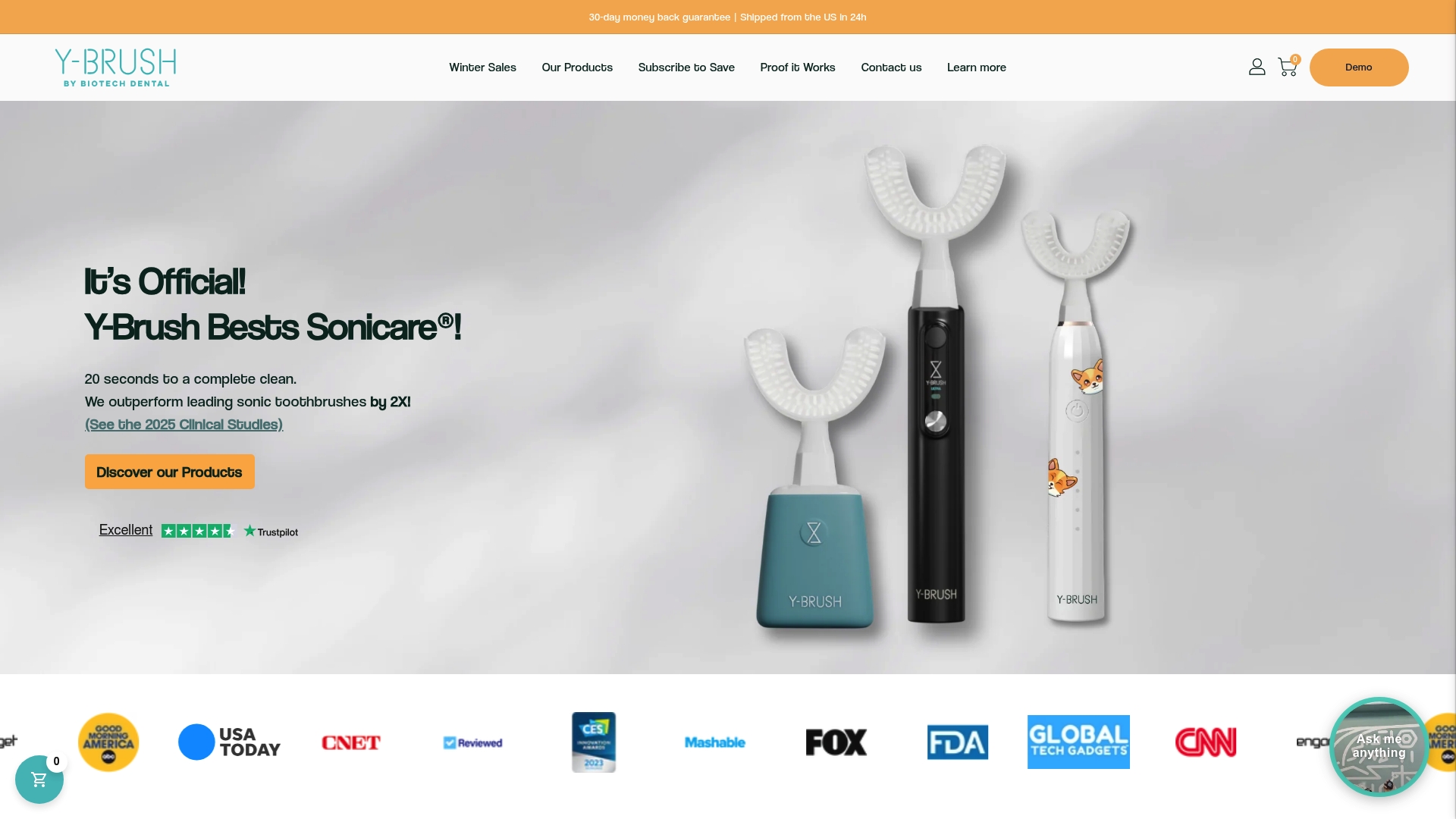
The lineup covers the household. The Y-Brush Essential Sonic Toothbrush is the core adult model, built around the coverage-first design discussed throughout this guide. For kids ages 4 to 12, the Y-Brush KidsBrush Sonic Electric Toothbrush applies the same automated-coverage principle in a size built for smaller mouths and shorter attention spans. Households with more than one adult brushing can look at the Y-Brush DuoBrush Sonic Electric Toothbrush or the Y-Brush Ultra Sonic Toothbrush for a higher-tier option.
To get started, pick the adult or kids model that matches your household, check the replacement-head cadence that fits your routine, and review the membership plan if you’d rather have heads arrive automatically than remember to reorder them yourself.
Sources
- Efficacy of an automatic electric toothbrush with nylon bristles in dental plaque removal: a cross-over randomized controlled trial
- CONSENSUS ON TOOTHBRUSHING (FDI)
- The efficacy of powered toothbrushes: A systematic review and network…
- A meta-analysis comparing toothbrush technologies on gingivitis and plaque - ScienceDirect


