


A patented toothbrush design is a legal document that describes and claims a specific, novel mechanical or structural feature of a toothbrush, not just a marketing label for “new and improved.” Reading one correctly means knowing where the abstract ends and the claims begin, since claims alone define what’s legally protected. This guide shows you how to find these documents, decode their anatomy using the ADA’s toothbrush standards as a benchmark, and evaluate real examples, including a brush head engineered around the same tradeoffs, Y-brush’s.
TL;DR:
- The scope of a patented toothbrush design is defined solely by its claims, with the abstract, drawings, and specification providing supporting context.
- Mechanical drive, detachable head mechanisms, bristle geometries, and electronic add-ons constitute the main categories of patented toothbrush innovations.
- Effective patent searches rely on classification codes like CPC class A46B, tracking patent families, and analyzing forward and backward citations for comprehensive landscape mapping.
- Freedom to operate involves comparing your design to the broadest independent claims, mapping each element carefully, and consulting a patent attorney before product development.
- Trends point toward multi-layered bristle arrangements, modular head designs, and integrated sensors, with core geometric relationships and retention features remaining key patent focal points.
Table of Contents
- What Does a Patented Toothbrush Design Document Actually Contain?
- What Are the Main Categories of Patented Toothbrush Designs?
- How Do You Search for and Retrieve Toothbrush Patents?
- How Do You Assess Freedom to Operate Against a Toothbrush Patent?
- Which Patented Toothbrush Designs Should You Study First?
- What Do These Patents Mean for Toothbrush Designers and Inventors?
- Where Is Toothbrush Patenting Headed, and What Should Inventors Do Now?
- A Design Built Around the Same Tradeoffs
- Sources
What Does a Patented Toothbrush Design Document Actually Contain?
Every patent record follows a predictable skeleton, and once you know where to look, you can pull the useful information in under five minutes. The abstract sits at the top and gives a one-paragraph summary, useful for triage but legally meaningless. The drawings come next, numbered figures that illustrate the invention from multiple angles, often the fastest way to understand a mechanical concept before you read a single word of technical description.
The specification (sometimes called the “detailed description”) walks through the invention’s structure and function in plain, if dense, language. It exists partly to satisfy legal disclosure requirements and partly to support the claims. This is where you’ll find manufacturing details, alternative embodiments, and background discussion of prior art the inventor wanted to distinguish from.
The claims, usually at the very end of the document, are the only legally enforceable part. Everything else is context.
A few metadata fields matter as much as the technical content:
- Priority date: the earliest filing date the invention can claim, critical for determining what counts as prior art against it.
- Publication and application numbers: the identifiers you’ll use to track the document across databases (a WO number signals a PCT international application, a US number a domestic filing).
- Inventor and assignee fields: who invented it and who owns the rights, often a company rather than the individual inventor.
- Legal status flags: whether the patent is active, expired, abandoned, or never granted at all. A published application (like most WO-prefixed documents) is not automatically a granted patent.
Claim hierarchy deserves its own attention. Independent claims stand alone and define the broadest scope of protection. Dependent claims reference an independent claim and add narrower limitations, useful as fallback positions during litigation or examination, but they never expand the scope of the claim they depend on. If you’re assessing how much protection a patent actually offers, the independent claims are where the real analysis happens. Everything dependent on them is narrower, by definition.
What Are the Main Categories of Patented Toothbrush Designs?
Toothbrush patents cluster around a handful of recurring inventive concepts, and recognizing these categories helps you spot candidate prior art quickly instead of reading hundreds of documents cold.
-
Mechanical drive systems. Electric and sonic toothbrushes frequently claim the specific mechanism that converts a motor’s rotary motion into brushing motion. Cam-driven oscillatory systems are the classic example: a cam lobe interfaces with a cavity in the brush head shaft to produce back-and-forth oscillation. US8955185B2 is a good reference point here, describing exactly this kind of direct-drive cam and oscillatory head arrangement, with the claims focused tightly on the structural relationship between cam and cavity.
-
Detachable and replaceable head mechanisms. A huge share of toothbrush patents cover how the brush head attaches to and detaches from the handle. These claims usually center on retention features, snap-fit lugs, apertures, friction collars, that hold the head securely during use but allow tool-free removal for replacement. US6546585B1 describes this category directly, with claim language built around the aperture and retention interface between head and handle.
-
Bristle geometries. Multi-level, angled, or tapered bristle arrangements get patented because bristle geometry materially affects plaque contact during brushing, particularly with sonic or oscillatory motion. A separate sub-category covers cosmetic or identification bristles, colored purely to signal wear or ownership rather than to improve cleaning. WO2001064072A1 falls into this bucket, disclosing toothbrushes that use different bristle colors for permanent identification.
-
Modern electronic add-ons. Sensors, cameras, and water jets are increasingly common in recent filings. Coverage of Dyson’s camera-equipped electric toothbrush shows where this trend is heading: integrated imaging and AI-guided brushing feedback. These features are typically claimed only when they’re structurally or functionally integrated with the cleaning mechanism itself, a bolted-on sensor with no functional tie to brushing motion is much harder to defend as a novel claim.
How Do You Search for and Retrieve Toothbrush Patents?
Start with a focused keyword search on Google Patents or WIPO’s Patentscope, using terms like “toothbrush oscillating head,” “detachable brush head retention,” or “sonic toothbrush drive mechanism.” These phrases surface the mechanical categories that matter most, rather than the generic word “toothbrush,” which returns thousands of irrelevant results.
Classification codes narrow things fast. Toothbrush patents cluster under CPC class A46B (brushes) with sub-groups for electric toothbrushes and detachable heads. Pulling the CPC code from one relevant patent and searching that code directly usually surfaces the entire technical family in one pass.
Once you find a strong candidate, don’t stop there:
- Pull its patent family through Global Dossier or Patentscope to see equivalent filings in other jurisdictions.
- Follow backward citations (the prior art the patent itself cites) and forward citations (later patents that cite it) to map the technical lineage.
- Filter by legal status to separate active enforceable patents from expired or abandoned ones, an expired patent’s technology is fair game for anyone.
- Filter by assignee if you’re tracking a specific company’s filing strategy over time.
Aggregator platforms like Patsnap’s Eureka go a step further, clustering toothbrush patents by technical topic, curved sound wave designs, drive units, quality-detection methods, which is useful when you want a category-level view rather than document-by-document reading.
Pro Tip: Save your searches with the exact classification codes and keyword strings you used. Toothbrush filing activity moves fast enough that rerunning the same search six months later often surfaces new entries you’d otherwise miss.
Export PDFs as you go and build a shortlist folder organized by category (drive mechanism, head attachment, bristle geometry) rather than by date. It makes claim comparison across similar patents much faster later.
How Do You Assess Freedom to Operate Against a Toothbrush Patent?
Freedom-to-operate analysis starts with identifying the controlling independent claims, the broadest claims in a patent that are still active and enforceable. Dependent claims narrow scope, so they matter less at this stage. If your design doesn’t fall within an independent claim’s scope, the dependent claims built on top of it generally become irrelevant too.
From there, the practical work is claim mapping: taking each limitation in the independent claim and checking whether your design includes it, element by element. This is literal infringement analysis, and it’s mechanical enough that most engineers can do a first pass themselves. A separate legal concept, the doctrine of equivalents, asks whether a design that avoids the literal claim language still performs substantially the same function in substantially the same way. That analysis is far more judgment-dependent and is where non-patent-attorney assessments tend to break down.
Watch for a few red flags as you work through claim language:
- Broad functional terms (“a retention mechanism configured to secure”) often cover more structural variations than they first appear to.
- Claims that list multiple alternative structures joined by “or” can be infringed by matching just one alternative.
- Dependent claims narrowed during prosecution (visible in the file history via Global Dossier) suggest the examiner rejected a broader version, worth noting as a boundary marker.
Document every difference between your design and the claim language in writing as you go, structural, functional, and geometric. Two concrete next steps follow naturally from this exercise: build a formal claim chart that lines up each claim limitation against your design feature by feature, and bring that chart to a patent attorney before finalizing anything. A claim chart you build yourself won’t substitute for legal advice, but it makes that conversation dramatically more efficient and cheaper.
Which Patented Toothbrush Designs Should You Study First?
Three patents cover the core categories well enough that studying them gives you a working vocabulary for almost any other toothbrush filing you’ll encounter.
- WO2001064072A1 discloses toothbrushes using bristles of different colors for permanent identification. It’s a design-focused filing rather than a mechanical one, useful for understanding how cosmetic or identification features get claimed distinctly from functional cleaning features.
- US6546585B1 covers a detachable and replaceable toothbrush head, with claims built around apertures and retention features at the head-and-handle interface. This is the reference point for any head-swap mechanism.
- US8955185B2 describes a direct-drive oscillatory toothbrush, where a cam-driven mechanism translates rotary motor motion into head oscillation. The claims focus on the structural relationship between the cam and the oscillatory cavity.
Each of these links to the full patent PDF, drawings included, so you can inspect the actual claim language rather than relying on secondhand summaries. Reading the drawings first, before the specification, is usually the fastest way to understand what’s actually being claimed in mechanical patents like US8955185B2.
What Do These Patents Mean for Toothbrush Designers and Inventors?
Head geometry and bristle layout aren’t cosmetic decisions, they directly determine how much plaque contact a brush achieves during its cleaning cycle, which is exactly why patent claims cluster so heavily around these elements. A full-mouth or multi-angled head, for instance, changes the manufacturing tolerances required to keep bristle tufts seated correctly across a more complex surface, a tradeoff that shows up in both the engineering literature on toothbrush design and in patent claim language itself.
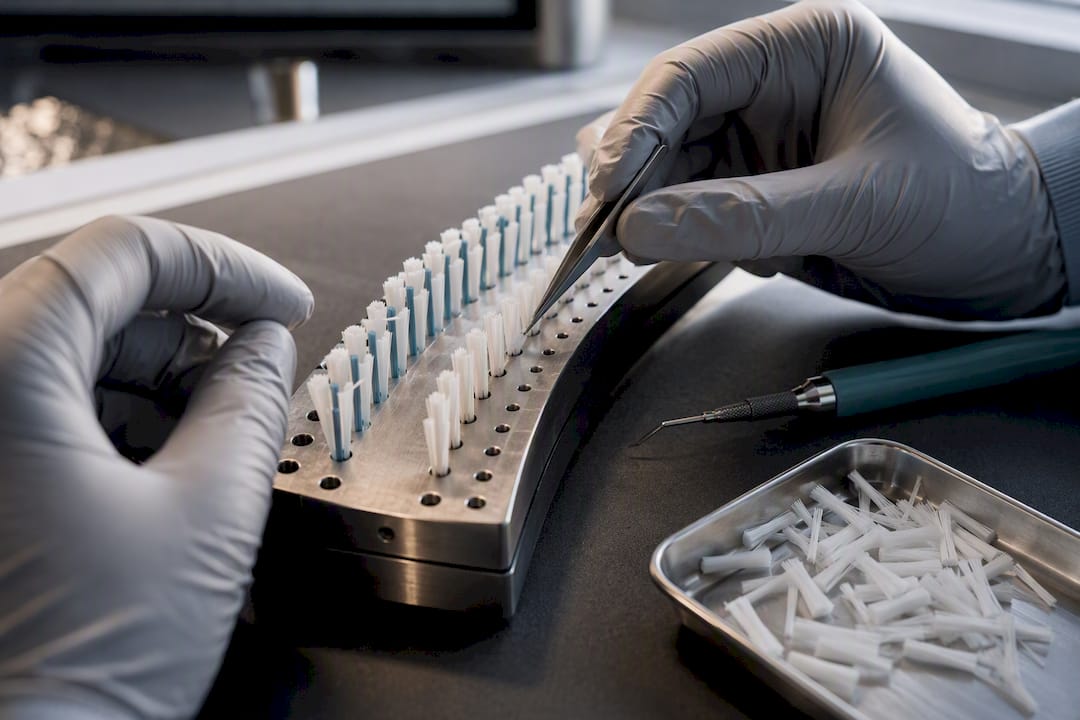
Adding sensors or cameras changes the cost and testing profile substantially. A camera-equipped brush needs waterproofing validation, data processing hardware, and often a companion app, none of which a purely mechanical design requires. That complexity is why electronic add-ons tend to get claimed only when they’re functionally tied to the brushing mechanism itself, rather than bolted on as an afterthought.
Y-brush’s own approach, a Y-shaped head designed to clean all tooth surfaces in a single 20-second sonic cycle, sits squarely in the head-geometry and drive-system categories this guide covers. It’s a useful case study precisely because it shows how a specific structural choice (the Y-shaped bristle arrangement) is meant to solve the same behavioral problem the ADA’s guidance highlights: most manual brushers fall far short of the recommended two-minute brushing time.
If you’re moving from concept sketch to prototype, a few checkpoints matter more than most inventors expect early on:
- Test tuft retention under repeated use, loose bristles are a common failure point in early prototypes.
- Validate durability across the toothbrush’s expected replacement cycle, generally three to four months per ADA guidance.
- Gather clinical or comparative evidence on cleaning performance before making efficacy claims publicly.
Pro Tip: Build your durability testing around the ADA’s replacement window rather than an arbitrary internal target. It gives you a defensible, industry-recognized benchmark when you eventually need to substantiate product claims.
Where Is Toothbrush Patenting Headed, and What Should Inventors Do Now?
The clearest trend line right now runs toward multi-layered bristle arrangements, modular head systems, and sensor fusion, cameras and pressure sensors combined into a single feedback loop rather than treated as separate add-ons. I’d argue the mechanical side of toothbrush patenting is far from exhausted, even though it looks like mature territory. Small structural tweaks to cam profiles, cavity shapes, or retention lugs still create genuinely defensible, non-infringing alternatives when they’re documented and tested properly.
My advice to inventors: build independent claims around the core geometric relationship, the tuft arrangement, the retention interface, the cam-to-cavity fit, and save performance tolerances and material choices for dependent claims. That structure protects the invention’s actual novelty without overreaching into territory an examiner will strip out anyway.
Use the search strategies and claim-reading framework here as your starting point, then bring a real claim chart to a patent attorney before you file or productize anything. The tools exist. Use them properly, and the guesswork mostly disappears.
— Joris
A Design Built Around the Same Tradeoffs
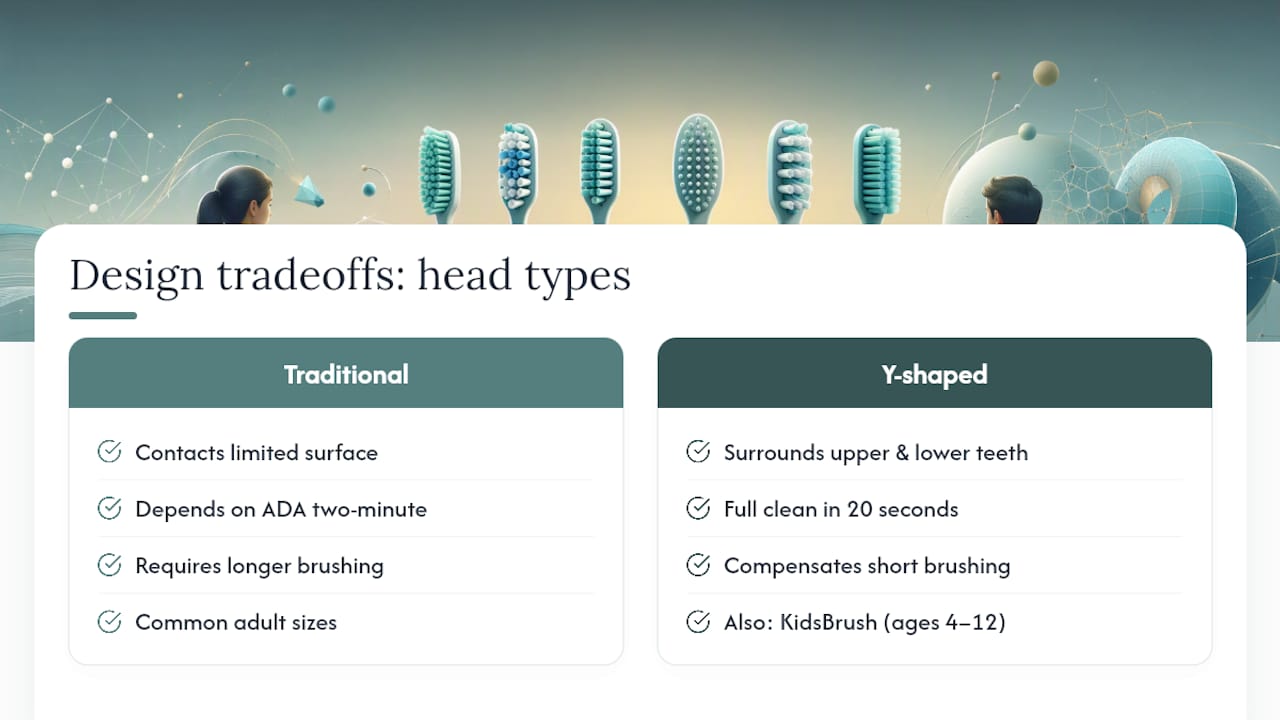
An Essential Sonic Toothbrush example shows the head-geometry and drive-system tradeoffs covered throughout this guide, engineered around a Y-shaped brush head that surrounds the upper and lower teeth simultaneously and delivers a full clean through sonic vibration in 20 seconds.
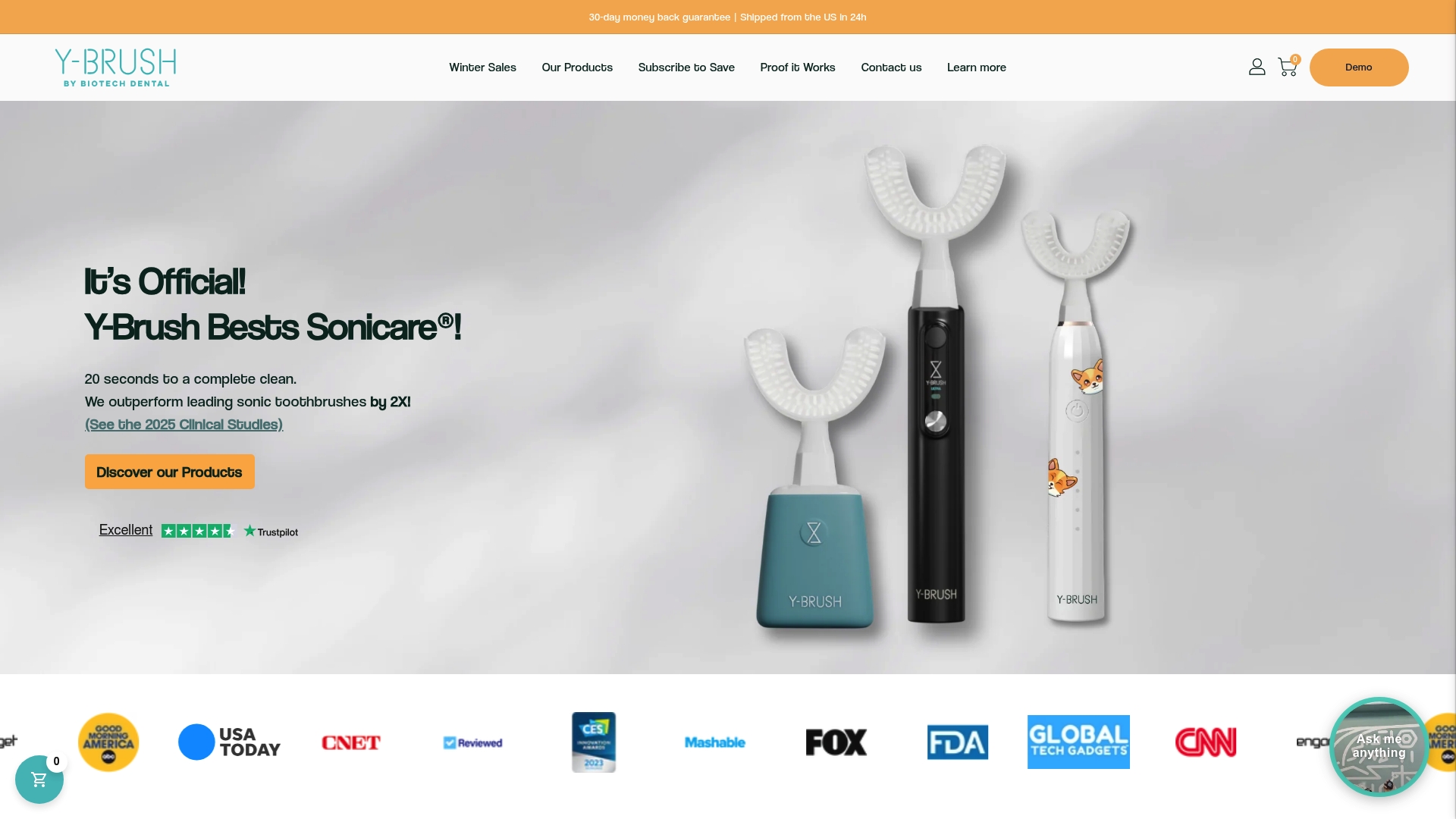
That geometry matters because it directly addresses the gap the ADA highlights: most people brush for a fraction of the recommended two minutes, and a head shape designed to contact more tooth surface at once compensates for that shortfall rather than asking users to change their habits. It’s the same design logic covered in the drive-mechanism and head-geometry sections above, applied to a finished, purchasable product rather than a patent claim on paper.
If you want to see how that head design translates into daily use, the Y-brush Essential Sonic Toothbrush product page walks through the specifics, and the KidsBrush version covers the same approach adapted for smaller mouths ages four to twelve.
Sources
Every source cited in this guide is worth bookmarking directly rather than relying on secondhand summaries, since patent claim language rewards a close read of the original document.
- Toothbrushes | American Dental Association
- Dyson’s Next Act Is an Electric Toothbrush With a Camera | WIRED
- US8955185B2 - Electric toothbrush with oscillatory head


