


Handle ergonomics improve comfort and control, and they matter most for people with limited dexterity, children, and older adults. For healthy adults, technique and brushing time usually outweigh handle design. A thicker grip or contoured neck can make brushing easier to sustain, but it works alongside brush head design and habit, not as a substitute for either.
TL;DR:
- Handle ergonomics benefits those with limited dexterity, children, or older adults, but has minimal impact on plaque removal in healthy adults.
- Thicker grips, thumb rests, rubberized textures, and angled necks improve control and comfort for users with physical limitations or joint issues.
- Standard handle design is less critical for healthy adults whose brushing effectiveness relies more on technique and duration than handle features.
- Customized handles and assistive attachments can significantly improve hygiene outcomes for users with reduced hand strength or coordination.
- Focus on brushing habit and head design rather than handle shape to achieve better oral health compliance and results.
Table of Contents
- What Toothbrush Handle Ergonomics Actually Means
- Who Benefits Most From Ergonomic Handles
- What the Research Says About Handle Ergonomics and Brushing Effectiveness
- Design Guidance: Dimensions, Neck Geometry, and Material Tradeoffs
- Customization and Assistive Attachments
- Design That Tackles the Real Problem: Habit, Not Just Handle Shape
- Practical Takeaways for Choosing or Adapting a Handle
- Why the Handle Debate Misses the Real Question
- A Toothbrush Built Around the Habit, Not Just the Grip
- Sources
What Toothbrush Handle Ergonomics Actually Means
“Ergonomic” gets stamped on packaging so often it has lost precision. In practice, toothbrush handle ergonomics refers to a specific set of design choices that change how much force, grip strength, and wrist rotation a person needs to clean their teeth well. Those choices show up in a handful of recurring features, each solving a distinct mechanical problem.
- Thicker diameters distribute grip force across more of the palm, reducing the fine motor strength needed to hold the brush steady.
- Thumb rests give a stable pivot point, which cuts down on the small stabilizing movements your hand otherwise makes throughout a two-minute session.
- Rubberized overmolds add friction, so a wet, soapy hand doesn’t have to squeeze as hard to keep control.
- Contoured or waisted midsections let the hand find the same position by feel every time, which matters more than it sounds for consistency night after night.
- Angled necks extend effective reach to the back molars without forcing the wrist into an awkward rotation.
- Balanced weight distribution keeps the head from feeling heavy or unwieldy mid-stroke, especially in electric models with motors housed in the handle.
Materials matter as much as shape. Textured silicone grips resist bacterial buildup better than porous foam inserts, and manufacturers increasingly favor smooth, closed-cell rubber precisely because it holds up to daily rinsing without harboring grime in seams and crevices.
Who Benefits Most From Ergonomic Handles
Not everyone needs to shop for handle ergonomics first. Healthy adults with normal grip strength and no joint pain can brush effectively with almost any handle shape, because their hands compensate automatically. The people who see a real, tangible difference fall into a few clear categories.
- Children, whose smaller hands and undeveloped fine motor control make standard adult-sized handles genuinely hard to manage.
- Older adults, particularly those with arthritis, reduced grip strength, or tremor, who benefit from thicker, lighter handles that need less sustained force.
- People with limited dexterity, including those recovering from stroke, living with cerebral palsy, or managing conditions like carpal tunnel syndrome.
- Caregivers brushing on behalf of someone else, who need a handle long and stable enough to control from an awkward angle.
A few practical signals suggest it’s time to prioritize ergonomics: dropping the brush mid-stroke, needing to switch hands to finish brushing, thumb or wrist pain during the routine, or a caregiver reporting that brushing takes far longer than it should.
Pro Tip: If pain or dropping persists even after switching to a thicker-handled brush, that’s a cue to talk to a dentist or occupational therapist about assistive attachments rather than cycling through more toothbrushes.
What the Research Says About Handle Ergonomics and Brushing Effectiveness
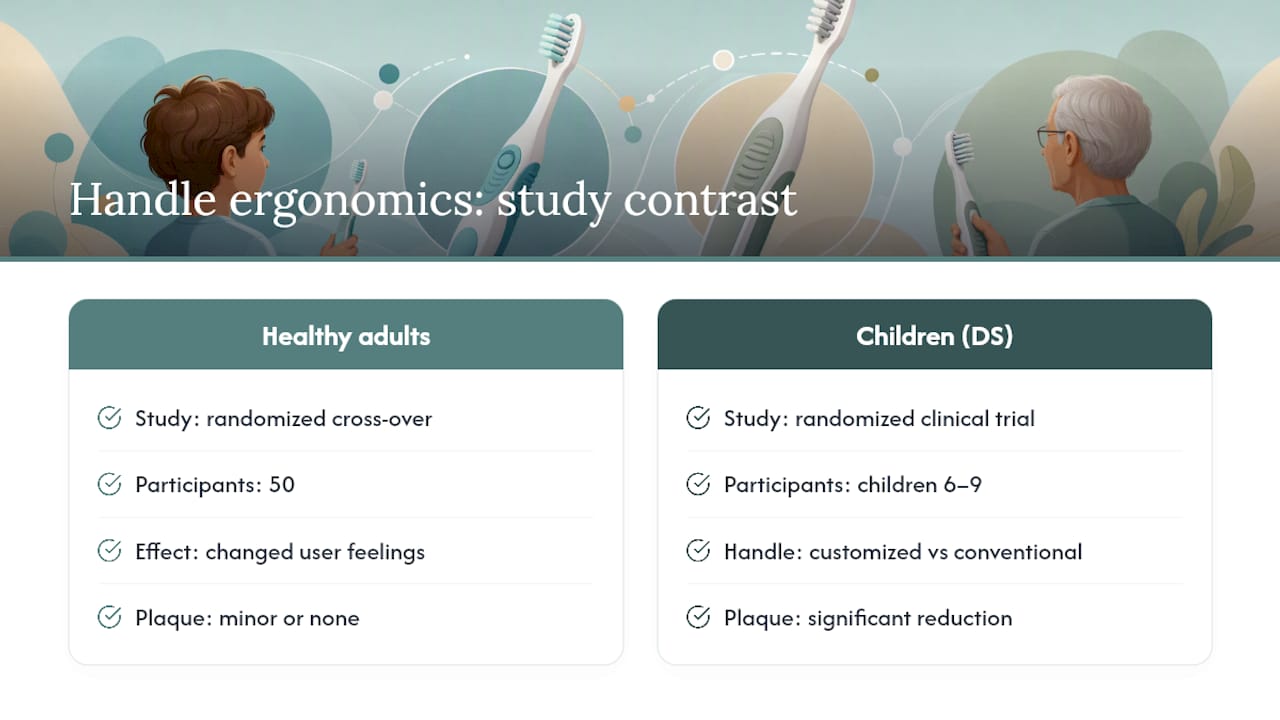
The evidence splits cleanly along one line: how much dexterity the user already has. For healthy adults, a randomized counterbalanced cross-over study with 50 participants found that different handle designs changed how people felt about their brushing far more than they changed actual plaque removal at the gum line. The measured differences in plaque were minor or nonexistent.
The researchers behind that study titled their findings almost as a warning to the industry: it is the habit, not the handle, that drives tooth brushing outcomes in people with normal manual dexterity.
For children with limited dexterity, the picture changes. A randomized clinical trial published in MDPI Healthcare tested customized handles against conventional ones in children with Down syndrome, ages 6 to 9, and found statistically significant reductions in both plaque accumulation and gingivitis in the customized-handle group.
That gap tells you something practical: handle design is not a universal lever. It becomes a meaningful clinical variable specifically when dexterity is already compromised. Meanwhile, bristle design and brushing duration tend to dominate outcomes across the board, which is why manufacturers keep innovating on brush heads even as handle shapes plateau.
Design Guidance: Dimensions, Neck Geometry, and Material Tradeoffs
Turning ergonomic theory into a buying or design decision comes down to four variables that interact more than most people expect.
- Grip diameter. Anthropometric research generally points toward a range of roughly 1.2 to 1.6 inches in diameter for adult hands, thick enough to reduce squeeze force without becoming unwieldy for smaller hands or children’s grips, which typically need something closer to the lower end of that range.
- Neck angle. A straighter neck favors stability and control near the front teeth; a more pronounced angle extends reach to the molars but can reduce leverage, which is a real tradeoff rather than a pure upgrade.
- Material selection. Rubberized grips outperform smooth plastic for wet-hand control, while PLA, the plastic commonly used in 3D-printed custom handles, offers a rigid, hygienic base that holds up to molding and daily cleaning.
- Head and bristle pairing. A comfortable handle paired with an oversized or poorly angled head still won’t reach the back molars effectively, so handle and head design need to be evaluated together, not separately.
Design case work from firms like Analogy shows this isn’t guesswork. Iterative user testing, not a single anthropometric chart, is what actually validates whether a grip geometry works across a range of real hands.
Customization and Assistive Attachments
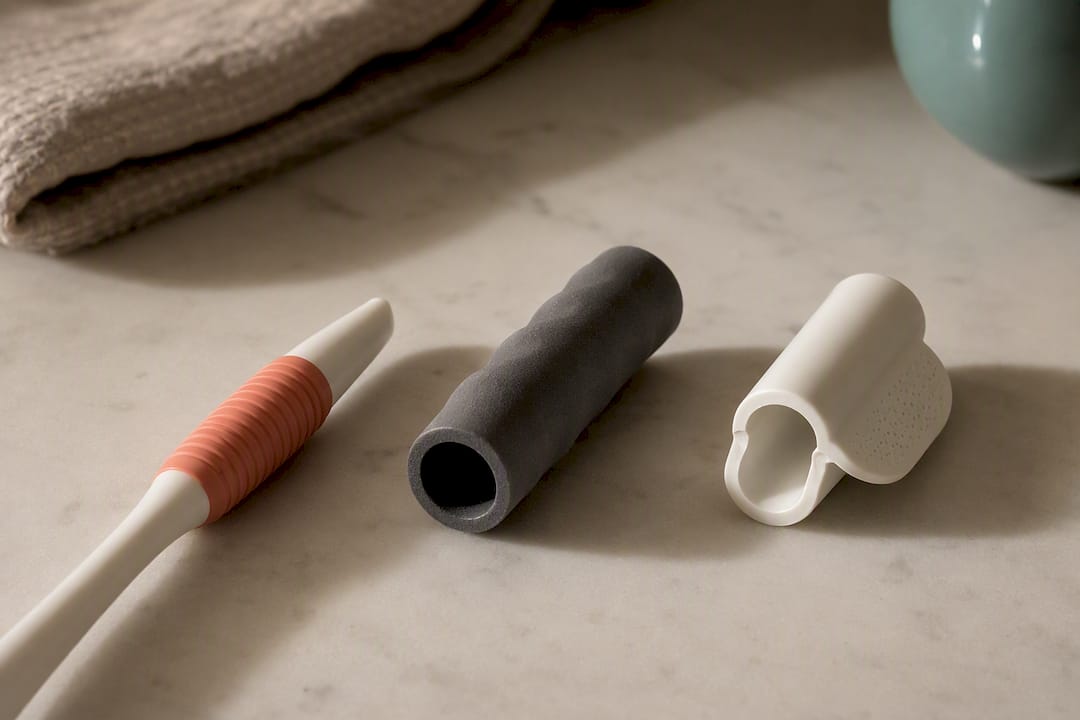
When a standard handle isn’t cutting it, you don’t necessarily need a new toothbrush. A few low-cost adaptations can solve grip problems immediately, and documented clinical and field use backs their effectiveness for people with limited dexterity.
- Foam bicycle grips or pool noodle segments slide over the handle to instantly increase diameter for an easier squeeze.
- Silicone sleeves, sold specifically for utensils and toothbrushes, add cushioning and a non-slip surface.
- Dental putty or moldable thermoplastic can be shaped around a user’s hand for a one-time custom fit.
- 3D-printed handles, typically produced in PLA from a mold of the user’s grip, then finished with a hygienic overmold for cleanability.
Pro Tip: Whatever adaptation you choose, never let it extend over the brush head or bristles. Check monthly for loose fittings, and replace silicone sleeves the moment they start to crack or peel, since damaged seams trap bacteria.
Design That Tackles the Real Problem: Habit, Not Just Handle Shape
Most people don’t struggle with grip. They struggle with time. The habitual gap between the recommended two minutes and the sub-one-minute brushing most people actually do is a design problem as much as a discipline problem, and it’s the gap Y-Brush was built to close.
A patented Y-shaped head can be designed to deliver a full clean in about 20 seconds using sonic vibrations, which could sidestep endurance problems that undermine longer brushing times.
- Such designs may target better compliance by reducing the time investment brushing requires.
- It reflects the same principle the research supports: handle comfort matters but pairing it with smart head design is what changes outcomes.
- Membership-based replacement head plans keep the hygiene and sustainability side of the equation simple for ongoing use.
This approach does not claim to outperform manual brushing on plaque removal clinically but aims to fit into lives where two full minutes, twice a day, rarely happens as planned.
Practical Takeaways for Choosing or Adapting a Handle
Handle choice should follow your actual constraints, not marketing language. If grip strength, dexterity, or pain are issues, prioritize ergonomic features first. If you’re a healthy adult with no grip complaints, put your attention on brush head design and consistent brushing time instead, since that’s where the evidence says the bigger gains live.
Try the in-store test: hold the brush as if brushing, and check whether your thumb finds a natural rest point without straining. At home, inspect any grip attachment monthly for cracking or looseness.
| Situation | Priority | Quick check |
|---|---|---|
| Healthy adult, no grip issues | Head design, brushing time | Time yourself; aim for 2 minutes |
| Limited dexterity or arthritis | Thick grip, rubberized texture | Thumb rests naturally, no squeezing |
| Child brushing independently | Smaller diameter, lighter weight | Child can hold it without dropping |
| Caregiver-assisted brushing | Longer handle, stable neck angle | Full mouth reachable at a comfortable angle |
The right handle supports a routine you’ll actually keep. The habit is still what does the work.
Why the Handle Debate Misses the Real Question
The conventional wisdom on toothbrush ergonomics treats handle shape as a clinical variable on par with bristle design, and the research doesn’t support that equivalence. For most healthy adults, a fatter grip or a fancier contour changes how brushing feels, not how clean teeth get. That’s not a knock against ergonomic design. It’s a correction to how it gets marketed.
Where handle design earns its keep is compliance, not clinical superiority. A brush that’s comfortable enough to pick up every night, easy enough for a child to hold without frustration, or stable enough for a caregiver to control, is a brush that actually gets used. That’s a behavioral outcome, and behavioral outcomes are where oral hygiene is won or lost.
If you take one thing from the evidence, take this: buy for dexterity needs first if they exist, then buy for a head and habit that you’ll sustain. Comfort earns its value by keeping you consistent, not by promising a clean a handle alone can’t deliver.
— Joris
A Toothbrush Built Around the Habit, Not Just the Grip
Y-Brush is built for exactly that gap. Its patented Y-shaped head cleans in about 20 seconds using sonic vibrations, designed for people whose real obstacle isn’t grip comfort but simply finding two uninterrupted minutes, twice a day.
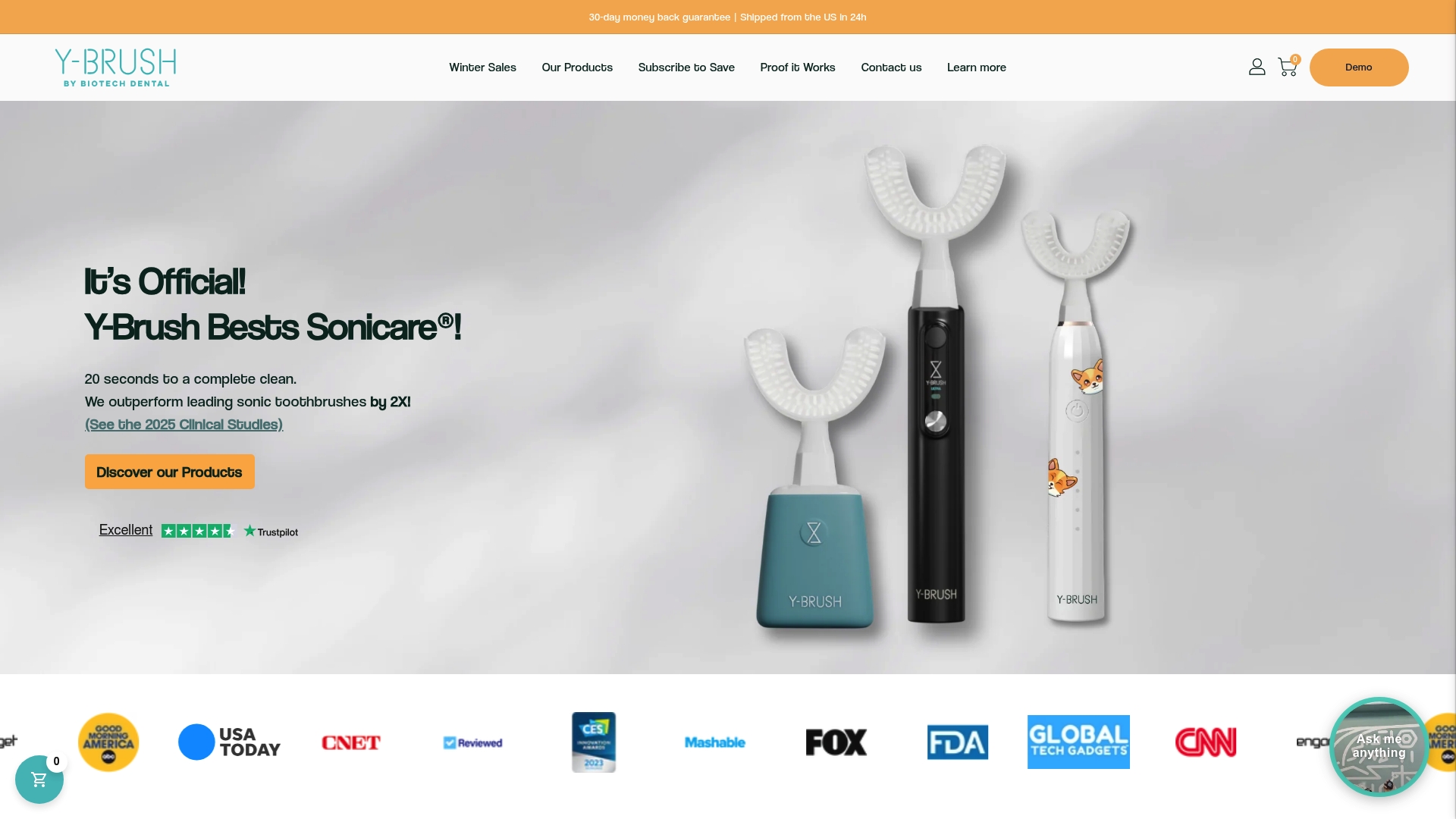
For adults who want a faster daily routine without abandoning thoroughness, the Y-Brush Essential Sonic Toothbrush is the starting point. Parents managing a child’s resistance to brushing might look at the Y-Brush KidsBrush Sonic Electric Toothbrush, sized for ages 4 to 12 and built around the same short-session logic. Either way, a membership plan keeps replacement heads arriving on schedule, so the habit never breaks down over a missing part. If your current routine depends on willpower more than design, that’s the signal to try something different tonight.
Sources
- It is the habit not the handle that affects tooth brushing - a randomized counterbalanced cross over study with young and healthy adults | BMC Oral Health
- Customized handle toothbrush improves plaque control in children with Down syndrome (MDPI Healthcare)
- Comparison of Manual Toothbrushes with Different Bristle Designs in Terms of Cleaning Efficacy and Plaque Control: A Pilot Study
- How often to brush your teeth (Cleveland Clinic Health Essentials)


