


The most common oral care myths debunked in one place: brushing harder does not clean better, bleeding gums are not normal, flossing is not optional, and whiter teeth do not mean healthier teeth. The American Dental Association (ADA) and CDC both confirm that most tooth loss and gum disease are preventable with consistent, evidence-based habits — not viral hacks or harder scrubbing. Y-brush is built on the same principle: effective cleaning does not require more time or more pressure, just the right approach.
Here are the most dangerous myths, corrected in one line each:
- Brushing harder cleans better. False. Pressure damages enamel and gums.
- Flossing is optional. False. Brushing misses up to 40% of tooth surfaces.
- Bleeding gums are normal. False. They signal gingivitis.
- Sugar alone causes cavities. False. Fermentable carbs and bacteria are the real mechanism.
- Oral health is separate from overall health. False. Gum disease links to cardiovascular disease and diabetes.
- Baby teeth don’t matter. False. Decay causes pain, infection, and affects permanent teeth.
- Whiter teeth are healthier teeth. False. Cosmetic brightness does not indicate absence of decay.
- Charcoal toothpaste is safe and effective. False. It is abrasive and lacks fluoride.
- Chewing gum replaces brushing. False. It stimulates saliva but cannot remove plaque.
- Wait until pain to see a dentist. False. Cavities and gum disease progress silently.
If you are experiencing persistent bleeding, swelling, or tooth pain, schedule a dental appointment promptly rather than waiting for symptoms to worsen.
Table of Contents
- Oral care myths debunked: the full evidence-based breakdown
- When should you see a dentist? Red flags that need prompt attention
- Evidence-based daily habits that replace myth-driven routines
- Why oral health myths persist and how to evaluate new dental claims
- Key Takeaways
Oral care myths debunked: the full evidence-based breakdown
1. Brushing harder cleans better

Myth: More pressure means a deeper clean.
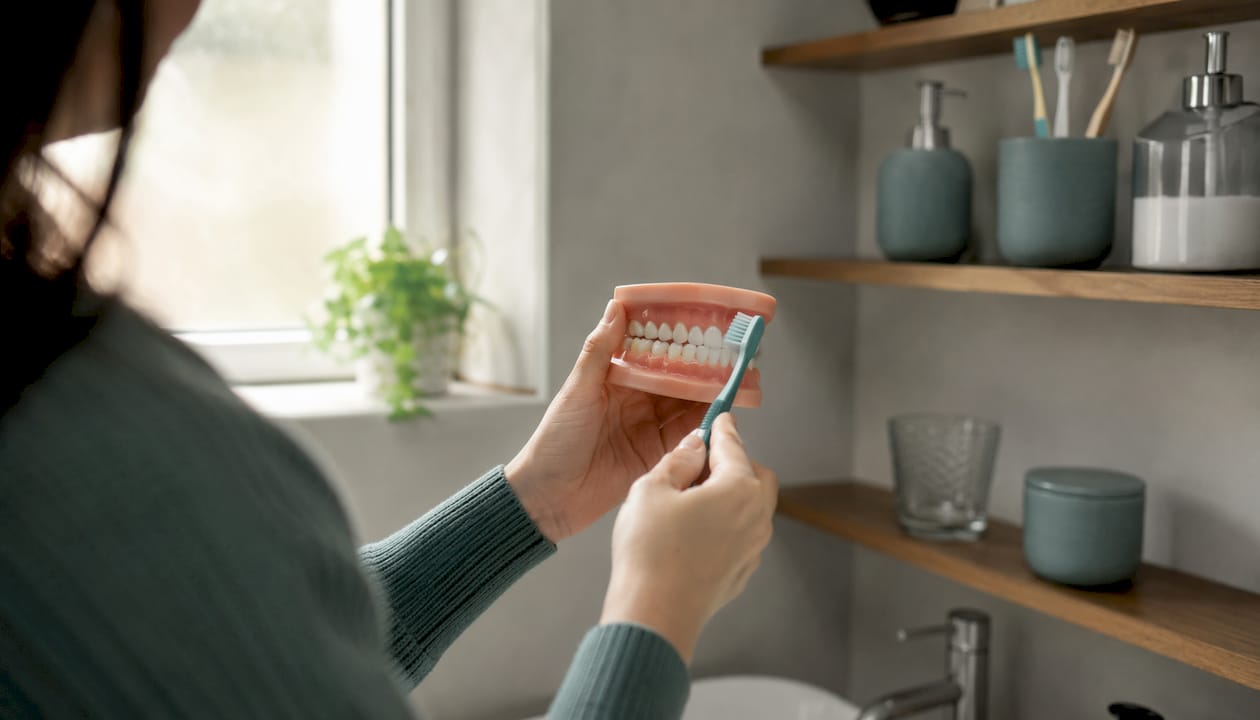
Why that’s wrong: Excessive pressure and hard bristles wear down enamel and cause gum recession, which leads to sensitivity and long-term structural damage. Plaque is a soft biofilm; it does not require force to remove.
What to do instead: Use a soft-bristle brush at a 45° angle to the gumline with gentle circular strokes. The ADA recommends brushing for two full minutes, twice daily, with light pressure. Y-brush’s sonic vibration technology does the mechanical work for you, removing the guesswork from technique entirely.
Clinician note: Gum recession from overbrushing is irreversible without professional treatment.
2. Flossing is optional
Myth: If you brush well, flossing adds nothing.
Why that’s wrong: A toothbrush physically cannot reach the spaces between teeth. Plaque that accumulates there causes interproximal cavities and gum disease regardless of how thorough your brushing is.
What to do instead: Floss before brushing — not after. Removing debris first allows the fluoride in your toothpaste to reach between teeth and remineralize those surfaces more effectively. Daily flossing is the standard; once is enough when done consistently.
Clinician note: Flossing before brushing increases fluoride exposure to interproximal surfaces, improving overall remineralization.
3. Bleeding gums are a sign you’re brushing too hard
Myth: Gums bleed because you’re being too aggressive.
Why that’s wrong: Bleeding gums during brushing or flossing usually indicate gingivitis or inflammation from plaque buildup, not mechanical trauma. Healthy gums do not bleed.
What to do instead: Do not stop flossing when gums bleed. Consistent, gentle cleaning typically reduces bleeding within two weeks as inflammation resolves. Persistent bleeding beyond that warrants a dental evaluation.
4. Sugar is the only cause of cavities
Myth: Cut sugar, and you won’t get cavities.
Why that’s wrong: Fermentable carbohydrates — bread, crackers, chips — feed the same oral bacteria that produce cavity-causing acids. Frequency of exposure matters as much as quantity. Sipping a sugary drink slowly over an hour is more damaging than drinking it quickly.
What to do instead: Reduce snacking frequency, rinse with water after eating when brushing is not immediately possible, and wait 30–60 minutes before brushing after acidic foods or drinks. Saliva needs time to neutralize acids before mechanical cleaning begins.
5. Oral health has nothing to do with your overall health
Myth: Dental problems stay in your mouth.
Why that’s wrong: Research published in the National Institutes of Health database links periodontal disease to cardiovascular disease, diabetes complications, and adverse pregnancy outcomes. The mouth is not isolated from systemic circulation. Bacteria from infected gums can enter the bloodstream and contribute to inflammation elsewhere in the body.
What to do instead: Treat gum disease as a whole-body concern. People managing diabetes should be especially attentive, as the diabetes-oral health connection runs in both directions: gum disease can make blood sugar harder to control.
6. Baby teeth don’t matter because they fall out anyway
Myth: Primary teeth are temporary, so cavities in them are no big deal.
Why that’s wrong: Decay in baby teeth causes pain, infection, and can damage the developing permanent teeth beneath them. Primary teeth also hold space in the jaw; losing them early can lead to crowding and alignment problems later.
What to do instead: Brush children’s teeth as soon as they appear, limit sugary drinks in bottles or sippy cups, and schedule the first dental visit by age one. The Y-brush KidsBrush is designed specifically for ages 4–12, making it easier to build consistent habits early.
7. Whiter teeth are healthier teeth
Myth: A bright smile means a healthy mouth.
Why that’s wrong: Tooth color is largely determined by genetics, diet, and age. Whitening products address surface staining, not structural health. You can have gleaming white teeth with active decay on your back molars or significant gum disease below the gumline.
What to do instead: Prioritize decay prevention and gum health over cosmetic brightness. If whitening is a goal, discuss it with your dentist to choose a method that does not compromise enamel.
8. Charcoal toothpaste and DIY trends are safe and effective
Myth: Natural or viral products are gentler and work just as well.
Why that’s wrong: Charcoal toothpastes are abrasive, lack fluoride, and can accelerate enamel wear. Social media trends like purple toothpaste and oil pulling create optical or temporary effects rather than improving structural tooth health. Dentists consistently advise prioritizing evidence-based, fluoride-supported care over viral hacks.
What to do instead: Choose an ADA-accepted fluoride toothpaste. If a product does not carry ADA approval, treat its claims with skepticism regardless of how compelling the before-and-after photos appear.
9. Chewing gum can replace brushing
Myth: Sugar-free gum cleans your teeth.
Why that’s wrong: Sugar-free gum stimulates saliva production and temporarily reduces acid levels, which is genuinely useful. But saliva cannot mechanically remove the plaque biofilm that adheres to tooth surfaces. Only brushing and flossing accomplish that.
What to do instead: Use sugar-free gum as a short-term adjunct after meals when brushing is not possible, not as a substitute for your morning and evening routine.
10. Rinsing after brushing makes your mouth cleaner
Myth: Rinsing with water after brushing washes away residue and finishes the job.
Why that’s wrong: Rinsing immediately after brushing removes the concentrated fluoride that toothpaste deposits on your enamel. That fluoride needs time to work. Washing it away defeats a significant portion of the toothpaste’s protective benefit.
What to do instead: Spit out excess toothpaste but do not rinse. Wait a short period before drinking or rinsing to allow fluoride to work effectively. If you use mouthwash, use it at a separate time from brushing, not immediately after.
11. Mouthwash replaces brushing and flossing
Myth: A good rinse is enough to keep your mouth clean.
Why that’s wrong: Mouthwash supplements mechanical cleaning but cannot remove plaque on its own. Liquid cannot dislodge the biofilm that adheres to tooth surfaces; only physical scrubbing does that.
What to do instead: Use mouthwash as a finishing step at a different time than brushing, or as a midday refresh. It adds fluoride exposure and reduces bacteria, but it is not a substitute for the brush and floss.
12. Tooth loss is mostly genetic
Myth: If your parents lost teeth, you will too.
Why that’s wrong: Genetics can influence susceptibility to gum disease or decay, but lifestyle habits and oral hygiene practices are equally significant factors. Most tooth loss results from untreated gum disease and decay, both of which are preventable with consistent care and regular professional checkups.
What to do instead: If you have a family history of gum disease, tell your dentist. More frequent monitoring may be appropriate, but it does not mean tooth loss is inevitable.
Myth vs. reality: quick reference
| Myth | Reality | Replacement behavior |
|---|---|---|
| Brush harder for a deeper clean | Pressure damages enamel and gums | Soft bristles, 45° angle, gentle strokes |
| Flossing is optional | Brushing misses interproximal surfaces | Floss daily, before brushing |
| Bleeding gums are normal | Usually indicates gingivitis | Consistent gentle flossing; see dentist if it persists |
| Sugar alone causes cavities | Fermentable carbs + bacteria + frequency | Reduce snacking; rinse after eating |
| Charcoal toothpaste is safe | Abrasive, no fluoride, wears enamel | Use ADA-accepted fluoride toothpaste |
| Rinse after brushing | Removes protective fluoride | Spit only; wait 20–30 minutes |
| Mouthwash replaces brushing | Cannot remove plaque biofilm | Use as a supplement, not a substitute |
When should you see a dentist? Red flags that need prompt attention
Some myth-driven habits delay care long enough for minor problems to become serious ones. Knowing which signs require prompt action can prevent that.
Bleeding that persists beyond two weeks of consistent flossing is not resolving on its own. Schedule a dental appointment rather than waiting for a routine checkup. Swelling in the gums or jaw, persistent bad breath that does not respond to brushing, and teeth that feel loose are all signs of active infection or advanced gum disease. These warrant a visit within days, not weeks.
Tooth pain is a late signal. Cavities and gum disease progress silently for months or years before causing discomfort. By the time pain appears, the damage is often significant enough to require more invasive treatment. Tooth pain that is sharp, throbbing, or worsening should be treated as urgent. Do not wait for a scheduled appointment if pain is severe.
Routine six-month checkups remain the most effective way to catch problems early, according to practitioners who observe that generational folklore and simplified marketing drive most delays in seeking care. A checkup that finds nothing wrong is not wasted money. It is confirmation that your habits are working. For a clear list of signs that should prompt an earlier visit, 10 signs you need a checkup is a practical reference.
Evidence-based daily habits that replace myth-driven routines
The following habits are aligned with ADA and CDC guidance and directly replace the behaviors the myths above promote.
Daily checklist:
- Floss before brushing, once daily
- Brush twice daily for two full minutes with a soft-bristle brush
- Use an ADA-accepted fluoride toothpaste; spit, do not rinse
- Clean your tongue to reduce bacteria and bad breath
- Wait 30–60 minutes before brushing after acidic foods or drinks
- Use mouthwash at a separate time from brushing, not immediately after
Technique matters as much as frequency. Hold your brush at a 45° angle to the gumline. Use short, gentle circular strokes rather than long horizontal scrubs. Cover all surfaces: outer, inner, and chewing. Two minutes is the minimum; most people underestimate how long that actually is until they time themselves.
| Routine step | Why it matters | How to do it |
|---|---|---|
| Floss before brushing | Clears debris so fluoride reaches between teeth | Gently slide floss between each tooth; curve around the base |
| Brush twice daily | Removes plaque before it hardens into tartar | Soft bristles, 45° angle, two minutes, light pressure |
| Wait after acidic foods | Enamel is temporarily softened by acid | Rinse with water; brush after 30–60 minutes |
| Skip the post-brush rinse | Preserves fluoride on enamel | Spit only; no water rinse for at least 20 minutes |
| Mouthwash separately | Adds fluoride and reduces bacteria without washing away toothpaste fluoride | Use midday or before bed, not right after brushing |
Pro Tip: Habit-stack your flossing onto an existing cue — right after washing your face at night, for example. Attaching a new behavior to an established one dramatically increases the likelihood it sticks.
Why oral health myths persist and how to evaluate new dental claims
Myths persist because visual or anecdotal cues outpace underlying clinical evidence. A product that makes teeth look whiter in a photo is compelling in a way that a clinical trial abstract is not. Social media trends and color-theory marketing — purple toothpaste being a recent example — create optical illusions rather than structural improvements, yet they spread because the before-and-after images are persuasive. Generational folklore compounds the problem: habits passed down from parents carry emotional authority that published research rarely matches.
Marketing oversimplification is another driver. “Natural” is positioned as synonymous with “safe,” and “whitening” with “healthy,” even when neither claim holds up clinically. Cognitive shortcuts do the rest: if something feels cleaner or looks brighter, the brain registers it as better.
How to evaluate a dental claim before adopting it:
- Does it have a clinical trial behind it, not just testimonials?
- Does it carry ADA acceptance or endorsement?
- Does it contain fluoride, or does it actively avoid it?
- Is the evidence mechanism-based (explains why it works) or purely anecdotal?
- Is the source a dental professional or a content creator?
Pro Tip: When a dental product goes viral, search for it on the ADA’s website before trying it. If it is not listed, that absence is itself informative.
Key Takeaways
Most oral care myths share a common flaw: they substitute intuition or aesthetics for mechanism, and the result is habits that feel right but cause measurable harm over time.
| Point | Details |
|---|---|
| Technique beats pressure | Soft bristles and a 45° angle remove plaque without damaging enamel or gums. |
| Floss before brushing | Clearing debris first allows fluoride to reach between teeth and remineralize surfaces. |
| Skip the post-brush rinse | Rinsing immediately after brushing removes protective fluoride; spit only and wait 20–30 minutes. |
| Mouthwash supplements, not replaces | Liquid cannot remove plaque biofilm; use mouthwash at a separate time from brushing. |
| Routine checkups catch silent problems | Cavities and gum disease progress without pain; six-month exams remain the most effective prevention. |
If you notice persistent bleeding, swelling, loose teeth, or tooth pain, contact a dentist promptly rather than waiting for a scheduled visit.
The case for getting your oral care right the first time
There is a pattern worth naming in how oral care myths spread: they tend to promise more with less. Harder brushing, a viral rinse, a charcoal paste. The appeal is real because good oral hygiene does feel like effort, and anything that promises to shortcut it is tempting.
What the evidence actually shows is that the fundamentals are not complicated, but they do require consistency. Flossing daily, brushing with the right technique, choosing fluoride, and seeing a dentist twice a year will outperform any trending product on the market. The myths persist not because people are careless but because the marketing around dental products is often louder than the clinical guidance.
Y-brush was built on a different premise: that most people already know what they should do, but the tools available make it harder than it needs to be. A complete clean in 20 seconds via sonic vibration is not a shortcut around good technique. It is a design that removes the friction so the right habit actually happens. If you are ready to replace myth-driven routines with something that works, the Y-brush Essential Sonic Toothbrush is a direct, evidence-aligned place to start.
Authoritative sources and further reading
The sources below represent the highest-authority references used in this article. For any oral health concern, the ADA and CDC remain the most reliable starting points for evidence-based guidance.
| Source | Description |
|---|---|
| American Dental Association — MouthHealthy | ADA’s patient-facing resource on the oral-systemic health connection, including diabetes. |
| National Institutes of Health — PMC | Peer-reviewed research on the link between periodontal disease and systemic conditions. |
| Northwell Health — Oral Health Myths | Clinical corrections on rinsing, mouthwash, and bleeding gums from a major health system. |
| Dentist Decoded — Dental Myths | Dentist-authored debunks covering brushing pressure, charcoal toothpaste, and acidic foods. |
| Forbes — Dental Myths | Clinician-sourced guidance on flossing order, social media trends, and DIY dental hacks. |
| ToothTalk — Oral Care Myths | Evidence-based corrections on sugar, chewing gum, and the value of routine checkups. |
For personalized advice, the ADA’s Find-a-Dentist tool can help you locate a licensed dental professional in your area. This article is general health information, not a substitute for professional dental advice. Confirm current recommendations with your dentist for your specific situation.


