


Angled bristles typically remove more plaque from between your teeth than flat-trim bristles, especially in the short term. That edge comes from lab and clinical evidence, not marketing copy, and it comes with one important caveat.
- Verdict: Angled or cross-angled bristle designs generally outperform flat trims for interproximal (between-teeth) plaque removal, particularly over the first few weeks of use.
- Safety first: Regardless of bristle cut, the American Dental Association recommends soft bristles to avoid wearing down gum tissue.
- What’s next: The sections below break down why angled bristles work mechanically, what the research actually shows, and how to shop for a brush head that fits your routine.
Key Takeaways
Angled and multilevel bristle designs generally clean interproximal areas better than flat trims in the short term, but soft bristles matter more than bristle angle for long-term gum safety.
| Point | Details |
|---|---|
| Angled bristles win short-term | Cross-angled designs show a medium effect size for plaque reduction in early use, per systematic review data. |
| Long-term gap narrows | Advantage largely disappears in longer follow-up, so technique and time matter as much as bristle shape. |
| Softness is non-negotiable | The ADA recommends soft bristles regardless of angled or flat cut to limit gum abrasion. |
| 16° is the engineering sweet spot | Lab models show a 16° incline boosts penetration about 15% and shear force about 60% versus vertical bristles. |
| Y-Brush aligns with the checklist | Its Y-shaped sonic head uses soft filaments and surrounding coverage to deliver a full clean in 20 seconds. |
Table of Contents
- How Angled vs Flat Bristles Differ Mechanically
- What Does the Research Say About Angled and Flat Bristles?
- How Should You Choose Bristle Style When Shopping?
- Where Y-Brush Fits the Evidence-Backed Checklist
- What the Angled vs. Flat Debate Actually Settles
- Get a Full Clean Without Fighting the Clock
- Sources
How Angled vs Flat Bristles Differ Mechanically
The difference comes down to geometry, not marketing. A flat-trim brush head presents bristles in a single, even plane. When that flat surface meets a tooth, most of the bristle tips press against the visible front and back surfaces, and comparatively few make it into the tight gap between teeth.
Angled bristles slant at a fixed degree instead of standing straight up. That tilt changes two things at once: how deep the tips reach into approximal (between-tooth) spaces, and how much shear force they generate against the tooth surface as they bend and release. Shear force is the sideways scrubbing action that actually dislodges plaque, as opposed to just tapping against enamel.
An engineering model and matching lab experiments found that a 16° filament incline increased penetration into approximal areas by about 15% and boosted transversal shear force by roughly 60%, compared to bristles standing straight up. That 16° figure has become something of an industry benchmark, which is why you’ll see it referenced on packaging for angled-bristle brush heads.
Pro Tip: If a product page cites a specific bristle angle like “16°,” that’s a signal the manufacturer engineered the head around penetration and shear force, not just appearance.
Several other design elements interact with bristle angle to determine real-world performance:
- Filament length — longer filaments flex more and can reach slightly further into gaps, though they trade off some stiffness.
- Bristle stiffness — softer filaments bend more easily around tooth surfaces without gouging gum tissue.
- Tuft arrangement — multilevel or staggered tufts (mixing heights) tend to hug the tooth’s contour better than one flat row.
- Head size — a compact head maneuvers into back molars and behind teeth more easily than a large paddle-shaped head.
- Brushing motion — oscillating, rotating, or sonic vibration changes how angled bristles interact with the tooth surface compared to a simple back-and-forth manual stroke.
None of these factors work in isolation. A steep bristle angle on a stiff, oversized head won’t outperform a well-designed flat brush with soft, multilevel bristles.
What Does the Research Say About Angled and Flat Bristles?
The evidence leans toward angled and cross-angled designs, but it’s not a landslide, and the advantage doesn’t always hold up over time.
A 2024 systematic review pooling nine studies and 20 comparisons found a medium effect size favoring cross-angled bristle configurations for short-term plaque reduction (SMD = 0.75). Follow-up testing over longer periods, though, showed that advantage essentially disappeared (SMD = -0.06), meaning angled bristles clean better out of the gate, but consistent technique and time matter more once you’ve been brushing with either style for weeks.
The ADA’s own guidance on toothbrushes echoes this pattern: multi-level and angled bristle arrangements often beat flat trims for plaque removal, but the ADA still recommends soft bristles across the board to limit gum abrasion. Effectiveness and safety are separate questions, and a good brush head answers both.
Other findings back up the short-term pattern:
- A randomized clinical trial comparing an oscillating power brush with angled tufts against a standard flat-trim manual brush found more than double the interproximal plaque reduction after six weeks.
- A 2023 robot-simulation study testing brushing motions mechanically found that longer, softer, multilevel filaments consistently outperformed short, stiff, flat-trim designs.
- A separate review found tapered-tip bristles often edge out end-rounded bristles for interproximal plaque and gum health in some comparisons, reinforcing that tip shape matters alongside angle.
The short-term signal is consistent across a lab model, a robot simulation, and a human clinical trial: angled, tapered, multilevel bristles reach places flat trims often miss. What’s less certain is whether that gap stays open after months of real-world use with proper technique.
| Criteria | Angled bristles | Flat bristles |
|---|---|---|
| Interproximal penetration | Higher, especially at ~16° incline | Lower, tips mostly meet flat surfaces |
| Whole-mouth plaque reduction | Moderate to strong short-term edge | Adequate with correct technique |
| Short-term vs. long-term effect | Clear early advantage, narrows over time | Comparable once technique is consistent |
| Gingival abrasion risk | Similar to flat if bristles are soft | Similar to angled if bristles are soft |
| Best fit by routine | Fast brushes, technique inconsistent | Thorough brushes with full 2-minute habit |
Want more of the underlying evidence? Y-Brush breaks down what the research shows on toothbrush effectiveness in more depth.
How Should You Choose Bristle Style When Shopping?
Start with your actual brushing habits, not the label on the box. If you’re consistently rushed, or you know interdental cleaning is your weak spot, angled or tapered bristles give you a built-in advantage that doesn’t depend on flawless technique. If you already brush the full two minutes with deliberate, methodical strokes, a well-made flat-trim brush can perform nearly as well.
Here’s a practical checklist for reading the packaging or product page:
- Bristle softness first. Soft or extra-soft, always, regardless of angle or shape.
- Tapered vs. end-rounded tips. Tapered tips tend to slip into gaps more easily; end-rounded tips are gentler on exposed root surfaces.
- Look for a stated angle. Products citing a specific degree (like 16°) have usually been engineered and tested for penetration, not just styled to look angled.
- Head size. Smaller heads reach back molars and awkward angles more reliably than large heads.
- Replacement head availability. A brush is only as good as your willingness to replace worn bristles every 3 months, so check that heads are easy to reorder.
Bristle geometry helps, but it doesn’t replace proper brushing technique or adequate time. The most consistent real-world factor in plaque removal remains how long and how thoroughly you brush; angled bristles narrow the margin for error, they don’t erase it.
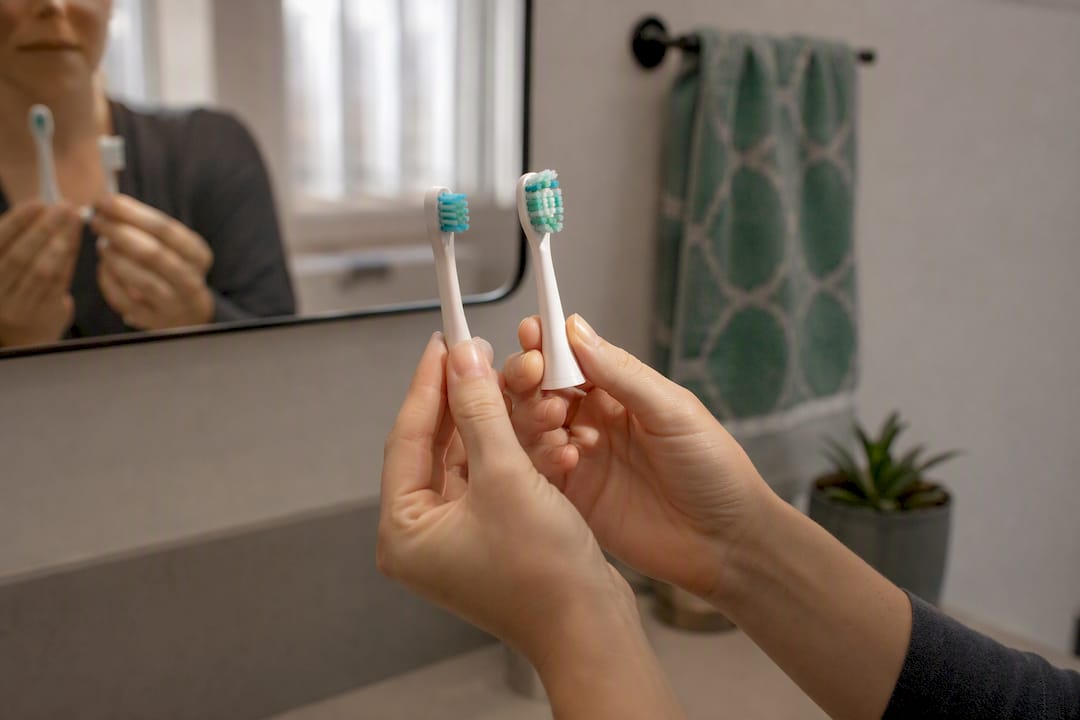
Pro Tip: When you’re choosing between two brush heads, pick up the box and check the head size against your own mouth. A compact head with flexible, tapered filaments often beats a larger “full coverage” head simply because it actually reaches where plaque hides.
If orthodontic brackets, bridgework, or gum recession are part of your situation, angled and multilevel bristles tend to help more, since they’re built to navigate irregular surfaces rather than a flat row of teeth.
Where Y-Brush Fits the Evidence-Backed Checklist
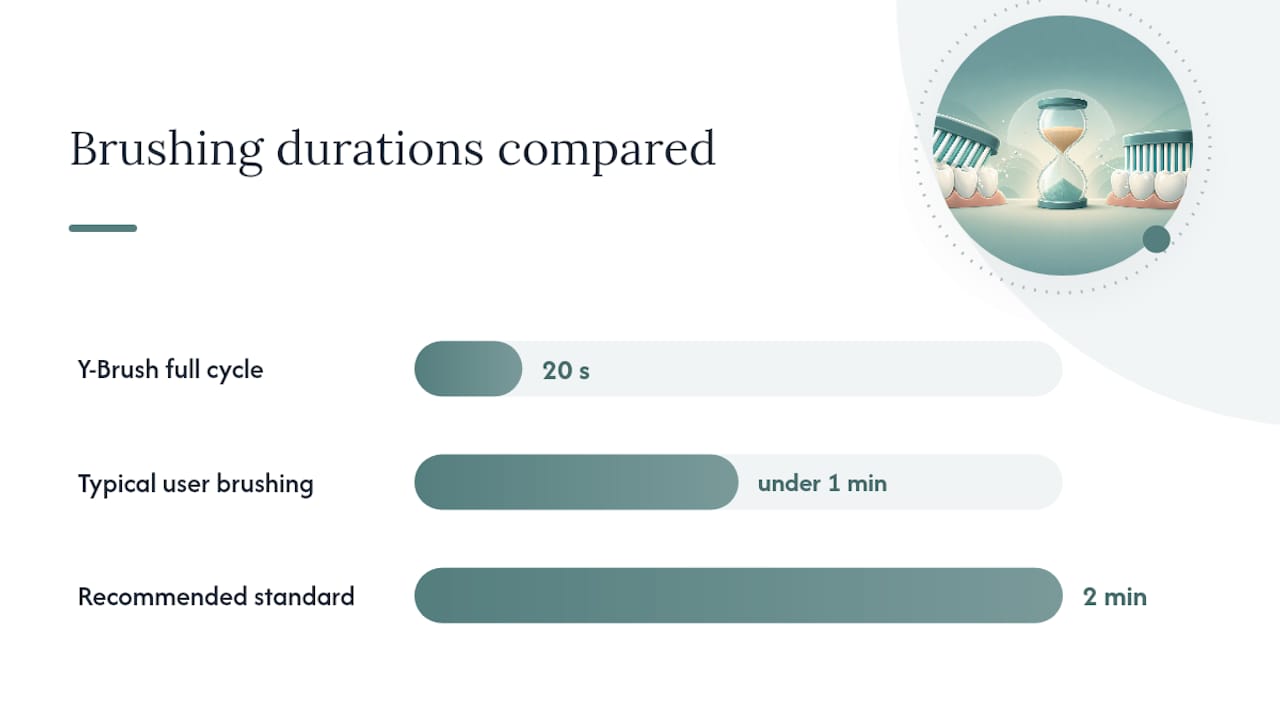
Y-Brush built its Essential Sonic Toothbrush around a patented Y-shaped head that surrounds teeth on multiple sides at once, paired with sonic vibration for a full clean in 20 seconds. That matters given that most people brush under a minute despite knowing the two-minute standard.
The design maps directly onto the criteria above:
- Soft filaments across the head, in line with ADA guidance on minimizing gum abrasion.
- Compact, surrounding coverage instead of relying on a single flat plane to reach every surface.
- Replacement heads available on a regular schedule, so bristles don’t overstay their effective lifespan.
- Options for kids and a premium Ultra pack for households wanting variants.
| Shopper profile | Why it fits |
|---|---|
| Rushed brushers who skip 2 minutes | 20-second sonic cleaning cycle addresses time as the limiting factor |
| Families with kids resistant to brushing | Dedicated kids’ model with age-appropriate design |
| Anyone replacing worn bristles inconsistently | Membership plans with regular refill heads |
For readers whose routine already runs short, that time-saving design addresses the biggest real-world gap identified in the research on brushing duration: technique and time beat any single design tweak.
What the Angled vs. Flat Debate Actually Settles
What it actually supports is narrower: angled and multilevel designs give you a head start on interproximal cleaning, especially if your technique is inconsistent or your time is short. That’s a real advantage, but it’s a compensating one, not a replacement for brushing properly.
Conventional wisdom online tends to flatten this into “angled is better, buy angled.” That skips the part where the 2024 systematic review found the short-term gap narrows significantly over time. If you already brush for two full minutes with good technique, you’re likely leaving less on the table than the marketing suggests.
What should shoppers prioritize first? Softness, not angle. A stiff angled bristle that nicks your gumline does more harm than a soft flat one used correctly. Get the safety baseline right, then let bristle geometry work in your favor.
— Joris
Get a Full Clean Without Fighting the Clock
Y-Brush exists for exactly the gap this article keeps circling back to: most people know they should brush for two minutes, and most people don’t. Its Y-shaped head surrounds your teeth from multiple angles simultaneously, using soft filaments and sonic vibration to deliver a full clean in 20 seconds, no perfect technique required.
That matters more than a bristle-angle spec sheet if your real obstacle is time, not knowledge. Instead of hunting for a brush head with the “right” degree of tilt, you get a design engineered around coverage and speed from the start, with soft bristles built in as standard rather than an upgrade you have to search for. Families can outfit the whole household, from the KidsBrush for younger brushers to the Ultra pack for those who want the premium option, and replacement heads arrive on a schedule so bristles never wear past their useful life.
If your current brush is asking you to choose between speed and thoroughness, check out the Y-Brush Essential Sonic Toothbrush and see whether a 20-second routine fits your mornings better than a rushed two minutes ever did.
Sources
- Toothbrushes | American Dental Association
- 2024 systematic review on bristle configurations (PubMed ID 38590292)
- Comparison of Vertical and Inclined Toothbrush Filaments: Impact on Shear Force and Penetration Depth (2013)
- Impact of manual toothbrush design on plaque removal efficacy (2023)


