


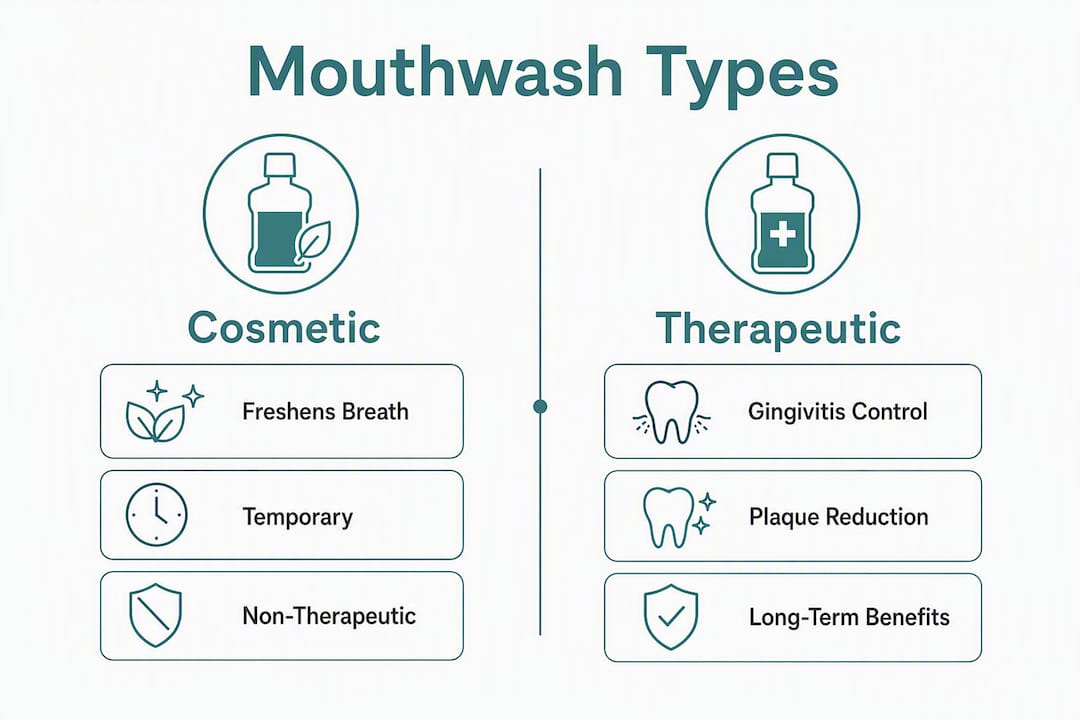
Mouthwash, also called mouth rinse, is a liquid you swish around your mouth to clean, freshen, or treat oral tissues. It falls into two broad categories: cosmetic rinses that temporarily mask bad breath, and therapeutic rinses that contain active ingredients to reduce bacteria, control gingivitis, or deliver fluoride. Either way, it works alongside brushing and flossing, not instead of them.
- Cosmetic mouthwash: Freshens breath temporarily; no lasting antibacterial or decay-prevention effect.
- Therapeutic mouthwash: Contains clinically active agents (fluoride, chlorhexidine, essential oils, cetylpyridinium chloride) that target plaque, gingivitis, or enamel protection.
- The bottom line: Mouthwash reaches areas a toothbrush cannot, but it cannot remove the sticky biofilm that brushing and flossing physically dislodge.
Table of Contents
- What can mouthwash actually do for your oral health?
- What are the types of mouthwash and what’s in them?
- How do you use mouthwash safely and effectively?
- How do you choose the right mouthwash for you or your child?
- What side effects and safety risks should you know about?
- How does mouthwash fit with a Y-Brush 20-second routine?
- Key Takeaways
- Mouthwash and fast brushing: a practical perspective
- Useful sources for further reading
What can mouthwash actually do for your oral health?
Therapeutic rinses have solid clinical backing. Systematic evidence confirms that mouthwashes containing chlorhexidine or essential oils reduce gingivitis and slow plaque formation when used consistently. Fluoride rinses add a meaningful layer of enamel protection, particularly for people prone to cavities. These are real, measurable benefits, not marketing claims.
The limitations are equally real. No rinse, regardless of how potent its formula, can physically break apart the biofilm that clings to tooth surfaces. That job belongs to mechanical action: a toothbrush and floss. Cosmetic rinses do even less on the therapeutic side; they mask odor for a few hours without addressing its bacterial source.
Pro Tip: Treat mouthwash as a targeted add-on, not a daily default. Identify a specific goal first — gingivitis control, fluoride delivery, or breath management — then choose a formula built for that purpose. Consistent brushing and flossing remain the foundation.
What are the types of mouthwash and what’s in them?
Cosmetic vs. therapeutic
Cosmetic and therapeutic mouthwashes serve different purposes, and confusing them leads to unmet expectations. Cosmetic rinses contain flavoring agents and mild antiseptics that neutralize odor temporarily. Therapeutic rinses carry regulated active ingredients that produce measurable clinical outcomes. Saltwater rinses sit in a third category: low-risk, useful for symptomatic relief or post-procedure care, but not a substitute for therapeutic formulas when plaque control is the goal.
Active ingredients and what they do
The table below maps the most common therapeutic ingredients to their primary purpose and the trade-offs worth knowing before you buy.
| Ingredient | Primary purpose | Key trade-offs |
|---|---|---|
| Chlorhexidine | Short-term gingivitis and plaque control | Brown staining on teeth and tongue; altered taste; prescription-only in the U.S. |
| Essential oils (thymol, eucalyptol, menthol) | Broad-spectrum antimicrobial; gingivitis reduction | Alcohol-based formulas may cause dryness or irritation |
| Cetylpyridinium chloride (CPC) | Antibacterial; reduces plaque and bad breath | Mild staining possible; generally well tolerated |
| Fluoride | Enamel remineralization; cavity prevention | Avoid swallowing; not for children under 6 without dentist guidance |
| Hydrogen peroxide | Whitening; mild antiseptic | Overuse can irritate soft tissue; limited long-term evidence for plaque control |
Formulation additives
Ethanol historically served as both solvent and antiseptic in mouthwash, but many modern formulas replace it with propylene glycol to reduce dryness and irritation. Glycerin improves mouthfeel, while surfactants help active ingredients distribute evenly. For people with sensitive mouths or dry-mouth conditions, alcohol-free formulas are often the more comfortable choice.
How do you use mouthwash safely and effectively?
The standard dosage is 15–20 mL (roughly 0.5–0.7 fl oz), swished or gargled for at least 30 seconds, then spat out completely. Do not swallow. Most caps on commercial bottles are calibrated to that volume, so use the cap as your measuring tool.
Sequence and timing matter more than most people realize:
- Brush and floss first. Mechanical cleaning removes the biofilm that mouthwash cannot.
- Wait before rinsing. Using mouthwash immediately after brushing washes away concentrated fluoride residue from toothpaste, reducing enamel-protective contact time. Consider using your rinse at a different time of day entirely.
- If your toothpaste contains calcium hydroxide or aluminum hydroxide, rinse with plain water and wait a few minutes before using a fluoride mouthwash. Those dentifrice ingredients can bind fluoride and blunt the rinse’s effectiveness.
- Follow label or dentist instructions for frequency. Many therapeutic rinses are designed for once-daily use; cosmetic rinses can be used more flexibly.
- Spit thoroughly. Residual swallowing, especially in children, is the primary safety concern.
Pro Tip: Y-Brush users who complete a full clean in 20 seconds get the most from their toothpaste fluoride by saving mouthwash for after meals or mid-day. That timing preserves the fluoride film on enamel and turns the rinse into a between-meal defense rather than a post-brush wash-out.
How do you choose the right mouthwash for you or your child?
Start with your primary goal, then match it to an ingredient class. That single step eliminates most of the confusion in the mouthwash aisle.
- Bad breath: Look for CPC, essential oils, or zinc compounds. A cosmetic rinse works for occasional freshening; a therapeutic formula addresses the bacterial source.
- Gingivitis control: Essential-oil rinses are available over the counter and have strong clinical backing. Chlorhexidine is more potent but requires a dentist’s recommendation and is best used short-term due to staining risk.
- Cavity prevention: Choose a fluoride rinse, particularly if your tap water is not fluoridated or your dentist has flagged enamel concerns.
- Dry mouth: Alcohol-free formulas with moisturizing agents (xylitol, glycerin) are far more comfortable and will not worsen dryness the way ethanol-based rinses can.
For choosing the best mouthwash for your household, consider the whole family. The ADA advises that children under 6 should not use mouthrinse unless a dentist specifically directs it, because young children lack the motor control to spit reliably and face a real swallowing risk. For children 6 and older, use age-appropriate formulas, supervise every session, and confirm the dose with your pediatric dentist. During pregnancy, check with your dental provider before adding any therapeutic rinse to your routine, particularly chlorhexidine or high-concentration fluoride products.

What side effects and safety risks should you know about?
Most people tolerate mouthwash well, but a few side effects are worth knowing before you commit to a product.
- Altered taste: Common with chlorhexidine; usually temporary and resolves after the treatment course ends.
- Tooth and tongue staining: Chlorhexidine is the primary culprit. Professional cleaning removes the staining, but it can be cosmetically bothersome during use.
- Dry mouth and irritation: Alcohol-containing rinses can dry out oral tissues, worsening sensitivity or dry-mouth conditions. Switching to an alcohol-free formula typically resolves this.
- Fluoride interactions: Some dentifrice ingredients bind fluoride in a mouthwash and reduce its effectiveness. A brief plain-water rinse between brushing and using a fluoride rinse helps avoid this.
- Accidental ingestion in children: This is why the under-6 guideline exists. If a young child swallows a significant amount, contact Poison Control (1-800-222-1222) immediately. For mouthwash side effects in general, the risk is low when used as directed by adults.
- When to call your dentist: Persistent oral irritation, a severe allergic reaction, staining that does not resolve, or any concern tied to an underlying medical condition all warrant professional advice before continuing use.
How does mouthwash fit with a Y-Brush 20-second routine?
Mouthwash reaches the soft tissue, gum line, and interdental spaces that even the best toothbrush cannot fully contact. For Y-Brush users who complete a clinically effective clean in 20 seconds, a well-chosen rinse becomes a finishing tool, not a crutch.
Here is how to pair them effectively:
- After meals or mid-day: Use a therapeutic or cosmetic rinse between brushing sessions to control bacteria and freshen breath without disturbing the fluoride film left by your toothpaste.
- Not immediately after brushing: Rinsing right after a Y-Brush session washes away the concentrated fluoride your enamel needs. Wait at least 30 minutes, or save the rinse for a different time entirely.
- Match the rinse to the gap your brushing leaves: Y-Brush handles plaque removal on tooth surfaces efficiently. A CPC or essential-oil rinse addresses the bacterial load in the soft tissue and gum pockets that a brush head cannot reach.
Pro Tip: Think of your oral-care routine as two distinct jobs: mechanical removal (Y-Brush + floss) and chemical coverage (mouthwash). Keeping them at separate times of day maximizes both.
Key Takeaways
Mouthwash is most effective when chosen for a specific goal and used at the right time, separate from brushing, to preserve toothpaste fluoride and maximize its own active ingredients.
| Point | Details |
|---|---|
| Match rinse to your goal | Choose fluoride for cavities, essential oils or CPC for gingivitis, alcohol-free for dry mouth. |
| Follow the standard dose | Use 15–20 mL, swish for at least 30 seconds, and spit completely — never swallow. |
| Time it away from brushing | Rinsing immediately after brushing reduces fluoride contact time on enamel; use mouthwash at a different time of day. |
| Children under 6: dentist first | The ADA advises against mouthrinse for children under 6 without explicit dentist direction due to swallowing risk. |
| Mouthwash complements, not replaces | No rinse removes biofilm; brushing and flossing remain the non-negotiable foundation of oral health. |
Mouthwash and fast brushing: a practical perspective
At Y-Brush, the position on mouthwash is straightforward: it is a clinically supported adjunct that earns its place in a routine when it is chosen deliberately and timed correctly. The evidence for therapeutic rinses, particularly those containing essential oils or CPC, is solid. What gets overlooked is the timing question. Most people who add a rinse to their routine use it immediately after brushing, which is precisely when it does the least good. Saving the rinse for after meals or mid-day turns it into a genuine between-session defense rather than a fluoride wash-out. For families using Y-Brush for both adults and children, the 20-second brushing format creates a natural opening: brush in the morning, rinse after lunch, floss at night. That sequence protects enamel, controls bacteria across the day, and keeps the routine fast enough that people actually follow it.
Useful sources for further reading
The claims in this article draw from the following authoritative sources. Each is worth bookmarking if you want to verify a specific point or dig deeper.
- American Dental Association — Mouthrinse (Mouthwash): Primary source for the cosmetic vs. therapeutic classification, child-safety guidance (under-6 recommendation), and the adjunct role of mouthwash. Also covers ingredient interactions with dentifrice components.
- ADA MouthHealthy — Mouthwash: Consumer-facing ADA resource covering types, uses, and general selection guidance; good starting point for parents.
- PMC — Therapeutic mouthwash evidence review: Peer-reviewed systematic review supporting the gingivitis and plaque-control claims for chlorhexidine and essential-oil rinses.
- PMC — Formulation and ingredient roles in mouthwash: Research-level analysis of ethanol, propylene glycol, glycerin, and surfactants; backs the alcohol-free formulation discussion.
- DermNet NZ — Mouthwashes: Clinical overview covering dosage (15–20 mL, ≥30 seconds), saltwater rinses, and postoperative use.
- Healthline — How to Use Mouthwash Safely and Properly: Practical consumer guidance on correct technique, timing, and realistic expectations.
- Wikipedia — Mouthwash: Useful for the fluoride-timing discussion and the dentifrice interaction notes; cross-reference with primary sources for clinical claims.


