


Most pediatric dentists recommend introducing a kids electric toothbrush around age 3, once a child can spit rather than swallow toothpaste. From there, the rule that matters most isn’t the brush itself, it’s supervision: plan to stay hands on until roughly age 7 or 8, choose a head sized for your child’s mouth, and keep toothpaste amounts age-appropriate. The specifics, by age and by stage, are below.
TL;DR:
- Children should generally use an electric toothbrush starting around age 3, but supervision remains essential until they are 7 or 8 years old.
- Small, soft-bristled heads and adjustable power modes improve safety and comfort, especially for sensory-sensitive children.
- Use age-appropriate toothpaste amounts: a smear before age 3 and a pea-sized amount from ages 3 to 6, both with fluoride.
- Introducing vibration gradually and supervising every step reduces sensory overwhelm and encourages proper brushing habits.
- Full independence in brushing usually develops around age 8, with supervision still recommended for thorough coverage.
Table of Contents
- What’s the Right Kids Electric Toothbrush Age, Stage by Stage?
- Is Your Child Actually Ready for an Electric Toothbrush?
- How Do You Choose an Age-Appropriate Kids Electric Toothbrush?
- How Do You Safely Introduce Vibration and Noise?
- When Does a Child Brush Independently?
- How Does Y-brush’s KidsBrush Fit This Guidance?
- Does an Electric Toothbrush Actually Clean Better Than a Manual One for Kids?
- What Common Problems Come Up With Kids and Electric Toothbrushes?
- A Parent’s Real Priority: Comfort First, Independence Second
- Give Your Child a Toothbrush Built for Their Age, Not a Scaled-Down Adult One
- Where This Guidance Comes From
- Sources
What’s the Right Kids Electric Toothbrush Age, Stage by Stage?
There’s no single switch that flips on a birthday. Readiness moves through stages, and matching the tool to the stage matters more than hitting an exact number.
Ages 0 to 2: Skip the electric brush entirely. Clean gums and the first erupting teeth with a soft-bristled manual brush or a damp washcloth. Infants and young toddlers don’t yet have the patience or oral tolerance for vibration, and there’s no health reason to rush the switch. This is also the window when the CDC’s guidance on fluoride toothpaste amounts starts to apply, since fluoride use begins as soon as the first tooth appears.
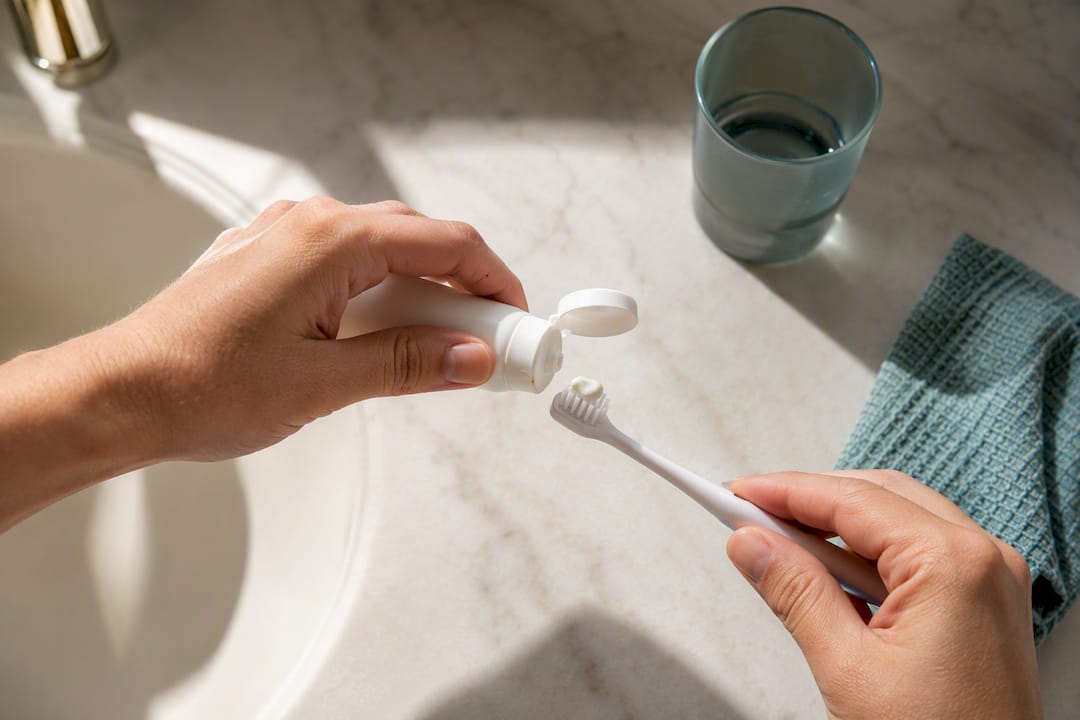
Ages 3 to 5: This is the window most parent-facing dental resources point to for introducing an electric toothbrush built for toddlers. Let your child feel the vibration on their hand first, then guide the brush into their mouth once they’re comfortable. Supervision here isn’t optional. It’s the whole point of starting this early.
Ages 6 to 8: Coordination improves a lot in this stretch, but judgment still lags behind. Many kids can hold and angle a brush correctly but still miss back molars or rush through the two-minute mark. A larger kid-sized head and, if your child wants it, a gentler mode can help. Stay involved even as you loosen your grip.
Ages 9 and up: Most children can brush independently by now. Step back from hands-on brushing, but keep doing occasional spot-checks, especially after meals with sticky or sugary foods.
Toothpaste amounts scale right alongside the brush itself:
- Under age 3: a smear the size of a grain of rice
- Ages 3 to 6: a pea-sized amount of fluoride toothpaste
- Both stages: fluoride toothpaste is recommended at both amounts, per CDC guidance for children
For a more detailed walkthrough of what to expect at each stage, Y-brush’s own checklist for introducing a kids electric toothbrush breaks the transition down step by step.
Is Your Child Actually Ready for an Electric Toothbrush?
Age is a starting point, not a verdict. Some three-year-olds take to an electric brush immediately; some five-year-olds still need more time. Watch for these signals instead of counting candles on a cake:
- Motor control: Your child can hold and move the brush around their mouth without gagging or choking on it.
- Sensory tolerance: They can handle the buzz and hum of the motor during a short test, ideally with the brush off first, then on and away from the face.
- Follow-through: They can manage a simple two-step routine, brush teeth, then rinse, and will still accept your help when they lose the thread.
- Curiosity: They’re asking to try the “cool buzzy brush” rather than recoiling at the sight of it.
If your child fails the sensory test but passes everything else, that’s not a reason to give up. It’s a reason to wait a few weeks and try again, or to stick with a manual brush while they warm up to the sensation. Clinics that specialize in pediatric oral health commonly see this staggered readiness and treat it as normal, not a red flag.
How Do You Choose an Age-Appropriate Kids Electric Toothbrush?
Not every “kids” toothbrush on the shelf is actually built for kids. Marketing language and genuine design fit are two different things, and the gap between them is where a lot of frustrated bedtime battles start.
Here’s what actually matters when you’re comparing options:
- Manufacturer age rating and head size. Look for a small brush head with extra-soft bristles rated for your child’s specific age band, not a scaled-down adult head.
- Power adjustability. Kids with sensory sensitivities do better with a lower-intensity mode or a dedicated “kids” setting rather than a single fixed speed.
- Built-in timers and reward cues. A two-minute timer, a light-up handle, or a companion app that tracks streaks does more for consistency than raw brushing power ever will.
- Replaceable heads and rechargeable batteries. Both matter for hygiene (heads wear out and should be swapped regularly) and for cost over time.
- Fit over flash. A brush covered in cartoon characters means nothing if the bristles are too stiff or the handle is too thick for small hands to grip.
Reviewers who test these models side by side, including Wirecutter’s roundup of kids’ electric toothbrushes, consistently flag head size and power modes as the features that separate a toothbrush kids will actually use from one that ends up abandoned in a drawer.
Pro Tip: Bring your child along when you’re choosing a brush, if you can. Letting them pick the color or handle design gives them a sense of ownership, and a toothbrush a child helped choose gets used far more willingly than one that simply appears in the bathroom cup.
For a side-by-side look at how different children’s models stack up on these criteria, Y-brush’s complete guide to children’s toothbrushes covers the tradeoffs in more depth.
How Do You Safely Introduce Vibration and Noise?
The biggest mistake parents make isn’t choosing the wrong brush. It’s introducing it too fast. A child who’s startled on day one may reject electric brushing for months afterward, so the sequence you use matters as much as the product.
Work through it in stages:
- Let your child hold and examine the brush while it’s off.
- Turn it on and let them feel the vibration against their hand or cheek.
- Only then guide it into their mouth, starting with front teeth where the sensation is mildest, always supervising brushing for young children.
- If they resist at any stage, back off to a manual brush or a lower-power mode and try again later.
Full supervision matters through this whole process, and it should continue well past the first successful brushing session. Children generally lack the fine motor skills to brush thoroughly on their own until around age 7 or 8, which means an adult-led finishing pass, going back over the teeth after your child’s attempt, is often the difference between a surface clean and one that actually clears plaque.
Keep toothpaste amounts consistent with the CDC’s guidance: a smear for children under 3, a pea-sized amount from ages 3 to 6. Reclining your child slightly during the parent-led pass can also improve access to back molars and reduce gagging, a small adjustment that makes the finishing brush far less of a struggle for both of you.
When Does a Child Brush Independently?
The realistic timeline runs longer than most parents expect. Introduction typically starts around age 3, independence builds gradually through ages 6 to 8, and full solo brushing, without a parent double checking the job, usually lands around age 8 or 9.
Before you step back completely, check for these markers:
- Brushing happens consistently, twice a day, without prompting turning into a fight.
- Coverage is thorough: front, back, and chewing surfaces, not just the teeth that are easiest to reach.
- Your child can rinse and spit reliably, without swallowing excess toothpaste.
If your child is well past age 8 and still missing these marks consistently, that’s worth raising with your pediatric dentist rather than assuming more time alone will fix it. Individual differences in motor development are common, and a professional can rule out anything beyond normal variation.
How Does Y-brush’s KidsBrush Fit This Guidance?
Y-brush built its KidsBrush sonic electric toothbrush specifically for the 4 to 12 age range, right in the window this guidance points to as the real supervision runway. The brush uses Y-brush’s patented Y-shaped head with sonic vibrations to clean all tooth surfaces in about 20 seconds, a shorter window that works in favor of a child’s limited patience rather than against it.
That short session length matters more for kids than the marketing angle suggests. A two-minute brushing goal is hard enough for adults to hit consistently; for a wiggly six-year-old, it’s often the actual barrier to a thorough clean. For a closer look at how the mechanism works for smaller mouths, Y-brush’s explainer on children’s electric toothbrushes walks through the design choices behind it.
Does an Electric Toothbrush Actually Clean Better Than a Manual One for Kids?
The honest answer is: it depends more on consistency than on the brush itself. A child who brushes thoroughly with a manual brush for two full minutes will out-clean a child who waves an electric brush around for twenty seconds without covering every surface.
That said, electric brushes remove some of the technique burden that trips kids up. Manual brushing asks a child to manage angle, pressure, and timing all at once, three things that are genuinely hard to coordinate before age 7 or 8. Sonic vibration does part of that work automatically, so a child who’s holding the brush roughly in the right place still gets meaningful plaque disruption even with imperfect technique.
Built-in timers are arguably the bigger advantage. Kids chronically underestimate how long two minutes feels, and a brush that buzzes or pulses at 30 second intervals gives a concrete cue that “keep going” alone never provides. KidsHealth’s guidance on building healthy routines points to exactly this kind of structured cue as a driver of consistency, more than raw brushing power.
For kids who already dislike the sensation of vibration, though, a manual brush with good supervision beats an electric one they resist using at all. The best toothbrush is the one that actually gets used, twice a day, without a fight.
What Common Problems Come Up With Kids and Electric Toothbrushes?
A few problems show up again and again, and nearly all of them have straightforward fixes.
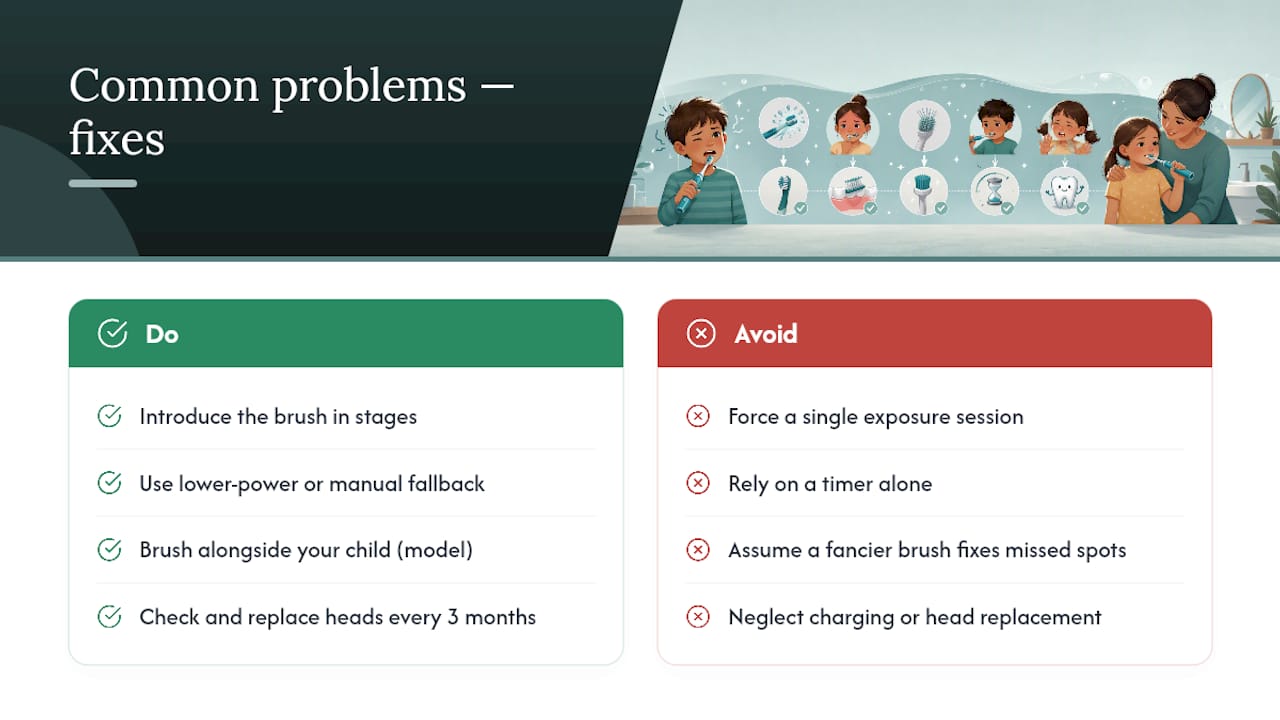
Sensory overwhelm. Some kids find the buzzing sensation unpleasant or even startling. The fix is the staged introduction covered earlier: off, then on the hand, then in the mouth, over several tries rather than one sitting. If a child still resists after multiple gentle attempts, a lower-power mode or a manual brush for a few more months is a completely reasonable fallback. Resources on sensory tolerance in early childhood note that repeated, low-pressure exposure works far better than forcing a single session.
Rushing through the session. Even with a timer, kids often pull the brush away early. Modeling the behavior yourself, brushing alongside your child at the sink, keeps the session going longer than a timer alone.
Missed surfaces, especially molars. This is less about the brush and more about supervision. If your child consistently misses the same spots, that’s a sign to return to a parent-led finishing brush for a while rather than assuming a fancier toothbrush will solve it.
Battery and hygiene neglect. Kids’ brushes get left uncharged or their heads go unreplaced far longer than adult brushes. Building a habit of checking the head every three months solves this before it becomes a bigger problem.
A Parent’s Real Priority: Comfort First, Independence Second
If there’s one thing worth taking from all of this, it’s that comfort and consistency beat early independence every time. A child who tolerates their toothbrush and brushes without a fight twice a day is doing better than one who’s “advanced” for their age but dreads the routine. When something about your child’s development doesn’t match the usual timeline, a pediatric dentist is worth a call before you assume the toothbrush is the problem.
— Joris
Give Your Child a Toothbrush Built for Their Age, Not a Scaled-Down Adult One
Most kids’ toothbrushes are adult designs shrunk down and repainted. The Y-brush KidsBrush is built the other way around: a sonic toothbrush designed from the start for ages 4 to 12, with a head sized for smaller mouths and a full clean that takes about 20 seconds rather than the two minutes most kids can’t sit still for.
That short session length is the whole point for this age group. Asking a seven-year-old to hold still for two minutes twice a day is a losing battle in most households, and a shorter, more consistent routine tends to win out over a longer one that gets skipped half the time. If your family is still using a manual brush and wondering whether your child is ready for the switch, the KidsBrush product page lays out sizing and age fit in detail, and Y-brush’s full lineup of new products is worth a look if you’re outfitting more than one child at different ages.
Where This Guidance Comes From
- CDC — Oral health tips for children: fluoride toothpaste amounts and early brushing timing.
- Kids Dentistry — Toothbrushing technique: supervision timelines through age 7 to 8.
- SuperKids Dentistry — Electric toothbrush readiness: recommended starting age around 3.
- Wirecutter — Best electric toothbrushes for kids: head size and mode comparisons across models.
Sources
- CDC — Oral health tips for children
- Kids Dentistry — Toothbrushing technique
- Wirecutter — The 2 Best Electric Toothbrushes for Kids in 2026
- SuperKids Dentistry — How old should my child be to use an electric toothbrush?


