


A Y-shaped mouthpiece toothbrush that cleans in about 20 seconds is the practical fix for ADHD tooth brushing struggles, and Y-Brush is the option built specifically around that design. The device won’t replace every benefit of a careful two-minute manual routine, but for someone who currently brushes for 15 seconds or skips entirely, it closes a real gap. Membership plans for automatic head refills can help keep the routine low-effort long after purchase.
TL;DR:
- The Y-Shape toothbrush is most beneficial for people who brush for less than a minute or skip brushing, especially children with ADHD.
- Short-term trials show it reduces plaque better than no brushing but less effectively than manual brushing over 45 to 120 seconds.
- Proper mouthpiece sizing and starting on gentle modes improve comfort and effectiveness, especially for sensory-sensitive users.
- Consistent use over weeks leads to behavioral improvements, while actual health benefits like reduced plaque take longer to appear.
- It complements rather than replaces traditional brushing, making it ideal for establishing a routine rather than full plaque removal.
Table of Contents
- What Is a Y-Shaped 20-Second Toothbrush, and Which Y-Brush Models Fit?
- What Do Clinical Trials Say About Y-Shaped Brushes?
- Who Actually Benefits From ADHD Oral Hygiene Strategies Like This?
- How Do You Use It Correctly From Day One?
- How Do You Choose the Right Model and Plan?
- How Does the Membership Plan and Upkeep Actually Work?
- When Should You Expect Results From a Faster Brushing Routine?
- How Does This Compare to Other ADHD-Friendly Brushing Options?
- What Do Real Users Say About Brushing With ADHD?
- What Are Some Tips for Making This Part of a Daily Routine?
- Does a Faster Toothbrush Actually Solve the Real Problem?
- Ready to Fix a Broken Brushing Routine?
- Sources
What Is a Y-Shaped 20-Second Toothbrush, and Which Y-Brush Models Fit?
A Y-shaped mouthpiece toothbrush looks nothing like a standard handle-and-head brush. It’s a U-shaped tray studded with bristles on every surface, built to slide over the teeth so the top and bottom arches get cleaned without any back-and-forth scrubbing motion. This version runs on sonic vibration, cleaning each arch in about 10 seconds for a 20-second total session, using nylon bristles rather than silicone paddles, which tend to glide over plaque instead of lifting it.
Y-Brush sells three main products built around this shape:
- Y-Brush Essential Sonic Toothbrush, the adult daily-use model with a Medium mouthpiece.
- Y-Brush KidsBrush Sonic Electric Toothbrush, sized Small for children roughly ages 4 to 12.
- Y-Brush Ultra Sonic Toothbrush, a higher-tier pack with extra modes and accessories.
Every model pairs with membership plans that ship replacement mouthpieces on a set schedule, so the ongoing cost is predictable and the household never runs out of a working head.
What Do Clinical Trials Say About Y-Shaped Brushes?
The clearest evidence comes from a cross-over randomized controlled trial comparing Y-shaped brushes, U-shaped brushes, manual brushing, and no brushing at all. The result was consistent: Y-shaped devices removed meaningfully more plaque than no brushing, but in these short, single-use sessions they removed less plaque than 45 to 120 seconds of manual brushing. Researchers pointed to mouthpiece fit and bristle reach as likely explanations for the gap.
That finding reframes the product correctly. It’s not a tool designed to outperform a dentist-grade manual technique. It’s a tool designed to beat the alternative that actually happens for millions of people: a rushed 15-second scrub or nothing at all.
A few practical takeaways from the trial data:
- Y-shaped brushing consistently beat no brushing on plaque removal.
- Thorough 45 to 120 second manual brushing still outperformed the mouthpiece design in these trials.
- Study sessions were short and single-use, so long-term, real-world results with correct sizing may differ.
Independent product testing has echoed a similar verdict, noting solid results for users who’d otherwise skip brushing, while still suggesting supplemental cleaning for full plaque control.
Who Actually Benefits From ADHD Oral Hygiene Strategies Like This?
The clearest fit is anyone who currently brushes for well under a minute, skips sessions outright, or struggles with the fine motor coordination and sustained attention that manual brushing demands. Research on ADHD populations backs up why this matters: people with ADHD face significantly higher rates of poor oral hygiene, largely tied to impulsivity and difficulty sticking with a repetitive, unstimulating task. Children specifically show higher plaque and caries scores, often linked to rushed or “perfunctory” brushing rather than a full skip.
That’s the population this device class targets well. It’s a poor fit for anyone expecting it to fully replace a dentist-recommended two-minute manual or standard electric routine every single time.
Known limits worth knowing before buying:
- Plaque removal can lag behind thorough manual brushing in short-session trials.
- A mouthpiece that doesn’t match mouth size or tooth alignment won’t clean effectively.
- Some users report a gag reflex or sensory discomfort on first use.
Pro Tip: Order the size based on current tooth spacing, not age alone, and start on the gentlest intensity mode for the first few sessions. Ramping up gradually gives sensory-sensitive users time to adjust without triggering a gag response that sours them on the device permanently.
How Do You Use It Correctly From Day One?
Getting this right on day one prevents the two most common complaints: poor fit and leftover toothpaste residue.
- Confirm the correct size (S for kids, M for most adults) before first use.
- Fully charge the handle following the included instructions.
- Apply a pea-sized amount of toothpaste directly into the mouthpiece bristles.
- Insert the mouthpiece and gently chomp down, then slide it forward and back along each arch.
- Run the top arch for about 10 seconds, then the bottom arch for about 10 seconds.
- Rinse the mouthpiece thoroughly under running water immediately after use.
A few maintenance basics keep the device performing well over time:
- Rinse bristles immediately, since dried toothpaste is harder to remove later.
- Let the mouthpiece air dry fully before storing it in a closed case.
- Replace the head on the manufacturer’s suggested interval rather than waiting until bristles look worn.
Start on the gentlest mode for the first week regardless of age. It builds tolerance before ramping up to a deeper clean setting.
How Do You Choose the Right Model and Plan?
Matching the model to the user matters more than chasing the most expensive option. Run through this checklist before buying:
- Mouthpiece size: S for children roughly 4 to 12, M for teens and adults.
- Bristle material: nylon bristles, which tend to lift plaque more effectively than smooth silicone paddles.
- Brushing modes and duration: confirm the 10-second-per-arch, 20-second-total cycle and any intensity settings.
- Battery life and charging: check how many sessions a full charge covers.
- Replacement head cost: factor this into total ownership cost, not just the sticker price.
- Warranty and return policy: useful if sizing turns out wrong on first try.
Pro Tip: If the primary goal is rescuing a routine that’s currently skipped entirely, prioritize speed and comfort over advanced modes. A user who won’t tolerate two minutes of brushing won’t benefit from an Ultra-tier feature set they never use.
The real tradeoff is speed versus completeness: this device wins on consistency and ease, while a supplemental manual brush for stubborn spots covers the completeness gap.
How Does the Membership Plan and Upkeep Actually Work?
Y-Brush’s membership plans auto-ship replacement mouthpieces on a set schedule, which removes the “did we run out” failure point that derails a lot of habit-building attempts. Manufacturer guidance suggests replacing heads on a regular cycle since worn bristles lose cleaning power gradually rather than obviously.
Simple upkeep extends mouthpiece life between shipments:
- Rinse immediately after each use to prevent dried paste buildup.
- Store the mouthpiece uncovered until fully dry to avoid bacterial growth.
- Check bristles periodically for fraying or flattening.
Subscriptions can cost less per head than repeated one-time purchases, which may matter for households replacing multiple mouthpieces on the same schedule.
When Should You Expect Results From a Faster Brushing Routine?
Most households notice the behavior change before they notice the dental change, and that order matters. Within the first one to two weeks, the shift that shows up is compliance: brushing actually happens twice a day instead of getting skipped or rushed, because the barrier to starting has dropped from “stand still for two minutes” to “hold this in for 20 seconds.” That’s the shorter active time reducing a real behavioral barrier that keeps a lot of ADHD brushing routines from sticking in the first place.
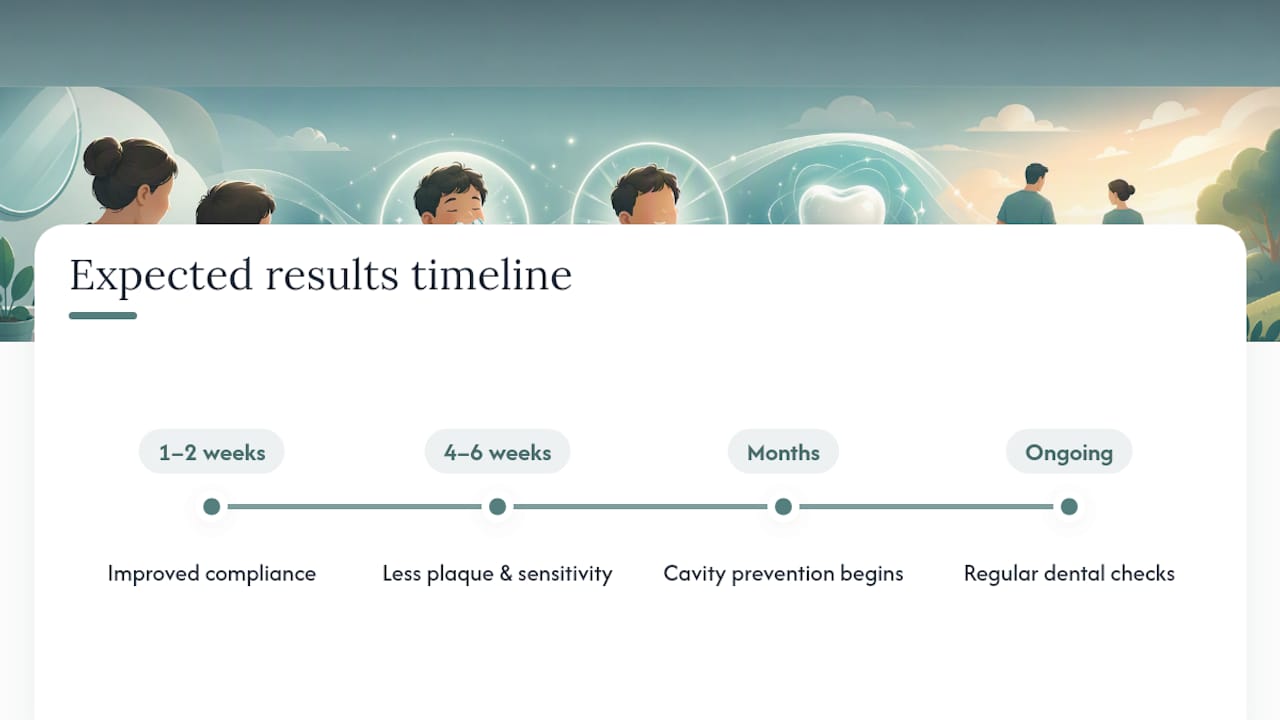
Visible or felt oral health improvements, like less plaque buildup and gum sensitivity, typically take longer to register, generally somewhere in the four to six week range with twice-daily use, since that’s roughly how long consistent plaque control takes to show up in gum tissue. Cavities and deeper issues take months to prevent or reverse, and a device swap alone won’t undo existing decay.
Set the expectation correctly from the start: this is a consistency tool first, a plaque-removal tool second. Families chasing a specific timeline for cavity prevention should still schedule regular dental checkups to track actual clinical progress rather than judging results by feel alone. The oral health data on children with ADHD consistently shows that regular twice-daily brushing, even an imperfect version, lowers the odds of poor outcomes compared to inconsistent brushing with a “better” tool.
How Does This Compare to Other ADHD-Friendly Brushing Options?
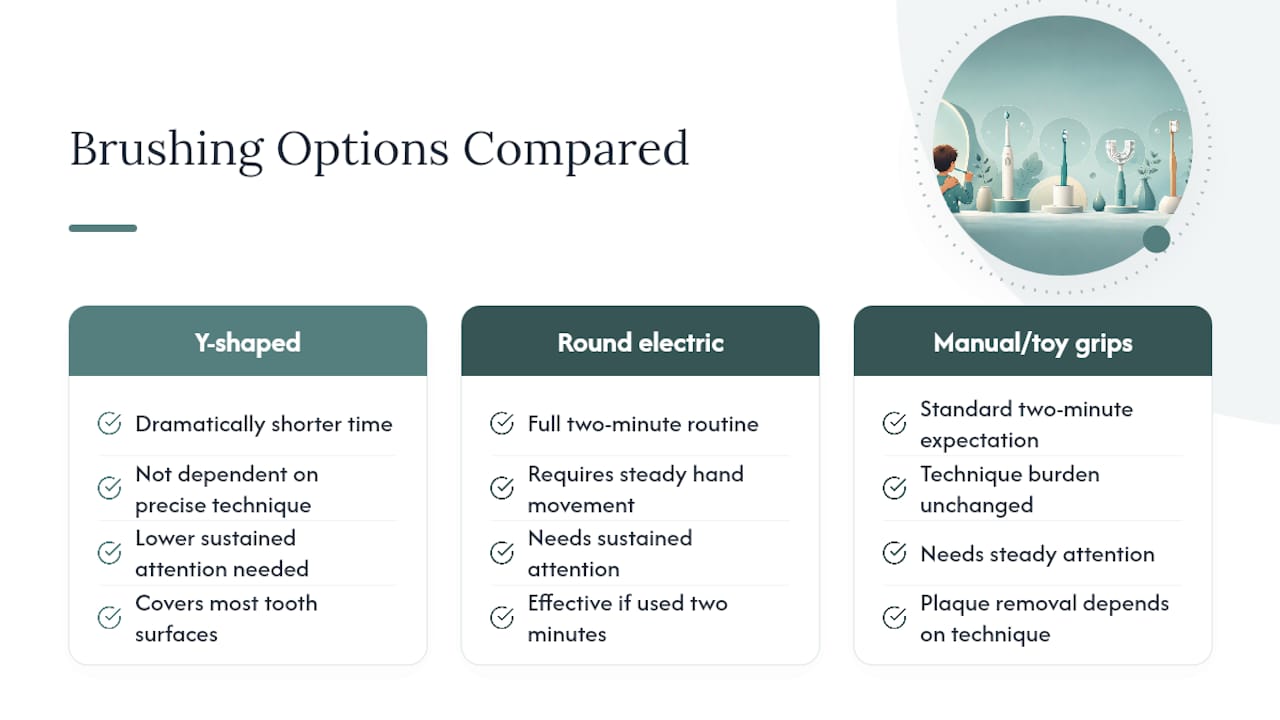
Standard electric toothbrushes with round oscillating heads are the most common alternative, and they generally perform well on plaque removal when used for the full two minutes. The catch is that they still require the exact skill this category struggles with: sustained attention and steady hand movement across every tooth surface for the entire cycle. A round head doesn’t shorten the time commitment or reduce the coordination needed.
Manual toothbrushes with sensory-friendly grips or timers help some users but don’t address the core issue either, since the technique burden stays the same regardless of handle design.
Sensory tools outside the toothbrush category, like chew-based sensory aids, can help some children tolerate having an object in their mouth, which is a useful bridge for kids who resist any brushing tool at first.
Where the Y-shaped mouthpiece format stands apart is the combination of two things at once: a dramatically shorter time commitment and a design that doesn’t depend on precise manual technique to reach most tooth surfaces. That combination is what a round-head electric brush or a manual brush with a fun handle can’t replicate, even though both remain reasonable options for users who tolerate a full two-minute routine without a fight.
What Do Real Users Say About Brushing With ADHD?
Independent testing of the Y-Brush format has found it delivers noticeably better results than many competing mouthpiece-style alternatives, particularly for users who’d otherwise skip brushing sessions altogether. That reviewer also noted that supplemental cleaning still helps for users chasing maximum plaque control, which lines up with the trial data showing thorough manual brushing edging out short mouthpiece sessions.
The pattern across research and product testing points to the same conclusion: the biggest win isn’t necessarily better cleaning per session, it’s more sessions actually happening. For a population where the barrier is executive function rather than motivation, a tool that lowers the effort threshold tends to get used more consistently than one that demands more discipline for a marginally better clean.
Parents shopping for children specifically should weigh this against their child’s sensory profile. A child who resists having anything unfamiliar in their mouth may need a gradual introduction period, while a child who mainly struggles with sitting still through a two-minute manual routine tends to adapt to the 20-second format quickly.
What Are Some Tips for Making This Part of a Daily Routine?
Pairing a new tool with an existing habit works better than trying to build brushing into a standalone task from scratch. Advice from ADHD-focused caregiver resources points to habit stacking: attach brushing to something that already happens reliably, like right after breakfast or right before the morning screen-time routine starts.
A few habit-building tips that make the biggest difference in practice:
- Keep a spare mouthpiece and toothpaste tube in an easily visible spot rather than tucked in a drawer.
- Use the same two anchor points every day (after breakfast, before bed) instead of a floating schedule.
- Let a child see the timer or count down out loud for the first few weeks, since the shortness itself becomes the reward.
- Avoid switching intensity modes daily. Consistency in the experience matters more than variety.
For kids specifically, a structured brushing guide can help caregivers build a routine that sticks past the first exciting week of a new gadget.
Does a Faster Toothbrush Actually Solve the Real Problem?
Here’s what gets missed in most conversations about ADHD tooth brushing: the obstacle usually isn’t a lack of knowledge about proper technique. It’s the daily friction of starting and sustaining a two-minute task that offers no immediate feedback. A device that shrinks that window to 20 seconds isn’t a shortcut, it’s a direct fix for the actual barrier.
I’d push back on any framing that treats this as an inferior substitute for “real” brushing. The trial data is honest about the tradeoff. It’s less thorough than a full manual clean in a single session, but it’s dramatically more likely to happen twice a day, every day. Consistency beats theoretical maximum effectiveness almost every time in real households.
The device works best paired with realistic expectations: it rescues a broken routine, it doesn’t erase the need for occasional dental checkups or supplemental care for stubborn areas.
— Joris
Ready to Fix a Broken Brushing Routine?
If two-minute brushing has never stuck, in your house, or for you personally, this product offers a route to a cleaner routine without demanding better willpower. The mouthpiece design fits both adults and kids across S and M sizes. The Essential Sonic Toothbrush is designed to meet common daily needs.
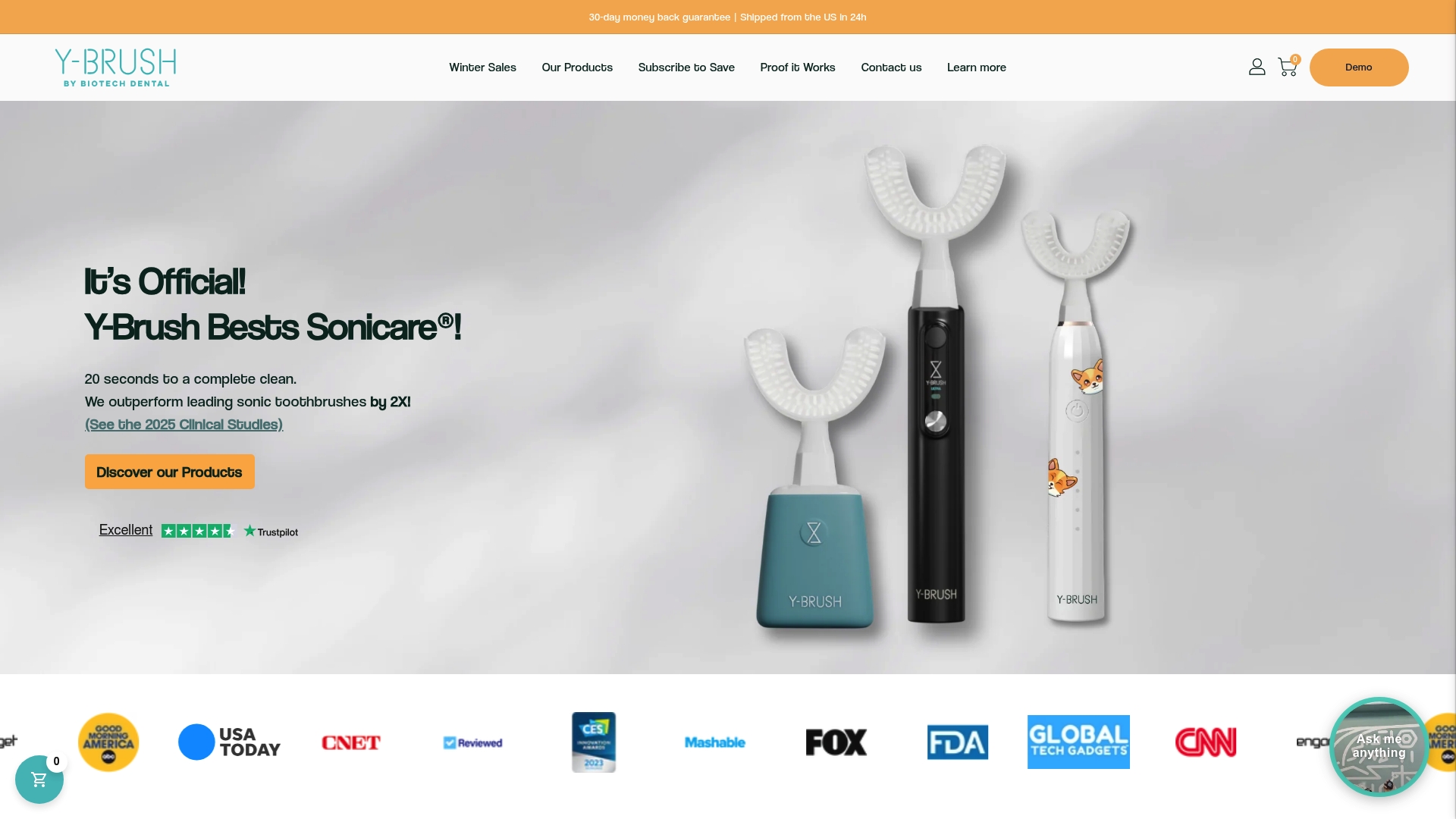
Parents shopping for a child between 4 and 12 should look at the KidsBrush Sonic Electric Toothbrush built specifically for smaller mouths and shorter attention spans. Either way, pairing your purchase with a membership plan means replacement heads show up automatically, so the routine you just built doesn’t stall out the day a mouthpiece wears down. Pick your size, place your order, and get the next two weeks of brushing on autopilot.


