


Yes. Electric toothbrushes are generally safe for people with pacemakers and other implanted cardiac devices, or CIEDs (cardiac implantable electronic devices), as long as you keep the charging base a modest distance from your chest. The main precaution isn’t the brush itself; it’s the charger, which can contain magnets and electronics strong enough to warrant caution.
Most manufacturers, including Medtronic, recommend keeping the charging base about 6 inches (15 centimeters) away from an implanted device. Don’t press a running brush directly over the chest pocket where your device sits, even though this alone rarely causes problems.
- Do: Keep the charger on a separate shelf or drawer, away from your chest.
- Do: Tell your dentist and hygienist you have a CIED before any procedure.
- Don’t: Rest the charging base on a nightstand right beside where you sleep on that side.
- Don’t: Ignore new symptoms like dizziness or palpitations after using any electronic device.
A 2015 prospective clinical study published in JADA tested electric toothbrushes and other dental instruments on 32 patients with pacemakers or defibrillators and found no clinically significant interference. That finding, backed by guidance from the FDA and the American Dental Association (ADA), is why cardiologists don’t consider electric toothbrushes a meaningful risk for most patients today.
Key Takeaways
Electric toothbrushes are safe for most people with pacemakers or ICDs when the charging base stays at least 6 inches (15 cm) from the chest.
| Point | Details |
|---|---|
| Core safety rule | Keep the toothbrush charger 6 inches (15 cm) from your chest; the brush itself is low risk. |
| Clinical backing | A 2015 JADA study of 32 patients found no significant pacing or sensing interference from electric toothbrushes. |
| Real risks lie elsewhere | MRI machines, electrosurgical units, TENS devices, and strong industrial magnets need clinician-led precautions, not toothbrushes. |
| Dental visit prep | Bring your device ID card and tell staff about your CIED before any cleaning or procedure. |
| Product transparency | Y-brush lists charger and model specs on its product pages for clinician review before you switch toothbrushes. |
This article is general information, not a substitute for advice from a qualified doctor. Consult a qualified healthcare professional about your own circumstances before acting on anything here.
Table of Contents
- Is an Electric Toothbrush Pacemaker Safe According to Manufacturers?
- How Could a Toothbrush Interfere With a Pacemaker?
- Daily and Dental Precautions Worth Following
- When Should You Call Your Cardiologist?
- What Does the Clinical Evidence Actually Show?
- Common Myths About Toothbrushes and Pacemakers
- Why This Question Deserves a Straight Answer, Not a Vague One
- A Safety-Forward Option Worth Knowing About
- Sources
Is an Electric Toothbrush Pacemaker Safe According to Manufacturers?
Device manufacturers have addressed this question directly, and their guidance is consistent. Medtronic, one of the largest pacemaker and ICD (implantable cardioverter defibrillator) manufacturers, advises keeping sonic toothbrush chargers roughly 6 inches (15 cm) away from an implanted device, largely because charging bases often rely on magnetic induction to transfer power wirelessly. That magnetic field is the actual point of caution, not the vibration or motor inside the brush handle.
The FDA takes a similar position on consumer electronics broadly. Its guidance on magnets in cell phones and smart watches warns that magnets in everyday devices can affect pacemaker function if held very close to the chest, and it recommends checking device labeling for model-specific instructions. The FDA doesn’t single out toothbrushes as a special hazard; it treats them the same as any household electronic with a magnet inside.
The ADA has weighed in specifically on dental instruments. Its position, summarized in guidance on cardiac implantable devices and electronic dental instruments, notes that while older in-vitro (lab-based) studies sometimes showed interference, real-world in-vivo evidence and improved device shielding mean most dental tools, including electric toothbrushes, are unlikely to cause clinically relevant problems when normal distances are maintained. The College of Dental Hygienists of Ontario factsheet echoes this, calling battery-powered toothbrushes generally safe while still flagging the charger-distance precaution.
The practical rule, stated plainly: keep your toothbrush charger at least 6 inches (15 cm) from your chest, and bring your device ID card to every dental appointment so your care team knows exactly what you’re working with.
How Could a Toothbrush Interfere With a Pacemaker?
Electromagnetic interference, or EMI, happens when an outside magnetic field or electrical signal gets picked up by a pacemaker’s sensing circuitry. In theory, that noise could confuse a device into misreading your heart’s natural rhythm. In practice, modern CIEDs are built with shielding specifically designed to filter out exactly this kind of background noise.
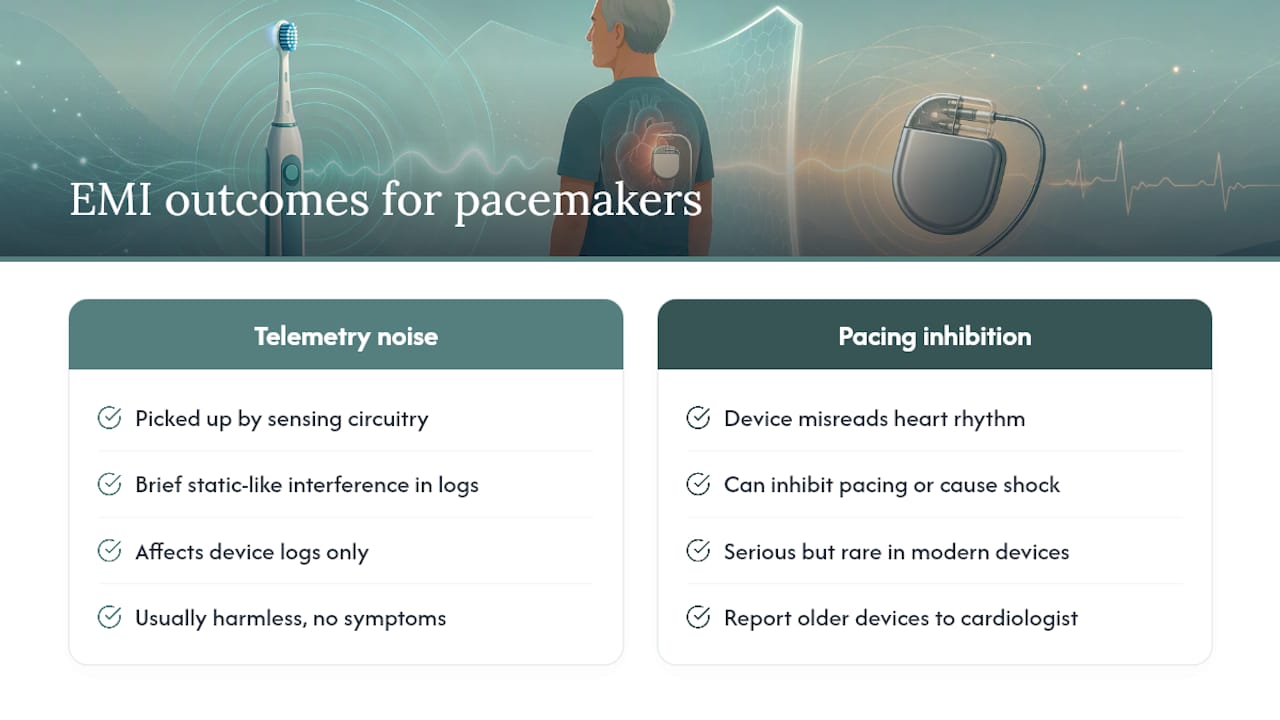
It helps to separate two very different outcomes. One is telemetry or monitoring signal noise, a brief static-like interference in the data a device logs. The other is true pacing inhibition or an inappropriate shock, which would actually affect how your heart is being paced. Documented cases of the second, more serious outcome from electric toothbrushes are rare in current-generation devices. Some interference recorded in older studies affected telemetry readings rather than pacing or shock delivery, and telemetry noise is typically harmless and produces no symptoms at all.
This is also why the charging base deserves more attention than the brush handle you hold in your hand. Chargers often use magnetic coils to transfer power without a cord, and that coil is the closest thing to a genuine magnetic source in your bathroom routine. The handheld brush itself, running on a small motor and battery, generates far less electromagnetic output at the distance you naturally hold it during brushing.
Risk here sits at the low end of the scale for anyone with a modern pacemaker or ICD. If you’re using an older device, implanted years ago before shielding technology advanced, it’s worth mentioning to your cardiologist, since older models can be somewhat more sensitive to nearby electronics.
Daily and Dental Precautions Worth Following
Small habits go a long way toward eliminating even the theoretical risk. During daily brushing, keep the charging base at least 6 inches (15 cm) from your chest, and avoid leaning a running brush directly over the pocket where your device sits. Store the charger on its own shelf, ideally somewhere you won’t lean over it while getting ready.
At the dentist, a short checklist keeps everyone informed:
- Bring your device ID card to every appointment, even routine cleanings.
- Tell the front desk and your hygienist that you have a CIED before treatment starts.
- Ask staff to avoid laying cords or cables across your chest during the visit.
- Request that ultrasonic scalers, which some clinics still use, be kept at a comfortable distance when practical.
Travel adds one more wrinkle. Pack chargers and spare parts in a bag rather than a jacket pocket close to your chest, particularly on flights where you might sit with a carry-on pressed against you for hours.
Pro Tip: Keep your electric toothbrush and its charger in the bathroom cabinet rather than on the counter next to where you stand each morning. That extra foot or two of distance costs you nothing and removes any chance of the charger sitting inches from your chest during your routine.

When Should You Call Your Cardiologist?
Certain symptoms deserve a phone call, not a wait-and-see approach. Dizziness, fainting, a racing or irregular heartbeat, or an unexpected shock sensation from your device are all signs worth reporting promptly. None of these are commonly linked to toothbrush use, but knowing the signs matters regardless of the cause.
For non-emergency symptoms or general questions, your device clinic or cardiologist is the first call. If your question is specific to your device model, such as whether a particular charger’s magnet strength falls within safe range, your manufacturer’s technical support line can usually confirm it directly. Loss of consciousness or repeated shocks call for emergency services without delay.
Keep your device ID card and clinic contact number somewhere easy to grab, whether that’s your wallet or a note on your phone. If you’re bringing a concern to an appointment, a photo of your toothbrush charger’s model number can help your care team check compatibility faster than a verbal description alone.
What Does the Clinical Evidence Actually Show?
The strongest evidence on this topic comes from a 2015 prospective in-vivo study published in JADA, which exposed 32 patients with pacemakers or ICDs to a range of dental electrical instruments, including a magnetostrictive scaler, an ultrasonic cleaning system, a curing light, a battery pulp tester, and an electric toothbrush. The result: no clinically significant interference with pacing or sensing from the electric toothbrush could be found.
That distinction between in-vivo (real patients, real conditions) and in-vitro (lab bench, simulated conditions) testing matters more than it might seem. A review comparing in-vitro and in-vivo findings on EMI and implanted cardiac devices found that laboratory setups sometimes overstate interference risk compared to what actually happens in a functioning human body with a shielded, modern device. Lab conditions can create artificially close proximity or unusually strong signal exposure that a real bathroom counter never replicates.
- The 2015 JADA study’s sample of 32 patients is small by clinical research standards, and device models vary, so results don’t cover every device on the market.
- Guideline statements from bodies like the ADA and manufacturer recommendations carry weight precisely because they synthesize multiple studies rather than resting on one dataset.
- Piezoelectric scalers appear to carry less interference risk than magnetostrictive scalers in comparative dental-device findings, a useful data point if your dentist still uses older equipment.
The 6 inch (15 cm) distance recommendation from the British Heart Foundation shows up consistently across patient guidance from multiple countries, which is a reasonable sign it reflects genuine clinical consensus rather than one organization’s caution.
Common Myths About Toothbrushes and Pacemakers
Myth: any powered toothbrush will interfere with a pacemaker. Fact: modern devices are shielded well enough that the toothbrush itself rarely causes measurable interference. The charger deserves the caution, not the brush.
Myth: all dental and medical equipment carries the same risk. Fact: some devices and procedures genuinely do require special handling, and lumping them together with toothbrushes creates unnecessary fear around a low-risk item while underselling real risks elsewhere.
The equipment that actually needs careful management includes:
- MRI machines, which use powerful magnetic fields that can affect device function; screening protocols exist specifically for CIED patients.
- Electrosurgical units (diathermy), used in some surgical settings, which generate electrical currents strong enough to require clinician-led precautions.
- TENS units (transcutaneous electrical nerve stimulation), sometimes avoided or repositioned away from the device.
- Industrial-strength magnets and security anti-theft gates in some retail settings, which involve field strengths well beyond a toothbrush charger.
If you have an upcoming procedure involving any of these, mention it to your cardiology team beforehand. That single conversation resolves more uncertainty than any amount of independent research.
Why This Question Deserves a Straight Answer, Not a Vague One
I’ve noticed that a lot of health content on this topic hedges every sentence into meaninglessness, and that habit does readers a disservice. The evidence here is genuinely reassuring: a real clinical study, real manufacturer guidance, and real regulatory statements all point the same direction. Patients with CIEDs deserve to hear that clearly instead of being buried in qualifiers that make a low-risk situation sound uncertain.
What the research doesn’t support is treating every electronic device as equally risky. An MRI machine and a toothbrush charger are not the same category of concern, and conflating them erodes trust in guidance that actually matters, like avoiding unscreened MRI scans or unmanaged electrosurgical exposure. The smarter approach is precision: know which few devices need real distance, follow the 6 inch rule for your toothbrush charger without anxiety, and save your attention for the handful of situations where caution genuinely changes outcomes.
A Safety-Forward Option Worth Knowing About
If you’re shopping for a new electric toothbrush and want one more data point for your cardiologist, Y-brush publishes technical specifications for its sonic toothbrush lineup, including charger details clinicians can review alongside manufacturer guidance like Medtronic’s.
The Y-brush Essential Sonic Toothbrush page lists the specs you’d want to check against the 6 inch (15 cm) charger guidance, and the KidsBrush model offers the same transparency for parents managing a child’s device concerns. Y-brush’s Y-shaped head delivers a full clean in 20 seconds, which also means less total time near any charger during your routine. Consult your cardiologist or device manufacturer for device-specific advice before switching toothbrushes, then browse the Essential Sonic Toothbrush page to compare specs with your care team.
Sources
- Interference between dental electrical devices and pacemakers or defibrillators: Results from a prospective clinical study — JADA (2015) (PubMed)
- Cardiac implantable devices and electronic dental instruments — American Dental Association (ADA)
- Magnets, cell phones and smart watches may affect pacemakers and other implanted medical devices — FDA
- Cardiac Implantable Electronic Devices — College of Dental Hygienists of Ontario (CDHO) factsheet
- Frequently asked pacemaker questions — British Heart Foundation (BHF)


