


Most toothbrush subscriptions generally range from moderate to premium starter kit prices, with replacement heads costing an amount that translates to a few dollars monthly depending on the plan and brand. The real value isn’t guaranteed savings. It’s convenience, since subscriptions exist to keep you on the dentist-recommended three-month head replacement cycle without you having to remember. Some brands offer subscription-backed options built around fast cleaning times and scheduled refills, so compliance happens automatically instead of depending on willpower.
TL;DR:
- Refill-only plans tend to be cheaper over time if you already own a handle, but bundled plans with extra items can increase overall expenses.
- Subscription flexibility matters: plans that are easy to modify or pause without support contact are more cost-effective and less likely to lead to unused refills.
- Speed and automatic replacements are the main benefits, making subscriptions worth it for busy, forgetful, or family users, rather than for those focused solely on saving money.
- Premium toothbrushes and plans offer features like pressure sensors and faster brushing but only justify their higher costs if those features significantly improve your experience.
Table of Contents
- How Much Does a Toothbrush Subscription Cost?
- What Do Toothbrush Subscription Plans Actually Include?
- Is a Toothbrush Subscription Worth the Cost?
- How Y-brush’s Subscription Fits Cost and Convenience Needs
- When I’d Sign Up for a Subscription, and When I’d Skip It
- Get Started With a Y-brush Subscription
- Sources
- FAQ
How Much Does a Toothbrush Subscription Cost?
Starter kits set the entry price, and the spread is wide. Budget electric toothbrush kits often land between $30 and $50, while premium sonic models with pressure sensors, travel cases, and multiple brush heads can reach $80 or more. That one-time fee typically buys the handle, a charging base, one or two brush heads, and sometimes a travel case. Wired’s hands-on testing found starter prices commonly falling in that $30 to $80 range across four major subscription brands, with replacement heads usually priced around $5 to $6 each.
Replacement heads are where the ongoing cost lives, and per-head pricing varies more than most shoppers expect.
- Budget plans: lower per-head prices, often shipped every 90 days
- Mid-tier plans: moderate per-head prices, sometimes bundled with toothpaste samples
- Premium plans: higher per-head prices, frequently tied to proprietary brush technology
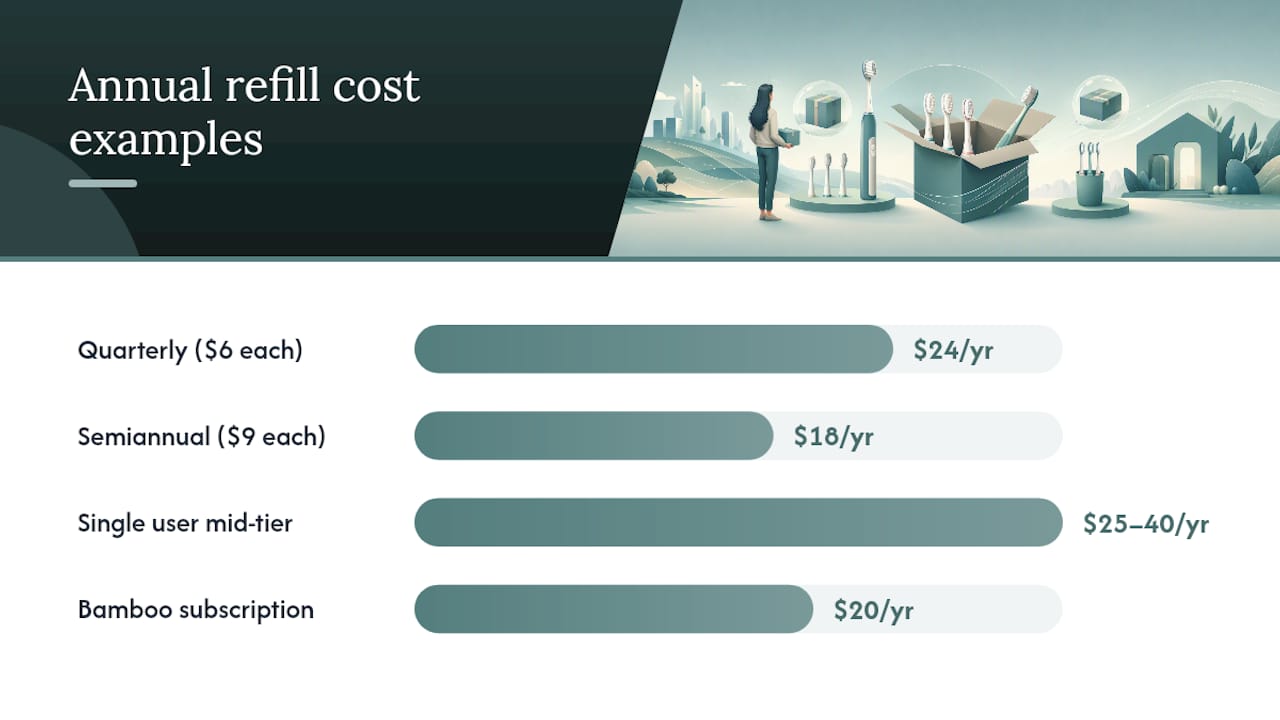
Quick Math: If your plan ships heads every three months at $6 each, that’s $24 a year, or about $2 a month. Bump the per-head price to $9 and stretch to a 180-day cadence, and you land closer to $18 a year, roughly $1.50 monthly. The cadence matters just as much as the sticker price.
Household size changes the math fast. A single user on a mid-tier plan might spend $25 to $40 annually on refills alone. Two people sharing one charging base but using separate heads roughly doubles that refill cost while splitting the one-time hardware fee. A family with kids often needs separate handles entirely, since children’s brushes are sized differently, which means multiple starter kits plus multiple refill lines running in parallel.
Buyer-focused roundups show the market stretching even further at both ends. Some no-frills subscriptions price as low as $1 to $10 per month total, while premium bundles push upfront costs higher and price replacement heads closer to the $7 to $10 mark. Not every subscription is electric, either. Some bamboo toothbrush subscriptions run flat annual rates near $20, though shipping thresholds and delivery frequency shift the effective per-brush cost.
Watch for extras that inflate the number you actually pay. Shipping is sometimes included and sometimes tacked on per shipment, which adds up over a year of quarterly deliveries. Sales tax applies in most states at checkout. Some auto-ship programs bundle in toothpaste, floss, or whitening strips, which raises the subscription price but can undercut buying those items separately at retail. Read the cart total before you commit, not just the advertised per-head price.
What Do Toothbrush Subscription Plans Actually Include?
Not all plans are structured the same way, and the structure affects both price and flexibility. Understanding the common models helps you read a pricing page without getting surprised at checkout.
- Starter kit plus recurring heads. You pay a one-time fee for the handle and base, then get billed on a schedule for replacement heads. This is the most common model among electric brush subscriptions.
- Refill-only plans. You already own the handle (maybe purchased outright, maybe from a previous kit) and sign up only for the recurring head shipments. This usually runs cheaper long-term since there’s no repeated hardware cost.
- Bundled plans. Toothpaste, floss, or mouthwash ship alongside your brush heads for one combined price. Convenient, but only a deal if you’d have bought those items anyway.
Refill cadence is the lever most people overlook. A 90-day cycle matches the dentist-recommended replacement schedule and keeps bristle wear in check, but it also means four shipments a year instead of two. Switching to a 180-day cadence roughly halves your annual head spend, though it means brushing with worn bristles for longer, which can reduce cleaning effectiveness even if your bank account doesn’t notice.
Policy details change the value of a plan more than most people expect. Consumer Reports found that subscribers cared less about shaving a dollar off per-head pricing and more about whether they could easily change intervals or cancel without a hassle. Plans that require a phone call or support ticket to pause a shipment create real friction, and unused refills piling up in a drawer often cost more than the savings ever delivered.
Pro Tip: Before you subscribe, check three things on the plan’s terms page: how many clicks it takes to change your ship date, whether cancellation requires contacting support, and if there’s a minimum commitment period before you can pause. If any of those answers involve “call us,” expect friction later.
Is a Toothbrush Subscription Worth the Cost?
Run the numbers before you decide. Add up what you currently spend per year on replacement heads bought individually at retail, or on manual toothbrushes replaced every few months. Compare that total against a subscription’s annual cost, including the starter kit amortized over its first year. For most single users, the difference is small, often within $10 to $15 a year either direction.
Household situations shift the calculation more than brand choice does.
- Single user: Subscription cost roughly equals retail replacement cost; convenience is the deciding factor.
- Partner sharing one base: Splitting the hardware fee while each person gets their own head cuts the effective per-person startup cost nearly in half.
- Family with kids: Multiple handles mean multiple subscriptions running simultaneously, so total household cost climbs even if per-unit pricing stays reasonable.
Data Point: Wired’s testing noted that performance differences, motor strength, pressure sensors, charger type, often matter more to perceived value than the price gap between budget and premium plans. A $10 difference in refill cost feels irrelevant if one brush actually gets you brushing longer and more consistently.
Price isn’t the only variable worth weighing. A subscription enforces the three-month replacement habit that most people abandon on their own, which matters for plaque control regardless of what you paid. Storage space, travel frequency, and whether you want automatic delivery versus remembering to reorder all factor into whether the convenience is worth paying for.
A few tactics lower the real cost without giving up the benefit:
- Share a charging base with a partner if the brand supports multiple compatible heads
- Choose a 180-day cadence if your bristles aren’t visibly frayed at 90 days
- Consider compatible third-party replacement heads where available, since they often undercut brand-name refill pricing
The honest takeaway: subscriptions rarely beat one-off retail pricing by much. What they buy is consistency, and consistency is what actually protects your teeth. Our breakdown of cost versus results digs further into whether the math favors an automatic brush at all.
How Y-brush’s Subscription Fits Cost and Convenience Needs
Some subscriptions are designed around a simple problem: most people know they should brush for two full minutes, but the average brushing session runs under a minute. Some products use patented Y-shaped heads to deliver a full clean in about 20 seconds using sonic vibrations, which removes the time excuse entirely. Pairing such designs with a subscription means the replacement schedule takes care of itself too.
A typical Y-brush subscription signup includes:
- A starter kit with the handle, charging base, and initial brush head
- Scheduled replacement head shipments on a cadence you select
- Compatible head options for both the Y-shaped design and other brands, including Philips Sonicare-compatible heads
- The option to adjust or pause shipments through your account
The core promise is speed paired with structure. A 20-second brushing routine only helps your oral health if the brush head doing the work is actually fresh, and worn bristles clean less effectively no matter how advanced the handle is. Scheduled refills close that gap automatically, which is the same convenience-first logic Consumer Reports found driving subscriber satisfaction across the category.
Pro Tip: If you’re brushing twice a day and hitting the recommended two minutes’ worth of coverage in Y-brush’s 20 seconds, don’t stretch your head-replacement interval past what your plan recommends. Faster brushing sessions mean your bristles still see the same number of uses; they just compress into less time.
To be direct about trade-offs: a manual toothbrush replaced every three months will almost always cost less in raw dollars than any electric subscription, Y-brush included. What you’re paying the difference for is speed, consistency, and not having to think about reordering. If your priority is the absolute lowest price and you’re diligent about buying replacements on your own schedule, a subscription may not be the better fit. If you’ve ever gone six months on a worn-out brush head because reordering slipped your mind, the subscription structure solves exactly that problem.
When I’d Sign Up for a Subscription, and When I’d Skip It
If you’re busy, forgetful about reordering, or managing brushing for a family with kids on staggered schedules, a subscription earns its cost. The automatic cadence does the remembering for you, and that’s worth more than the few dollars you might save shopping around each time.
If you brush infrequently, don’t mind buying in bulk, or you’ve found reliable compatible third-party heads at a lower price, skip it. You’re disciplined enough to not need the automation, so paying for it is pointless.
My practical advice: start with a single starter kit before committing to a subscription. Try a 90-day cadence first since it matches dental guidance, then stretch to 180 days if your bristles still look fine. Adjust from real usage, not guesswork.
— Joris
Get Started With a Y-brush Subscription
Some subscriptions are alternatives to guessing when to reorder heads or scrambling to find a new one at the drugstore. A subscription locks in the schedule for you, pairing fast cleaning technology with replacement heads that show up before your current one wears out.
Signing up gets you a starter kit, your choice of refill cadence, and the flexibility to adjust shipments as your routine changes. If you want the fast clean without the family-size commitment, the Y-brush Essential Sonic Toothbrush is the standard entry point. Households with children can start with the Y-brush KidsBrush, sized for ages four to twelve. For anyone who wants the full-featured version with additional accessories, the Y-brush Ultra Sonic Toothbrush covers that ground.
Check the subscription details page for current cadence options and what each shipment includes, then pick a starter kit that matches your household size.
Sources
- Electric toothbrush subscriptions - Consumer Reports
- Which toothbrush subscription service is the best? - Wired
- The best toothbrush subscriptions to keep your breath fresh - Byrdie
FAQ
Can I Pay Monthly for an Electric Toothbrush Subscription?
Most subscriptions bill per shipment (typically every 90 to 180 days) rather than monthly, but the total cost translates to roughly a few dollars monthly depending on the plan and cadence you choose.
Is There an Electric Toothbrush Subscription Available?
Yes. Several brands offer electric toothbrush subscriptions covering starter kits and recurring replacement heads, and Y-brush’s subscription pairs its 20-second sonic clean with scheduled head shipments you can adjust.
How Much Does a Premium Toothbrush Subscription Cost?
Premium plans generally run higher on both ends: starter kits can reach $80 or more, and replacement heads often price around $7 to $10 each, compared to $3 to $6 for budget plans.
Are Premium Toothbrushes Worth the Extra Cost?
It depends on what you value: testing has shown that motor strength, pressure sensors, and charger quality can make a premium brush feel worthwhile even when refill pricing is similar to budget options.
Do Toothbrush Subscriptions Actually Save Money Compared to Buying Retail?
Usually not by much. Subscriptions mainly deliver convenience and help you stick to the three-month replacement cycle dentists recommend, rather than guaranteeing lower costs than buying heads individually.


