


Most toothbrush bristles are nylon, a synthetic polymer, and the most common grade is nylon 6-12. Polyester filaments such as PBT and PET are the main alternative. Natural hog and horse hair, once standard, is now rare. Newer plant-derived and compostable filaments exist too, and each material differs in stiffness, water absorption and how long it keeps its shape. Below, we explain what each one does in your mouth, which differences matter, and how bristle material fits with head design and brushing time.
TL;DR
- Nylon is the standard bristle material, and nylon 6-12 is the most widely used type, valued for flexibility, softness and wear resistance.
- PBT and PET polyesters absorb far less water than nylon and keep their stiffness when wet, but they are stiffer, so they are often blended with nylon.
- Plant-based and compostable bristles exist, but “plant-based” does not automatically mean soft, long-lasting or home-compostable.
- Rounded bristle ends, bristle diameter and head design affect gentleness and cleaning as much as the polymer does.
- Whatever the material, replace the brush head regularly so the bristles still clean as designed.
Table of Contents
- What are toothbrush bristles made of?
- The main types of toothbrush bristles
- Nylon 612 explained
- PBT versus nylon: a head-to-head
- Can bristles be softer by design?
- Plant-based, bio-based and compostable bristles
- What about BPA-free claims?
- How to choose bristles that suit you
- Where the head design comes in
- Promo: Y-Brush plans and brush heads
- Perspective
- FAQ
- Sources
What are toothbrush bristles made of?
A narrative review of powered toothbrush design states that toothbrushes are typically fitted with nylon or nylon-polyester mixed bristles. PBT and PET are listed as alternatives, and natural bristles historically came from hogs and horses.
The same review explains why nylon won out. It was discovered in 1935 by a former Harvard professor working for DuPont, and the first nylon-bristled toothbrush appeared in 1938. Nylon has the right flexibility and softness, plus good chemical, heat and wear resistance. Its weaknesses are that it absorbs water and can deform, which is why manufacturers round off the bristle tips to protect gums.
In the United States, the bristle is part of the legal definition of the product. Under 21 CFR 872.6855, a manual toothbrush is a shaft with natural or synthetic bristles at one end, meant to remove adherent plaque and food debris to reduce tooth decay. It is a Class I device under general controls and is exempt from premarket notification.
The main types of toothbrush bristles
When readers search for bristle types, they usually mean one of two things: the material, or the stiffness label (soft, medium, firm). This section covers materials. Stiffness comes later.
| Material | Where it comes from | Main strengths | Main trade-offs |
|---|---|---|---|
| Nylon (6-12 and others) | Synthetic polyamide | Flexible, soft, wear resistant | Absorbs water, can deform |
| PBT / PET | Synthetic polyester | Low water absorption, durable, lower cost | Stiffer, less flexible |
| Nylon-polyester blends | Mixed filaments | Balance of softness and durability | Depends on the blend |
| Natural hair | Hog or horse | Historic standard | Absorbs water fast, loses stiffness |
| Plant-derived or compostable filaments | Bio-based polymers such as PLA or castor-oil nylons | Lower reliance on petroleum, end-of-life options | Performance varies by formulation |
Nylon
Nylon is the workhorse. It is easy to extrude into very consistent filaments, can be tapered and end-rounded, and gives the springy softness most people want. The review above names nylon as the most commonly used bristle material, and nylon 6-12 as the most common type. The numbers refer to the carbon atoms in the two building-block molecules, a diamine and a dibasic acid.
PBT and PET polyesters
According to the same review, polyesters such as PBT and PET beat nylon on cost, durability and water absorption. They are not soft, though. Their low flexibility and excess stiffness can damage gums, so they tend to appear in disposable brushes or blended with nylon. That is useful context if you see “PBT bristles” on a label: it tells you the polymer, not how gentle the finished brush is. Tip shape and filament thickness decide that.
Natural bristles
Hog and horse hair were the original material. Natural fiber soaks up water faster and in larger amounts than nylon. Filament supplier data reports that natural hair bristle loses 40% of its stiffness after only 10 minutes in water, while Tynex 612 nylon needs 10 hours to lose 28%. For a tool that lives in a wet bathroom and is used twice a day, that gap explains why synthetics took over.
Nylon 612 explained
Nylon 612 (sold under the Tynex name) is the grade behind the common “nylon 6-12” description. It is a nylon variant made from longer-chain building blocks, and that structure is why it handles moisture better than older nylons.
The same filament performance data compares moisture uptake and stiffness retention:
| Nylon type | Moisture absorbed at 50% RH | Moisture absorbed at 100% RH | Wet-to-dry stiffness ratio |
|---|---|---|---|
| Nylon 6 | 2.7% | 9.5% | 0.50 |
| Nylon 66 | 2.5% | 8.5% | 0.35 |
| Nylon 610 | 1.5% | 3.5% | not listed |
| Nylon 612 | 1.3% | 3.0% | 0.72 |
A wet-to-dry ratio of 0.72 means a nylon 612 bristle keeps 72% of its dry stiffness when wet. For you, that means the bristle behaves more predictably from the first brushing of a new head to the last, and it springs back rather than going limp as it soaks.
PBT versus nylon: a head-to-head
PBT shows up on packaging as a selling point, so it helps to see the actual properties. Technical data from a filament manufacturer compares a 6.12 nylon filament with a PBT filament:
| Property | Nylon 6.12 (Wytex 6.12S) | PBT (Plyer SK) |
|---|---|---|
| Specific gravity | 1.06 | 1.26 |
| Melting point | 410°F | 430°F |
| Bend recovery | 95% | 94% |
| Tensile modulus | 490 k-psi | 520 k-psi |
| Maximum water absorption | 3.5% | 0.5% |
The same source shows how stiffness changes with humidity. The nylon’s tensile modulus falls from 570 k-psi at 0% relative humidity to 490 at 50% and 410 at 100%. The PBT holds at 540, 530 and 515 k-psi over the same range. So PBT is the steadier material when wet, while nylon 6.12 is a little less stiff to begin with, which is part of why it feels softer.
The practical point: neither is simply “better.” PBT wins on consistency and durability, nylon on softness and flexibility. Many manufacturers use both, in the same head or across product lines, and tune the result with diameter and tip finish.
Can bristles be softer by design?
Yes, and polymer chemistry is only one lever. A 2024 in vitro study compared a polyester filament called Curen with nylon. The polyester filaments had a much lower tensile strength (41.69 MPa dry, 35.18 MPa wet) than nylon (321.56 MPa dry, 325.44 MPa wet). That corresponded to 72.84% less enamel abrasion in the lab test. After 5,000 brushing cycles they showed 30% less splaying than nylon, and the authors link this to roughly twice the nylon filament’s longevity, up to six months of brushing.

The study also notes that because these polyester filaments absorb almost no water, finer filaments and a shorter head can be used while keeping durability. One ultra-soft brush in the study carries 5,460 bristles of 0.1 mm each. The lesson is that a bristle’s behavior comes from material, diameter, count, tip shape and head layout together.
Plant-based, bio-based and compostable bristles
This is where labels get slippery, so it helps to know the terms.
- Bio-based means the raw material comes from plants rather than petroleum. Castor-oil nylons are the common example.
- Biodegradable or compostable describes what happens at end of life, and usually only under specific conditions.
- Plastic-free is a different claim again. A bio-based nylon is still a polymer.
PLA is one well-known bio-based polyester. A review of its production describes it as biodegradable and derived from renewable sources such as corn sugar, potato and sugar cane. It is considered GRAS by the US FDA, and the major producer, NatureWorks, operates a 150,000 metric-ton-per-year facility in Blair, Nebraska.
For compostability, look for recognized standards. One filament maker says its fully biodegradable BioFil filament complies with ASTM D6400 and EN 13432, which require more than 90% conversion to carbon dioxide, water and minerals within six months under aerobic composting conditions. Those conditions are industrial or controlled, so check how a brand tells you to dispose of the product.
Does a bamboo-handle brush clean differently? A 2024 clinical comparison in Saudi Arabia measured gingival bleeding over eight weeks. Bleeding sites fell 21.04% in the bamboo group and 22.7% in the conventional group, with 16.68% in a miswak group. The takeaway is that the handle material is not what drives results. The bristles, the technique and the time do.

What about BPA-free claims?
You will see “BPA-free” on many toothbrush listings. It means the product was not made with bisphenol A. It does not describe stiffness, durability or what the bristles are actually made of. If safety is your concern, read the full material description and look at what the manufacturer says about testing, rather than relying on one label. For questions about a specific sensitivity or allergy, ask your dentist.
How to choose bristles that suit you
- Start with softness. Pick soft or extra-soft if you have gum recession, sensitivity or bleeding. The reviewed literature is clear that stiffness is what can harm gums, which is why tips are rounded and stiffer polyesters are often blended.
- Look at tip finish and diameter. Rounded ends and finer filaments matter as much as the polymer name.
- Consider water behavior. If your brush sits damp, a material that holds its stiffness when wet (nylon 612 or PBT blends) will feel more consistent over its life.
- Match the head to your mouth. Children and adults with smaller mouths do better with heads sized for them.
- Replace heads on schedule. Splayed bristles stop cleaning as designed, whatever they are made of.
- Factor in the technique. The best bristle still has to reach all surfaces for enough time, which is where design and motion count.
Where the head design comes in
Bristle material is one input. The other is how the bristles are arranged and how the head moves. Our brush heads use a patented Y-shaped design, and our sonic brush is designed to deliver a complete clean in 20 seconds. We built the product around a problem we see constantly: people know they should brush for two full minutes, yet a typical brush session lasts under one minute. A head that cleans more surfaces at once is designed to close that gap.
Promo: Y-Brush plans and brush heads
If you are ready to try a brush built around fast, full-mouth cleaning, our membership plans keep fresh heads arriving on a schedule. Published prices are $29.90 per quarter for the Core Plan, $49.90 per quarter for the Pro Plan and $69.90 per quarter for the Pro+2 Plan. You can compare them on our toothbrush plans page.
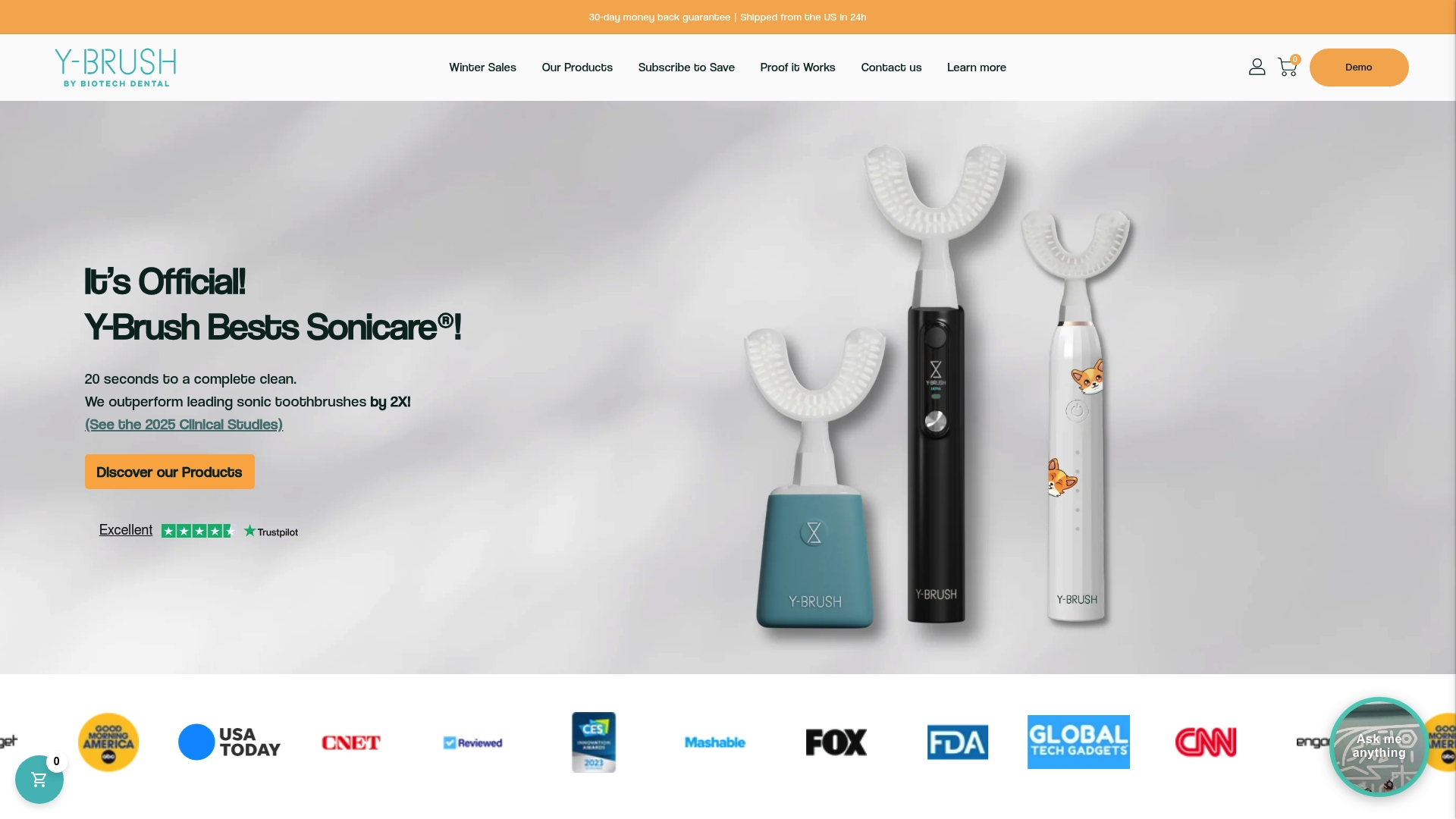
Need replacements only? Browse our brush heads and toothbrushes, including compatible heads for other brands.
Perspective
We get asked about bristle materials a lot, and our answer is that the material is the starting point, not the finish line.
Nylon and polyester both clean well when they are made into well-finished, rounded filaments. What changes the result in real life is whether the brush gets used for long enough and reaches every surface. That is why we put our effort into the Y-shaped head and into a 20-second routine people can actually keep.
We also think replacement is part of the product. Bristles splay and wear, so a membership that delivers fresh heads each quarter keeps the brush working the way it was designed. Our approach is clinically proven, in our testing, to remove plaque 2X more effectively than leading sonic toothbrushes, and we back it with a subscription-based lifetime warranty.
Choose a soft bristle, a head that fits your mouth, and a routine you will keep. Everything else is detail.
Joris
FAQ
Are toothbrush bristles plastic?
Most are. Nylon is a synthetic polymer, and PBT and PET are polyesters, which are also plastics. Natural hair and some bio-based or compostable filaments are exceptions, and the powered toothbrush review lists these material families. Check the product description for the exact polymer.
What does PBT mean on a toothbrush?
PBT is polybutylene terephthalate, a polyester used for bristles. It absorbs very little water and keeps its stiffness when wet. It is stiffer than nylon, so it is often blended with nylon or used in finer filaments to keep the brush gentle.
What is nylon 612?
Nylon 612 is a nylon grade, sold as Tynex, and the same family as the “nylon 6-12” most bristles use. It absorbs less moisture than nylon 6 or nylon 66 and retains about 72% of its stiffness when wet, according to filament performance data.
Are natural or plant-based bristles better?
Not automatically. Natural hair absorbs water quickly and loses stiffness, and plant-based filaments vary by formulation. Judge any bristle by softness, tip finish, diameter and how long it holds its shape, and ask your dentist if you have gum concerns.
How often should I replace my brush head?
Replace it when the bristles look splayed or worn, and on a regular schedule even if they do not. Fresh bristles clean as designed. Our membership plans deliver replacement heads quarterly so the schedule takes care of itself.
Sources
- Safety and Design Aspects of Powered Toothbrush, narrative review (PMC, 2020)
- 21 CFR 872.6855, manual toothbrush classification (govinfo)
- Filament Performance in Brushes (Brushtec)
- Toothbrush filament data (Monahan Filaments)
- Physicochemical Properties of Curen Filaments Versus Nylon (PMC, 2024)
- Poly(lactic acid): mass production, processing, industrial applications
- Plaque Removal and Gingival Bleeding Using Biodegradable Toothbrushes (PMC, 2024)
- BioFil fully biodegradable filament (Tai Hing)


