


Mouthpiece toothbrushes are generally low-risk to put in your mouth, but safe is not the same as effective. Safety depends on bristle softness, fit, hygiene and, for children, supervision. Whether a brush actually cleans your teeth depends on whether its bristles reach every tooth surface and the gumline. This guide covers both questions, so you can judge any mouthpiece or U-shaped brush, and any other electric brush, on the same checklist.
TL;DR
- Look for soft bristles, a comfortable fit and gentle pressure. The ADA recommends soft-bristled toothbrushes and gentle pressure to help reduce the risk of gum injury.
- Safety and cleaning power are separate questions. A 2020 clinical trial of one U-shaped brush found it did not remove plaque better than no brushing.
- Fit is the main issue: a fixed mouthpiece may not match your dental arches, leaving bristles off the teeth and gums.
- Children need parent-assisted brushing with a soft, age-appropriate brush and fluoride toothpaste, whatever device is used.
- Rinse, store upright to air dry, and replace the brush or head every three to four months.
Table of Contents
- What a mouthpiece toothbrush is, and why people ask about safety
- How toothbrushes are regulated and what the ADA Seal means
- Are mouthpiece toothbrushes safe for teeth and gums?
- What the clinical evidence shows about plaque removal
- Fit: the safety factor people overlook
- Are mouthpiece toothbrushes safe for kids?
- Braces, retainers and other dental work
- Cleaning, storing and replacing your brush
- A checklist for any brush you are considering
- Our perspective
- Fast brushing without the guesswork
- FAQ
- Sources
What a mouthpiece toothbrush is, and why people ask about safety
A mouthpiece toothbrush, also sold as a U-shaped or automatic toothbrush, has a molded tray lined with bristles, usually silicone or nylon. You bite into it, press a button, and it vibrates or oscillates for a short cycle, often 10 to 30 seconds. The promise is speed: all tooth surfaces at once, with no technique required.
That promise is why the category is popular with busy adults, parents of young children and people with limited hand mobility. It is also why people search for safety information. A device that sits in the whole mouth raises fair questions. Can it hurt gums? Does it fit every mouth? Is it fine for a six-year-old? Can you use it with braces?
The answers below separate three things that are often blurred together: whether the device is safe to use, whether it cleans well, and whether it suits a particular person.
How toothbrushes are regulated and what the ADA Seal means
In the United States, the FDA classifies powered toothbrushes as Class I devices that are exempt from 510(k) premarket notification, and manufacturers must register their establishment. Manual toothbrushes are also Class I and exempt from premarket notification. In plain terms, a toothbrush does not need FDA clearance before it is sold, so a brush on a store shelf or website has not necessarily been independently tested.
The ADA Seal of Acceptance is the closer check. According to the ADA, the Seal indicates the manufacturer supplied scientific evidence of safety and efficacy for plaque removal and gingivitis reduction, which the ADA Council on Scientific Affairs evaluates against objective requirements.
Two practical points follow:
- Look up the exact product. The ADA lists accepted products individually, so a Seal on one model does not carry over to a similar-looking brand. At least one U-shaped brush has an ADA Seal listing, which shows the category is not automatically excluded.
- Read the Seal for what it says. It speaks to safety and to plaque and gingivitis outcomes, evaluated on the manufacturer’s evidence. It does not tell you whether a brush fits your mouth.
Are mouthpiece toothbrushes safe for teeth and gums?
The risk to gums and enamel comes mostly from two things: stiff bristles and heavy pressure. The ADA advises soft bristles and a gentle touch, and that applies to every brush type.
For a mouthpiece brush, add these checks:
- Soft, rounded bristles. Silicone or soft nylon, never firm or splayed.
- No pinching or rubbing. If the tray digs into the gums or cheeks, it does not fit. Stop using it.
- A sensible cycle length. Follow the manufacturer’s time; running it longer does not clean better and can irritate soft tissue.
- Intact parts. Cracked trays or loose bristles are a reason to replace the device.
- Bleeding or soreness that lasts. See your dentist, because it can signal gum disease or a poor fit.
Nothing in the checked research points to a specific injury pattern unique to mouthpiece brushes. The documented concern is different: a brush that is gentle but does not touch all the surfaces leaves plaque behind. That is a cleaning problem, and over time plaque is a gum health problem. The ADA states that the main purpose of brushing is to remove plaque, which is the primary cause of gum disease and combines with sugar to make acids that decay enamel.
What the clinical evidence shows about plaque removal
The best-known test is a 2020 randomized crossover trial of 22 participants. It found the U-shaped automatic electric toothbrush tested was not significantly better than no brushing for plaque removal, and significantly worse than both a powered toothbrush and the participants’ usual brushing. The authors said it could not be recommended for regular home oral hygiene. They suggested the silicone bristles may have been too short to reach teeth and gums, and that the fixed shape and size may not fit individual dental arches.
A 2023 pilot study of an auto-cleaning device found similar fit problems. Increasing brushing time from 5 to 15 seconds per jaw produced plaque reduction comparable to manual brushing. The same study reported that in 95% of people the device was too short to cover the second molars, and that in 30.67% of teeth the gingival margin was not covered by bristles.
How to read this fairly:
- Each study tested one specific device. They do not test every mouthpiece product, and design details such as bristle length, material and tray size matter.
- The 2020 trial measured one-time plaque removal in dental students. It did not assess gingivitis or long-term effects, so it speaks to cleaning, not to long-term harm.
- The consistent theme is coverage. The question to ask of any brush is whether its bristles touch the full tooth surface and the gumline in your mouth.
Fit: the safety factor people overlook
A fixed tray assumes a standard-sized arch. Mouths vary in width, tooth position, crowding, bite and gum height. When the tray does not match, three things happen: bristles miss the back molars, bristles skip the gumline where plaque collects, and areas of the gum get pressed more than others.
A quick fit test before you commit to a device:
- Bite into the tray without turning it on. All teeth, including the back molars, should sit in the channel.
- Check the gumline. Bristles should rest against the junction of tooth and gum, not hover above it.
- Turn it on briefly. It should feel like light vibration, never pinching or scraping.
- After a week, check with a disclosing tablet or ask your hygienist at your next visit where plaque remains.
If the answer to any of these is no, the device is not right for your mouth, whatever the packaging says.
Are mouthpiece toothbrushes safe for kids?
Children are the group most marketed to, and the one where adult supervision matters most. The American Academy of Pediatric Dentistry advises a soft, age-appropriate toothbrush and fluoride toothpaste twice daily once teeth erupt, with young children needing a parent to perform or help with brushing.
U.S. dentists interviewed by Parents in 2025 cautioned that U-shaped brushes may miss some tooth surfaces and should not replace parent-assisted brushing. One described a possible limited role when a child with a disability or injury cannot brush independently, which is an exception rather than a general recommendation.
Practical rules for parents:
- Pick a size made for the child’s mouth. An adult tray on a small child is a fit and gag-reflex problem.
- Stay with the child for the full cycle, and keep the device away from unsupervised use.
- Use a pea-sized or smear amount of toothpaste as your pediatric dentist advises for the child’s age.
- Ask the child’s dentist at the next checkup to look at how clean the teeth are, which tells you more than any claim on a box.
Braces, retainers and other dental work
This is the question the checked research does not settle. Some manufacturers state their brushes are safe around braces and retainers, but those are company claims, and no independent trial of mouthpiece brushes on orthodontic patients turned up in our research. Brackets and wires create surfaces a flat tray cannot follow, and plaque tends to build around them.

If you wear braces, have bonded retainers, crowns, bridges or implants, ask your orthodontist or dentist before using any new device. They can tell you whether it is safe for your hardware and whether you need a brush with a head shaped for the job. Never swap it in for the cleaning routine your orthodontist prescribed without their approval.
Dentist-applied protection can also add to daily brushing. If you are prone to cavities in the grooves of your molars, sealants for adults are one option to discuss at your next visit.
Cleaning, storing and replacing your brush
Hygiene is the other half of safety, and it is the same for every brush. ADA guidance is to rinse the toothbrush thoroughly after use and store it upright so it can air dry. The ADA notes that closed containers can promote microbial growth, so skip the sealed travel case except when you are traveling, and let the brush dry before you pack it. Replace toothbrushes every three to four months, or sooner if bristles become matted or frayed.
With a mouthpiece device, apply that guidance to the tray:
- Rinse the tray under running water right after use, getting into the bristle channel.
- Let it air dry upright, away from the toilet and other people’s brushes.
- Clean the charging base and button with a damp cloth, keeping electronics away from water unless the manufacturer says the part is waterproof.
- Follow the maker’s replacement schedule for the tray or head. Silicone can look fine while it wears down.
A checklist for any brush you are considering
| Question | What a good answer looks like |
|---|---|
| Is it ADA-accepted? | The exact model appears in the ADA product listing |
| Are the bristles soft? | Soft, rounded bristles, no firm filaments |
| Does it fit your arches? | Reaches back molars and sits at the gumline |
| Is there evidence it removes plaque? | Independent testing or the ADA Seal, not marketing claims alone |
| Is it right for the user’s age? | Child-sized for kids, with a parent supervising |
| Is it compatible with your dental work? | Confirmed by your orthodontist or dentist |
| Can you replace the head affordably? | Replacement heads are available on a regular schedule |
Our perspective
We built Y-Brush around a simple observation: most people know they should brush for two minutes, yet a typical brush lasts under one. The answer is not to ask people to try harder. It is a brush that fits how people live.
That is why our design starts from coverage, the same issue the research above keeps returning to. Our patented Y-shaped head uses sonic vibrations and is designed to deliver a complete clean in 20 seconds, so speed does not come at the expense of reaching the teeth and gumline.
We also stand behind that design. Y-Brush is clinically proven, in our testing, to remove plaque 2X more effectively than leading sonic toothbrushes, and we back it with a subscription-based lifetime warranty.
Our advice for anyone comparing quick-clean brushes is the checklist above: soft bristles, real coverage, proper hygiene and fresh heads on schedule. Our membership plans ship replacement heads regularly, so the third item is handled for you.
Joris
Fast brushing without the guesswork
If the appeal of a mouthpiece brush is a faster routine, a sonic brush with a Y-shaped head is built for the same goal. Y-Brush delivers a complete clean in 20 seconds for adults and children, and replacement heads arrive on a schedule so you never brush with worn bristles. Plans are published per quarter: the Core Plan is $29.90, the Pro Plan $49.90 and the Pro+2 Plan $69.90.
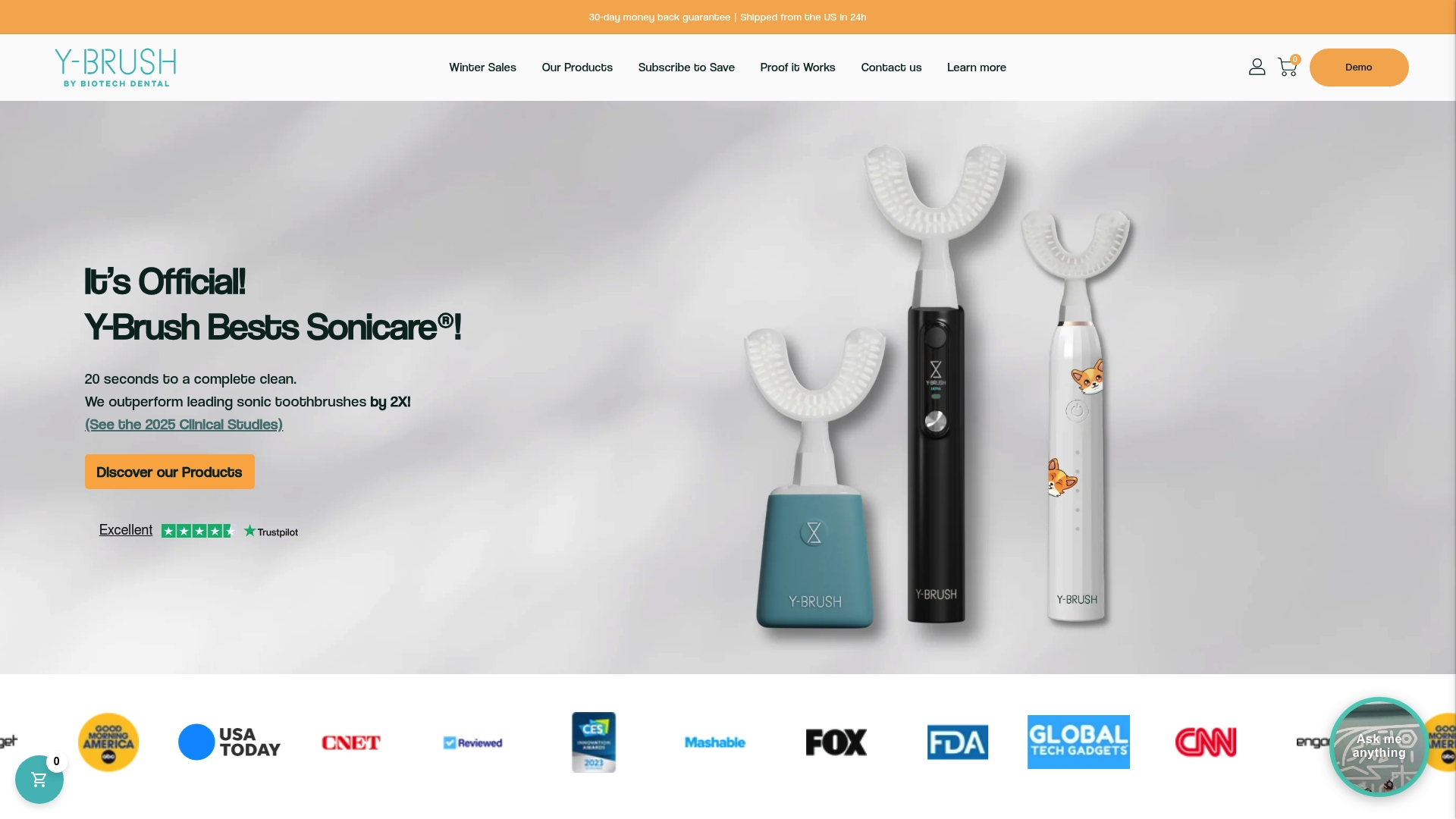
You can also browse Y-Brush toothbrushes and brush heads, including heads compatible with other brands.
FAQ
Are electric toothbrushes safe for gums?
Yes, when used as directed. The ADA recommends soft-bristled brushes and gentle pressure for any toothbrush, manual or powered. Let the brush do the work, follow the timer, and see your dentist if your gums bleed or hurt for more than a short time.
Do U-shaped toothbrushes work?
It depends on the product and your mouth. One 2020 trial found the tested U-shaped brush was not better than no brushing, mainly because of poor contact with teeth and gums. Others have an ADA listing. Check the specific model, the fit and what your dentist sees at your checkups.
Can children use a mouthpiece toothbrush?
Only with a parent supervising, and not as a replacement for parent-assisted brushing. The AAPD advises a soft, age-appropriate brush and fluoride toothpaste twice a day. Ask your child’s dentist whether a device suits your child’s mouth.
Can I use one with braces or retainers?
Ask your orthodontist first. Brackets and wires are hard for any fixed tray to clean around, and manufacturer statements are not a substitute for your orthodontist’s advice on your specific appliance.
How often should I replace my toothbrush or brush head?
Every three to four months, or sooner if the bristles are frayed or matted, according to the ADA. Rinse after each use and store the brush upright so it dries fully.
Sources
- Toothbrushes, American Dental Association
- Care of children’s teeth, American Dental Association
- ADA Seal of Acceptance product listing for a U-shaped toothbrush series
- Efficacy of a U-Shaped Automatic Electric Toothbrush, 2020 trial
- Cleansing efficacy of an auto-cleaning toothbrushing device, 2023 pilot study
- AAPD parent FAQ
- Are U-Shaped Toothbrushes Good For Kids?, Parents
- FDA product classification, powered toothbrush
- FDA product classification, manual toothbrush


