


Kids’ and adult brush heads differ in three ways that matter: head size, bristle softness and, on electric models, how much power the handle delivers. A child needs a small, soft head that fits a small mouth and reaches the back teeth. An adult needs a head that cleans efficiently without being too big to maneuver. Most children can move to an adult-sized head around ages 9 to 10, and some adults with small mouths do better with a compact head.
This guide covers how the two types differ, how to match a head to your child’s age, whether adults can use kids’ heads, and what to check before you swap heads between handles.
TL;DR
- Kids’ heads are smaller with soft bristles, so they fit small mouths and protect developing teeth and gums. Adult heads are larger and designed for a fully grown mouth.
- The American Dental Association (ADA) and the American Academy of Pediatric Dentistry (AAPD) both point children to a small-headed, soft-bristled brush.
- By ages 9 to 10, when many adult teeth are present, the AAPD says an adult toothbrush and toothpaste may be used.
- Adults can use a compact or kids’ head if it fits their mouth better, as long as the bristles are soft and the technique is sound.
- Before mixing heads and handles, confirm compatibility with the handle’s manufacturer. A head that clicks on is not always designed for that handle.
Table of Contents
- How kids’ and adult brush heads differ
- Matching the head to your child’s age
- Can an adult use a kids’ brush head?
- Are kids’ heads compatible with adult handles?
- Sonic heads: why shape matters as much as size
- Perspective
- A practical checklist for choosing
- Replacing heads: why it matters for both ages
- Y-Brush plans for families
- FAQ
- Sources
How kids’ and adult brush heads differ
Children’s mouths are not scaled-down adult mouths. Their teeth are still erupting, their gums are more delicate, and the space to work in is much smaller. Brush heads reflect that in a few concrete ways.
| Feature | Kids’ brush head | Adult brush head |
|---|---|---|
| Head size | Small, easy to move around the whole mouth | Larger, built for a full-sized mouth |
| Bristles | Soft | Soft recommended (medium and hard are usually discouraged) |
| Electric power | Often lower power settings | Typically a wider range of intensities |
| Handle fit | Designed for smaller hands | Designed for adult grip |
| Goal | Reach every surface, build the habit | Efficient plaque removal, gum care |
Head size
The ADA says a toothbrush head should be small enough to maneuver easily inside a child’s mouth and reach all tooth surfaces, including the back teeth. It also advises caregivers to use a child-sized brush with a small head and soft bristles once a child’s first teeth come in.
If you want a number, Children’s Hospital of Philadelphia cites a head of roughly 1 inch by 1/2 inch as a general guideline for children. One oral health guideline from Hong Kong’s health authorities gives head diameters that range from 15 mm for ages 0 to 2 up to 25 mm for age 12 and above. Treat those as reference points, not strict rules: fit in your child’s mouth is what counts.

Bristle softness
Soft bristles are the standard for children. The AAPD recommends soft-bristled toothbrushes only for kids, and the ADA recommends soft bristles because they lower the risk of gum abrasion. Healthy gums matter early: if your child’s gums look red, swollen or bleed when brushing, this explanation of gingivitis in children covers what gum inflammation looks like in young patients, and a pediatric dentist can tell you what is going on.
Soft is not just a kids’ rule. The ADA’s advice for adults is also soft bristles with gentle pressure, so the bristle category itself is the same across both age groups. What changes is the head that carries them.
Power and handle design
On electric brushes, the AAPD notes that some models are designed specifically for children, with smaller heads and lower power settings than adult versions. The same guide says power brushes can make the transition from parent-assisted to independent brushing easier, which is a real benefit for kids who tire of manual brushing quickly.
Matching the head to your child’s age
The AAPD guidance is simple: choose a brush designed for a child’s smaller hands and mouth, and let the head size grow as your child does. In practice, here is how that tends to look.
Babies and toddlers (first teeth to about age 3)
The ADA and AAPD advise caregivers to clean teeth with a child-sized, small-headed, soft-bristled brush as soon as teeth erupt. At this age you are the one brushing, so a small head that lets you see and reach every surface is more important than any feature. Powered heads are optional here; many families wait until the child tolerates the sensation.
Preschool and early school age (about 4 to 8)
Children start to brush on their own but rarely do a thorough job without help. This is where a kids’ electric brush can help. Lower power, a small head and a handle sized for small hands let a child take over without losing coverage. Keep checking their work, especially the back teeth and the gumline.

Ages 9 to 10 and up
The AAPD’s parent FAQ says that by ages 9 to 10, when many adult teeth are present, a child can use an adult toothbrush and toothpaste. That does not mean every 9-year-old must jump to a full-size head. If your child still finds the back molars hard to reach, a compact head is a sensible stepping stone.
Can an adult use a kids’ brush head?
Yes. Delta Dental of Nebraska notes that some adults use children’s toothbrushes when the smaller head fits their mouth better. A dentist quoted in a ranking discussion put it plainly: with proper technique, you should be fine. Adults most likely to benefit include people with a small mouth, a strong gag reflex, or difficulty reaching the back teeth.
If you go that route:
- Choose soft bristles. This is the same rule as for any adult.
- Use gentle pressure and proper technique. The brush does the work; scrubbing harder does not clean better.
- Pick a compact head if reaching your back teeth is difficult. A head you can angle behind the last molar beats a larger one you cannot.
- Replace it on schedule. The ADA says to replace a brush or head every three to four months, or sooner if the bristles are matted or frayed.
The flip side, a child using an adult head, is less ideal before the teen years. A larger head is harder to control in a small mouth and can miss the back teeth, which is exactly where the ADA says a child’s head needs to reach.
Are kids’ heads compatible with adult handles?
This is the question that trips up many shoppers. Brush heads attach to the handle through a specific connector, and each manufacturer builds its own. Some heads fit more than one handle in the same product family, and some adult heads will physically attach to a children’s handle. But fitting is not the same as being designed for it.
Three things to check before you mix and match:
- Connector and model. Look at the head’s listed compatible handles, not just whether it snaps on.
- Power and motion. A kids’ handle is often tuned to lower power. A head built for a more powerful adult handle may not move as intended on it, and a small kids’ head on a high-power adult handle can feel too intense for a child.
- Size for the user. Whatever the fit, the head still has to suit the mouth it is going into.
The safest route is to buy heads the manufacturer lists for your exact handle. If you are unsure, the manufacturer’s compatibility chart or support team can confirm it.
Sonic heads: why shape matters as much as size
Size and softness are the basics, but head design also affects how well bristles reach the places plaque hides: along the gumline and between teeth. That is the idea behind Y-Brush’s patented Y-shaped head, which we design to cover the tooth surfaces in a single pass so a full clean takes 20 seconds rather than two minutes of manual effort.
To be clear about the standard guidance: the ADA recommends brushing twice a day for two minutes, with either a manual or powered brush. Y-Brush’s own claim is that its design delivers a complete clean in 20 seconds and, per the company’s clinical testing, removes plaque 2X more effectively than leading sonic toothbrushes. Whatever brush you choose, keep up the habit of brushing twice daily and see your dentist regularly.
Perspective
Parents often ask us whether they should buy one brush for the whole family and just swap heads. Our view: the handle can be shared when it is designed for it, but the head should always be chosen for the mouth it goes into.
We built Y-Brush around a simple fact: most people brush for under a minute, even though they know they should brush for two. A head that covers more of each tooth at once, with sonic vibrations doing the work, closes that gap for adults and for children alike. For kids especially, a short routine is easier to stick to, and a habit that sticks matters more than any single feature.
So we recommend sizing the head to the age and mouth, keeping bristles soft, and replacing heads on schedule. Our membership plans exist for that last part: fresh heads arrive regularly, so nobody is brushing with frayed bristles because they forgot to reorder.
Joris
A practical checklist for choosing
Use this when you are standing in front of a shelf or a product page.
- Check the age range. Does the manufacturer say the head suits your child’s age?
- Check the bristles. Soft only, for kids and adults.
- Test the size. Can the head move easily in the mouth and reach the back molars?
- Confirm handle compatibility. Match the head to the handle model, not to the brand alone.
- Set a replacement reminder. Every three to four months, or sooner if bristles splay. Children’s brushes often wear out faster because kids chew on them.
- Plan the transition. Around ages 9 to 10, review whether your child is ready for an adult-sized head.
Replacing heads: why it matters for both ages
Worn bristles clean less well, and the ADA’s guidance is to replace your brush or head every three to four months. For children, who tend to bite and chew bristles, check more often. A head that looks fanned out or flattened is done, whatever the calendar says. Keeping spares on hand avoids the temptation to stretch a worn head another month.
Y-Brush plans for families
Y-Brush makes electric toothbrushes with patented Y-shaped heads for adults and children, plus replacement heads and compatible heads for other brands. Our membership plans bring regular refills so heads get replaced on time, and they come with a subscription-based lifetime warranty.
- Core Plan: $29.90 per quarter
- Pro Plan: $49.90 per quarter
- Pro+2 Plan: $69.90 per quarter
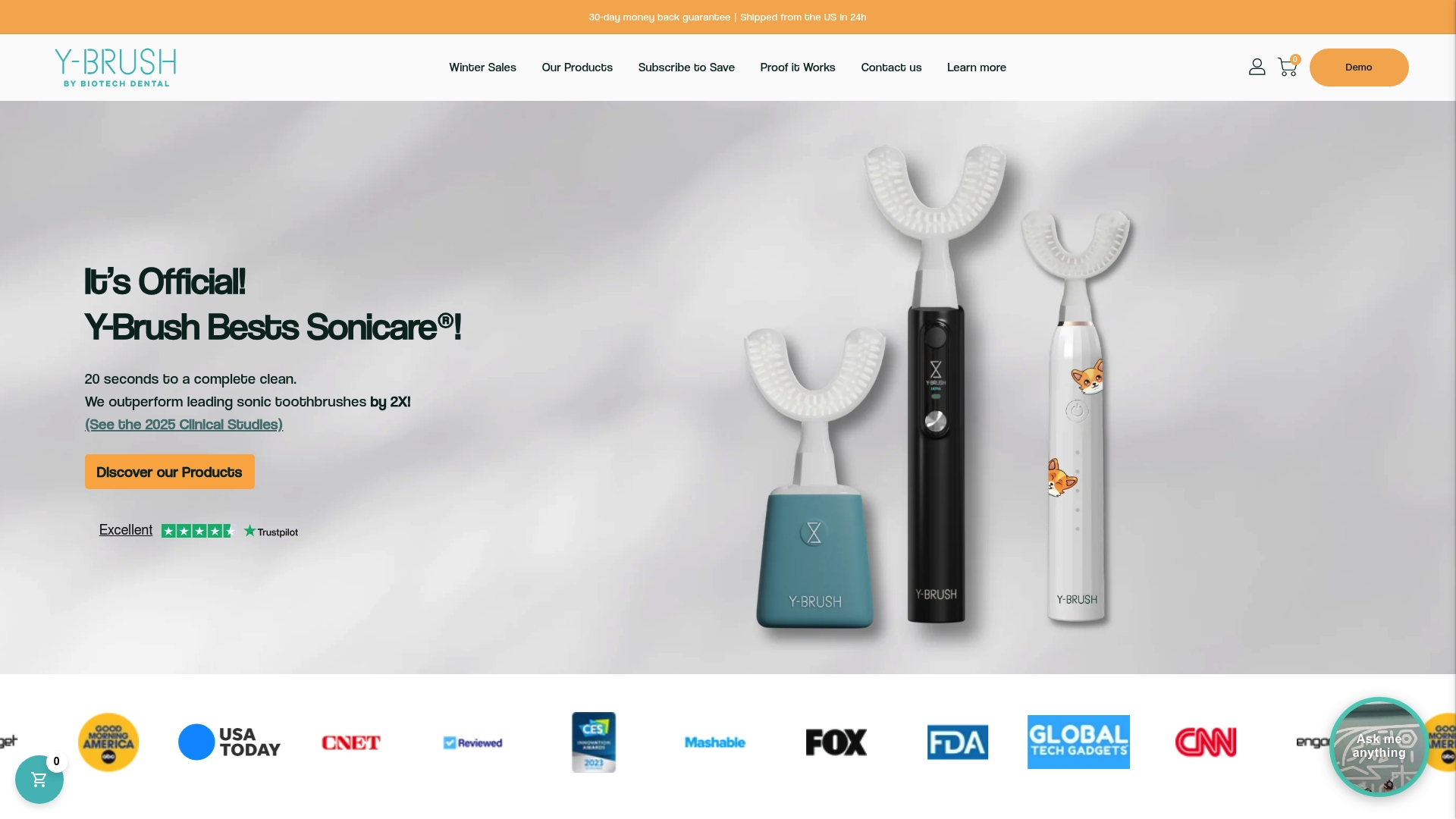
You can compare the options on our toothbrush plans page, or browse replacement brush heads and toothbrushes if you already own a handle.
FAQ
How long should kids brush?
The ADA recommends brushing twice a day for two minutes. Younger children often need help to reach that, so a parent should supervise or take over the brushing until the child can cover every surface alone. A timer or a brush that signals the time can help.
Is a kids’ toothbrush different from an adult one?
Yes. Kids’ brushes have a smaller head, soft bristles and a handle sized for small hands. Kids’ electric models may also use lower power settings. These features help a child reach all tooth surfaces without irritating gums.
What is the difference between a kids’ electric toothbrush and an adult one?
The main differences are head size and power. Per the AAPD, some electric brushes are designed specifically for children, with smaller heads and lower power than adult versions. The soft bristles are the same standard for both.
When can my child switch to an adult brush?
The AAPD says that by ages 9 to 10, when many adult teeth are present, a child may use an adult toothbrush and toothpaste. Switch earlier only if your dentist agrees, and keep a compact head if your child still struggles with the back teeth.


