


USB-charging toothbrushes are a practical choice for most shoppers, especially anyone who travels or wants to skip bulky wall chargers. We recommend Y-Brush as a USB-capable option worth considering for its speed and convenience. Before buying, confirm the USB type (A or C), realistic battery life, and whether travel charging features come included.
TL;DR:
- Confirm whether the handle uses USB A, USB C, or a proprietary cradle, and check that the required cable or adapter comes in the box.
- Treat battery life claims as estimates: brushing twice daily for two minutes and using stronger modes can shorten advertised multiweek runtime.
- Read the manual before using a wall adapter or power bank, since some models require their supplied cradle and may reject low output sources.
- Budget for replacement heads every three to four months, and compare refill availability and subscription pricing rather than judging ownership cost by handle price alone.
- For frequent trips, a battery case can reduce charging worries, but it adds bulk and cost; check airline rules for built in lithium batteries.
Table of Contents
- What to check when choosing a USB charging toothbrush
- How USB charging and compatibility actually work for electric toothbrushes
- Battery life expectations and safe charging practices
- Travel charging options and accessories that work with USB brushes
- How Y-Brush meets the USB-charging buyer’s needs
- When USB charging should be a priority
- Try the Y-Brush approach to faster, simpler brushing
- FAQ
- Sources
What to check when choosing a USB charging toothbrush
Not every “USB-rechargeable” toothbrush works the same way, so a little label-reading saves frustration later. Electric toothbrushes require electricity and are rechargeable, and most remove plaque through rapid brush-head movement, which is exactly why charging method and reliability matter so much when you are comparing options.
Before adding anything to your cart, run through these checks:
- USB type: confirm whether the brush uses USB-C or USB-A, and whether a cable or wall adapter is actually included in the box.
- Battery claims versus real use: a “weeks per charge” figure usually assumes moderate brushing time, not two full minutes twice a day every day.
- Charging method: some brushes use a cradle, others a magnetic stand, and a growing number charge through a direct USB-C port.
- Replacement-head cost: check availability and subscription pricing so you know the real cost of ownership, not just the sticker price.
- Travel and warranty notes: look for water-resistance ratings and whether the warranty covers the charging base.
Consumers comparing models should also weigh in features like two-minute timers and quadrant alerts, since most people brush for far less time than recommended, and replacement heads generally need swapping every three to four months according to Consumer Reports.
Pro Tip: Check the product page for the exact cable type pictured, not just the word “USB,” since USB-A and USB-C cables are not interchangeable.
How USB charging and compatibility actually work for electric toothbrushes
Charging setups fall into two broad categories: cradle-based systems, where the handle sits in a dock that connects to power, and built-in USB-C ports, where you plug a cable directly into the handle. Both approaches ultimately draw from the same type of power source, but the hardware inside the handle is tuned to a specific voltage and current range.
Here is what matters when you plug in:
- Voltage is standard: most USB chargers output 5 volts, so voltage mismatches are rarely the problem.
- Amperage can vary: a charger with too little current may charge slowly, while an unregulated source can stress the battery over time.
- Inrush protection differs: some cheap adapters and power banks cannot handle the toothbrush’s initial power draw and simply won’t start a charge.
- Manufacturer instructions take priority: manuals commonly warn against charging while wet and against charging outside a specified temperature range, and some explicitly require the supplied cradle to protect both safety and warranty coverage, as outlined in a typical charging and safety manual.
A “USB-capable” handle does not automatically mean any wall charger or power bank will work safely, so the included instructions are worth a quick read before your first charge.
Battery life expectations and safe charging practices
Battery claims like “40 days” or “two weeks per charge” describe lab conditions, not necessarily your bathroom routine. Some premium brushes and travel-case systems advertise multi-week battery life per charge, though real-world runtime depends heavily on brushing frequency and which intensity mode you use most, according to a recent sonic toothbrush review.
A few habits keep batteries healthy and charging predictable:
- Fully charge the handle before first use, even if the brush already powers on.
- Unplug once charged rather than leaving it docked indefinitely.
- Dry the handle before placing it on the charger, especially around the base.
- Charge within the temperature range listed in the manual, since extreme heat or cold can shorten battery life.
If runtime drops sharply, the handle won’t hold a charge overnight, or the indicator light behaves erratically, those are signs to contact support or consider a replacement handle. Whether you can brush while charging depends entirely on the specific model, so check the manual rather than assuming.
Travel charging options and accessories that work with USB brushes

Travel is where USB charging earns its keep, but not every accessory performs equally well. Charging cases with built-in batteries add convenience and sometimes UV sanitizing, while magnetic stands are simple but require a nearby outlet, and standard power banks offer flexibility if their output is strong enough to actually start a charge.
Before you pack:
- Bring the correct cable type (confirm USB-C versus USB-A ahead of time).
- Pack a spare brush head if you’re traveling longer than a few days.
- Let the brush dry fully before sealing it in a case.
- Check airline rules on lithium batteries if your case has a built-in battery pack.
- Choose a power bank with sufficient output rating and pass-through charging, since some lower-output banks won’t initiate a charge at all.
Travel cases with integrated batteries can meaningfully reduce charging anxiety on trips, though they add bulk and cost, so weigh the battery-days claim against how much you actually travel.
How Y-Brush meets the USB-charging buyer’s needs
We built our toothbrush around the idea that oral care should fit real schedules, not the other way around. Our brush head is designed to deliver a complete clean quickly using sonic vibrations, which pairs naturally with USB-friendly charging since you spend far less time at the sink and less time tethered to an outlet overall.
We offer subscription plans that include regular brush-head refills, so replacement timing is handled automatically rather than guessed at, complementing professional care like routine hygiene appointments. That matters for the buying criteria above: predictable replacement costs, travel-friendly design, and a charging setup that doesn’t demand constant attention. The handle and charging base are designed to work together reliably, which keeps the experience simple for anyone who wants fast, consistent results without extra steps.
When USB charging should be a priority
If you travel often, share a bathroom with limited outlet space, or just want one less cable to manage, USB charging is worth prioritizing. If you need a long-term institutional setup or a brush with an extended warranty tied to a specific charging base, a traditional pedestal charger might suit you better. For most everyday households, though, a USB-capable brush strikes the right balance between simplicity and reliability.
— Joris
Try the Y-Brush approach to faster, simpler brushing
We offer three subscription options built around convenience, each including regular brush-head refills; current prices are on the pricing page.
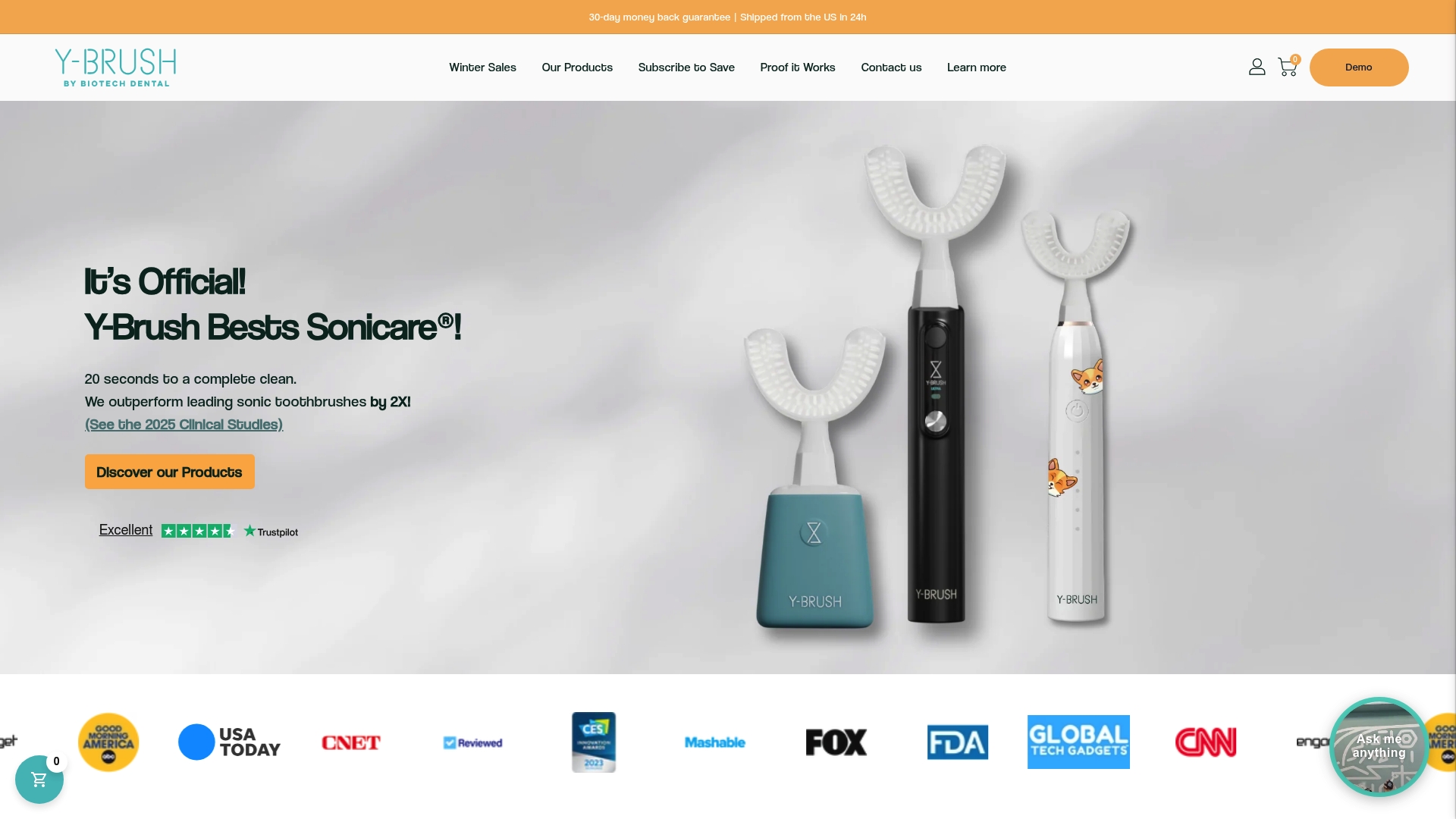
- A 20-second clean replaces the standard two-minute routine without cutting corners.
- Subscription refills mean you’re never guessing when to replace a head.
- USB-friendly charging keeps travel and daily use simple.
Browse the full lineup and find your plan on our Y-Brush toothbrush collection.
FAQ
Which USB-charged toothbrush is the best?
The right choice depends on your priorities, but Y-Brush stands out for pairing a 20-second clean with USB-friendly charging and subscription-based head replacements. Always confirm the USB type and included accessories before buying any model.
What electric toothbrushes charge with USB-C?
A growing number of rechargeable toothbrushes now use USB-C ports or cables instead of older USB-A or proprietary plugs. Check the product listing and included manual to confirm the exact cable type, since USB-C and USB-A are not interchangeable.
Is there a way to charge an electric toothbrush without a charger?
Some brushes can charge through a standard USB cable connected to a computer or wall adapter if the handle has a built-in USB-C port, but others require their specific cradle. Manufacturer manuals often warn against using unapproved power sources, so check your device’s instructions before improvising.
Does an electric toothbrush need to be plugged in all the time?
No, most rechargeable toothbrushes are designed to hold a charge for days or weeks depending on use, so constant plugging in isn’t necessary. Leaving the handle on the charger between uses is common, but unplugging once it’s fully charged helps protect long-term battery health.


