


Sonic toothbrushes remove more plaque than manual brushing, with moderate-quality evidence backing that conclusion, but differences between sonic and other powered brush types are small and inconsistent across trials. The strongest findings come from Cochrane-level reviews comparing powered to manual brushing, while head-to-head comparisons between sonic and oscillating-rotating models show mixed results that depend heavily on study design. The sections below walk through that evidence in order of strength.
TL;DR:
- Cochrane pooled estimates show powered brushes reduced plaque by about 11% short term and 21% longer term, though mixed brush types prevent technology specific conclusions.
- Oscillating rotating brushes had a modest interdental plaque advantage over sonic models at eight weeks, but the measured gap narrowed by six months.
- Head to head trials often enroll fewer than 100 participants per group and run only 8 to 12 weeks, while manufacturer sponsorship complicates comparisons.
- Choose a brush you will use consistently and brush for two minutes; claims that 20 seconds is enough need published clinical evidence gathered over several weeks.
Table of Contents
- What Systematic Reviews Say About Powered Toothbrushes and Plaque Removal
- Head-to-Head Trials: Sonic vs Oscillating-Rotating Brushes
- Single-Brushing Studies: What Immediate Plaque Removal Evidence Actually Shows
- How Sonic Brushes Remove Plaque: Mechanism and Practical Relevance
- How Much Does This Evidence Actually Matter for Oral Health?
- Practical Evidence-Based Takeaways for Choosing and Using a Sonic Brush
- Our Take on Rapid-Clean Marketing Claims
- Where Y-Brush Fits Into the Evidence
- FAQ
- Sources
What Systematic Reviews Say About Powered Toothbrushes and Plaque Removal
The clearest evidence in oral care research concerns powered brushes as a category, not sonic brushes specifically. A widely cited Cochrane update found that powered toothbrushes reduce plaque and gingivitis more effectively than manual brushing, with moderate-quality evidence supporting roughly an 11% reduction in plaque at short-term follow-up and around 21% at longer-term follow-up, measured using the Turesky plaque index. That gap between short- and long-term results matters: it suggests the benefit of powered brushing compounds with consistent use rather than appearing only in a single session.
The review pooled results from numerous randomized trials, each measuring plaque using standardized indices before and after switching from manual to powered brushing. Because trials varied in brush type, bristle design, and follow-up length, the pooled estimate carries real uncertainty, and the review’s authors graded the supporting evidence as moderate rather than high quality.
Key findings from the pooled evidence:
- Powered brushes outperformed manual brushes on plaque scores at both short-term and long-term follow-up.
- Gingivitis improved alongside plaque reduction, suggesting the plaque benefit translates into gum health gains.
- Rotation-oscillation and sonic brushes were grouped together in many of the included trials, which limits what the pooled result tells us about either technology specifically.
The powered-versus-manual plaque reduction gap grows over time: short-term studies show about an 11% reduction in plaque, climbing to roughly 21% with sustained use, according to Cochrane’s pooled analysis. That trend points toward real-world habit formation as a factor, not just a one-time mechanical advantage.
Heterogeneity across included studies means the headline percentages should be read as averages across different brush models, bristle configurations, and patient populations rather than a promise about any single device. A review that mixes sonic brushes with rotation-oscillation models cannot tell a reader which specific technology drove the improvement. That distinction becomes important once we look at trials designed to isolate sonic brushes from their oscillating-rotating competitors.
Head-to-Head Trials: Sonic vs Oscillating-Rotating Brushes
Once researchers compare sonic brushes directly against oscillating-rotating brushes, the picture gets more complicated. A 2021 narrative review found rotation-oscillation brushes reduced plaque and gingivitis slightly more than side-to-side sonic brushes over short-term follow-up, with a standardized mean difference of 0.24 for plaque reduction under three months. That is a real but modest effect, and the review’s authors flagged its clinical importance as unclear.
More recent evidence narrows the question to interproximal plaque, the film that builds up between teeth where brushing often falls short. A 2024 systematic review found oscillating-rotating brushes removed slightly more interdental plaque than sonic brushes, with a mean difference in the Rustogi Modified Navy Plaque Index of 0.09 at eight weeks. That result reached statistical significance, but the review also noted the effect shrank by six months, suggesting any early advantage narrows as both groups continue brushing.
Not every trial favors oscillating-rotating designs. Some studies and reviews report comparable outcomes between the two technologies on gingival indices, and a handful find sonic brushes performing better at reducing gum inflammation, depending on bristle design and brushing pressure. The inconsistency across trials is itself informative: it tells us no single powered technology has established a clear, repeatable edge across every outcome measure.
What limits confidence in these comparisons:
- Many trials enroll fewer than 100 participants per arm, which makes small effect sizes hard to distinguish from noise.
- Follow-up periods cluster around 8 to 12 weeks, leaving long-term comparative data thin.
- Industry sponsorship is common in this research area, and trials funded by a brush manufacturer sometimes cluster around favorable results for that manufacturer’s technology.
A narrative review examining oscillating versus sonic action heads noted that effect sizes between powered modes are often small and of uncertain clinical relevance, and that heterogeneous trial reporting makes cross-study comparison difficult. Taken together, the head-to-head literature supports a modest, short-term edge for oscillating-rotating brushes on interproximal plaque specifically, not a broad verdict that one powered technology beats the other.
Single-Brushing Studies: What Immediate Plaque Removal Evidence Actually Shows
A separate category of research measures plaque removal after a single brushing session rather than weeks of use. These studies typically have participants accumulate plaque for 24 hours without brushing, then measure plaque scores immediately before and after one timed brushing session. Some of these protocols have reported statistically significant plaque score drops after a single use, which is unsurprising since even manual brushing removes substantial plaque in one session.
The appeal of single-brushing trials is that they isolate the mechanical cleaning action from behavioral factors like consistency over weeks. The limitation is that they cannot tell us anything about gingivitis control, long-term plaque accumulation patterns, or whether a shorter brushing protocol holds up outside a controlled lab setting. A single-use result is a surrogate endpoint: it measures immediate mechanical removal, not the sustained oral health outcome that actually matters to patients.
Why single-brushing data needs a careful read:
- These trials usually recruit healthy adult volunteers, not the periodontal patients or children who may benefit most from improved plaque control.
- A strong single-session result does not predict whether users will maintain the behavior long enough to see gingivitis improvement.
- Shorter brushing protocols, including claims around 20 to 30 second routines, deserve scrutiny for peer-reviewed, multi-week data before being read as equivalent to a full two-minute brushing session.
Pro Tip: Treat any single-session plaque removal statistic as a starting point for curiosity, not a stand-in for the multi-week gingivitis data that determines real clinical benefit.
Single-brushing studies are genuinely useful for understanding mechanical efficiency in isolation, but they sit lower on the evidence hierarchy than the multi-week randomized trials discussed earlier. A brush that performs well in a single 20-second test still needs longer trials to confirm that performance holds up as a practical daily habit.
How Sonic Brushes Remove Plaque: Mechanism and Practical Relevance
Sonic toothbrushes move bristles side to side at high frequency, typically in the range of tens of thousands of movements per minute, generating vibration that agitates fluid around the bristle tips. The proposed mechanism involves this fluid motion creating shear forces that help dislodge plaque even in areas the bristles do not directly touch, a claim often described as the brush’s fluid dynamics effect. This differs mechanically from oscillating-rotating brushes, which use a small round head that rotates in alternating directions against each tooth surface.

In practice, the fluid agitation effect is thought to help most along the gum margin, where plaque forms a thin biofilm that bristles alone may not fully disrupt. Some clinicians favor sonic brushes for patients managing early gum inflammation, reasoning that the vibration’s reach into the gingival crevice offers an advantage there, though the comparative trial evidence on this point remains mixed rather than conclusive.
Head size and design often matter more than the underlying motor technology. Oscillating-rotating brushes use small round heads that can access tight interproximal spaces one tooth at a time, which may explain their modest edge on interdental plaque in recent trials. For patients with orthodontic hardware or dental implants, the ability of a given head to maneuver around brackets and wires frequently outweighs any difference between sonic and rotation-oscillation technology.
The practical takeaway is straightforward: the specific motor technology inside a powered brush is one variable among several, and brushing technique, duration, and head fit to the user’s mouth often carry more weight than whether the bristles move side to side or in small circles.
How Much Does This Evidence Actually Matter for Oral Health?
Reading plaque removal research critically means separating a statistically significant result from one that changes real-world outcomes. Many of the trials comparing powered brush types report differences of a few percentage points or small standardized mean differences, numbers that can reach statistical significance in a large enough sample without translating into a meaningfully different experience for the person holding the brush.
Several recurring quality issues limit how much weight any single trial should carry. Sample sizes in comparative powered-brush trials often run under 100 participants per group, follow-up periods rarely extend past three to six months, and risk-of-bias assessments frequently flag unclear randomization or blinding procedures. Industry sponsorship adds another layer of caution, since a trial funded by the manufacturer of one brush type may be more likely to report results favoring that brand.
Plaque measurement itself varies across studies. The Turesky index, the Rustogi Modified Navy Plaque Index, and the Löe and Silness gingival index all quantify different things in different ways, which means a result expressed as a percentage reduction on one index is not directly comparable to a standardized mean difference on another.
What this means for interpreting small numeric differences:
- A 3 to 7% difference in plaque index between two powered brush types is unlikely to be noticeable without laboratory measurement.
- Consistency of use over months matters more to gingivitis outcomes than the size of any single trial’s reported effect.
- A brush with a slightly lower short-term plaque score in one trial does not guarantee a better long-term gum health outcome for every user.
The interdental plaque difference between oscillating-rotating and sonic brushes shrinks over time: the 0.09 mean RMNPI difference favoring oscillating-rotating brushes at eight weeks narrows by six months, reinforcing that early trial results do not always predict longer-term parity between technologies.
Practical Evidence-Based Takeaways for Choosing and Using a Sonic Brush
The research supports a few clear, low-risk decisions for anyone evaluating a sonic toothbrush against their current routine.
- If you currently brush manually, switching to any powered brush, sonic or oscillating-rotating, is likely to improve plaque control, based on the moderate-quality evidence behind powered brushing overall.
- When choosing between sonic and oscillating-rotating models, prioritize the brush you will actually use consistently over small differences reported in short-term trials, a point echoed in consumer-testing summaries that found both types effective.
- Aim for a full two-minute brushing session, or follow your brush’s built-in timer, since duration and coverage influence plaque removal as much as motor technology.
- If a product advertises a validated shorter brushing protocol, ask for peer-reviewed, multi-week data before assuming it matches the gingivitis outcomes documented for standard two-minute brushing.
- Replace brush heads on the manufacturer’s recommended schedule, since worn bristles reduce the mechanical effectiveness that the underlying research measures.
Pro Tip: Keep a brush’s timer or pacer running for the full cycle rather than stopping early. Most of the plaque reduction evidence assumes a complete, unhurried session.
Any brand claiming a rapid-clean alternative to the standard two-minute routine should be evaluated against its own published, peer-reviewed data rather than general powered-brush research, since the evidence summarized above was gathered using conventional brushing durations.
Our Take on Rapid-Clean Marketing Claims
Marketing claims about dramatically faster brushing deserve the same scrutiny we apply to any clinical claim: look for peer-reviewed randomized trials, clearly defined endpoints, and ideally independent replication outside the manufacturer’s own research. A single internal test is not the same as a published, multi-week RCT measuring plaque and gingivitis over time.
We think claims like a 20-second clean deserve to be read as exactly what they are: a brand’s own stated benefit, not an independently established clinical finding until corroborating published data exists. That distinction matters because the Cochrane-level evidence behind powered brushing in general was built on standard-length brushing sessions, not abbreviated ones.
Readers evaluating any rapid-clean product should ask their dentist or hygienist whether a shorter protocol suits their specific oral health needs, particularly if they manage gum disease, orthodontic hardware, or other conditions where thorough interproximal cleaning carries extra weight.
— Joris
Where Y-Brush Fits Into the Evidence
We built our brush around a simple observation in this research: powered brushing works, but only when people actually do it consistently, and most people fall short of a full two-minute session. Our design surrounds the teeth on multiple sides at once, aiming to deliver a complete clean in 20 seconds using sonic vibration, a claim we present as our own stated benefit rather than an independently published clinical finding.
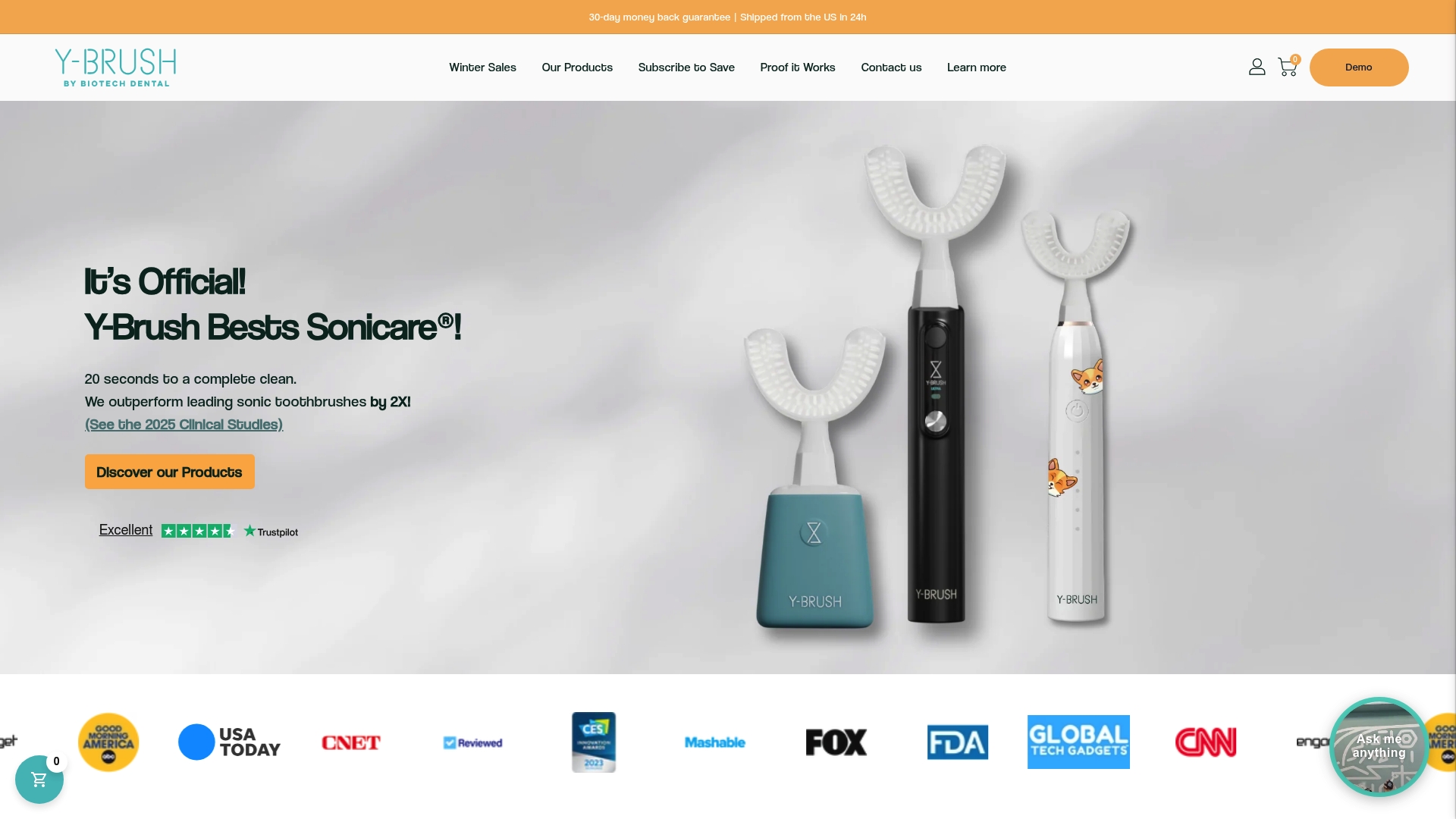
We back our design with a warranty, and we invite anyone evaluating the claim to review our published product information or reach out for details on the studies behind it.
- Explore our toothbrush and subscription plans for current details.
- Browse our full toothbrush and brush head catalog for replacement heads and accessories.
- If you brush manually today or struggle to hit two minutes consistently, our Y-shaped design is built to meet you where your routine already is.
We encourage you to weigh our claims the same way you would weigh any brand’s: against the published evidence and your own dentist’s guidance.
This article is general information, not a substitute for advice from a qualified doctor. Consult a qualified healthcare professional about your own circumstances before acting on anything here.
FAQ
What do dentists think of sonic toothbrushes?
Dental guidance generally supports powered brushes, including sonic models, for patients managing gum inflammation or limited dexterity, since the moderate-quality evidence shows they outperform manual brushing on plaque and gingivitis. Many clinicians emphasize that consistent, correct technique matters more than the specific powered technology chosen.
What is the downside of a sonic toothbrush?
The main downsides are cost compared to a manual brush and the need for regular brush head replacement, plus the fact that some trials show oscillating-rotating brushes edging out sonic models on interdental plaque in short-term follow-up. Evidence on these differences remains mixed and the gap tends to narrow over longer use periods.
Can Sonicare cause receding gums?
No published evidence in the research reviewed here ties sonic brushing to gum recession when used with proper technique and pressure. Receding gums are more commonly linked to aggressive brushing pressure or hard bristles regardless of brush type, so checking technique with a dentist is the appropriate step if recession is a concern.
What type of toothbrush is best for removing plaque from my teeth?
Any powered toothbrush, sonic or oscillating-rotating, removes more plaque than manual brushing according to pooled clinical evidence. Our Y-Brush is designed around sonic vibration delivered through a Y-shaped head meant to clean multiple tooth surfaces at once, offered through our toothbrush plans, though the brush you will use consistently every day remains the most important factor.


