


Do three things and splatter stops: put the brush head in your mouth before switching it on, use an amount of toothpaste about the size of a pea, and keep the bristles mostly inside your mouth while brushing. Research on electric toothbrushes shows they produce splatter, not aerosol, meaning droplets fall fast and land close by, so the fixes are about technique and surface control rather than complicated equipment. Keep reading for the science and a step-by-step routine you can start today.
TL;DR:
- Most splatter from sonic toothbrushes falls within one meter and settles within 1.8 seconds, making surface cleaning more effective than ventilation adjustments.
- Using a pea-sized amount of toothpaste and fully inserting the brush before turning it on can significantly reduce droplet dispersion during brushing.
- A smaller, denser brush head and regular cleaning of the connection point help prevent hardware issues that cause unexpected spraying.
- Shortening brushing time with faster routines like Y-Brush further minimizes splatter exposure without sacrificing cleaning efficacy.
- Pre-brush rinses can lower microbial load, but technique and hardware maintenance remain the primary ways to control splatter risks.
Table of Contents
- Why sonic toothbrushes splatter instead of spraying aerosol
- Step-by-step technique to reduce splatter while brushing
- Brush setup, head choice, and maintenance that prevent spraying
- Pre-brush rinses and their role in cleaner, lower-risk splatter
- What to do when your toothbrush suddenly starts spraying
- Why we think the fuss over splatter misses the bigger picture
- A faster brushing routine that limits splatter exposure
- FAQ
- Sources
Why sonic toothbrushes splatter instead of spraying aerosol
The mess your sonic toothbrush makes has a name in the research world, and it is not what most people assume. A 2021 study measuring droplet sizes from demonstration electric toothbrushes found that the particles produced were consistently between 200 and 1200 micrometers, with an average size of about 500 micrometers. That range puts them firmly in the splatter category rather than the aerosol category, a distinction that matters more than it sounds.
Splatter and aerosol behave in completely different ways. Aerosol particles are small enough to stay suspended in the air, drift with currents, and potentially travel across a room. Splatter droplets are heavier and follow a ballistic path, meaning they shoot out, arc, and land, much like a tiny water balloon rather than a mist. The droplet-size study found that most splatter settled within about 1 meter of the source, and 99% of droplets fell within less than 1.8 seconds. High-speed video and particle-sizing instruments both confirmed the same pattern: fast-falling splatter, not lingering aerosol.
This matters for how you think about controlling the mess. If your toothbrush produced true aerosol, you would need ventilation changes or air filtration to manage it. Because it produces splatter, the problem is almost entirely about trajectory and distance, which you control with technique and a few seconds of cleanup.
It is worth being honest about the limits of that research. The study tested specific demonstration electric toothbrush models under simulated conditions, not every sonic brush on the market, and lab setups do not always mirror a bathroom sink with a mirror, faucet, and countertop in the mix. Results give a reliable general picture of droplet behavior, not a guarantee for every device and every brushing style.
A few practical conclusions follow directly from the data:
- Keeping the brush head inside your mouth reduces the distance splatter has to travel before it lands on a surface.
- Because droplets fall within roughly 1.8 seconds, a quick wipe-down right after brushing catches nearly everything before it dries.
- Splatter traveling about 1 meter means your sink, mirror, and nearby counter are the realistic zone of concern, not the whole bathroom.
- Technique changes that reduce how far droplets fling in the first place will outperform any after-the-fact cleaning strategy.
None of this means splatter is purely cosmetic. The droplets carry saliva, toothpaste, and some bacterial load from your mouth, so reducing both the spread and the biological content gives you a cleaner routine on two fronts. The next section turns the physics into a step-by-step method you can use starting with your next brushing session.
Step-by-step technique to reduce splatter while brushing
Knowing that splatter is ballistic and short-lived tells you where to intervene: at the source, with how you load the brush, angle it, and move it. Here is the order that produces the most noticeable difference, starting with the highest-impact change.
- Wet the bristles and load an amount of toothpaste about the size of a pea. The American Dental Association recommends a pea-sized amount for adults and children aged 3 and older, and using more than that gives the vibrating bristles extra slurry to fling before it has a chance to work into your teeth.
- Place the brush fully in your mouth before turning it on. This single habit change eliminates the moment when most splatter happens, which is the half-second between activation and insertion when bristles are moving at full speed with nothing to contain them.
- Angle the brush head at about 45 degrees to your gumline. The ADA’s brushing guidance describes this angle for a reason beyond plaque removal: it keeps the bristle tips oriented toward your gums and teeth rather than outward toward your lips, which reduces how much slurry gets projected forward.
- Use steady, light contact rather than broad sweeping strokes. Sonic brushes are designed to do the scrubbing motion internally, so pressing hard or swinging your arm in wide arcs just displaces more liquid without improving the clean.
- Work quadrant by quadrant with consistent, gentle contact. Moving methodically through each section of your mouth keeps the brush head stable against your teeth instead of bouncing, which is often what sends droplets flying toward the mirror.
- Rinse with short, controlled spits rather than one long stream. Keeping your mouth partially closed as you spit, and using small, deliberate motions, limits how far rinse water travels.
- Rinse from a small cup instead of running water straight from the tap. Cupping a small amount of water in your hand or a rinse cup gives you more control than leaning over a running faucet, which splashes unpredictably.
- Try a lower-power or sensitive mode while you build the habit. Many sonic brushes offer multiple intensity settings, and a gentler mode while you practice the new routine reduces how much liquid gets displaced during the learning period.
- Keep timed passes shorter per quadrant if splatter persists. If a full 30 seconds of continuous contact on one area still produces mess, breaking it into shorter bursts with brief pauses can help you keep the brush steady.
- Wipe the mirror and sink immediately after brushing. Since the droplet research shows 99% of splatter falls within about 1.8 seconds, almost everything that is going to land has already landed by the time you finish brushing, so a 10-second wipe-down handles it before it dries into spots.
- Keep a small towel or tissue within reach. Having something on hand means the wipe-down becomes automatic rather than another task you have to remember separately.
Pro Tip: Turning the brush on only after it is fully seated against your teeth, not just inside your lips, removes the single biggest source of stray splatter in a typical routine.
The order matters here. Turning the brush on inside your mouth and using the right toothpaste amount address the two biggest sources of excess slurry before you even start brushing, which is why they come first. Everything after that is refinement: angle, pressure, rinsing method, and settings all compound on top of a routine that was already going to produce less mess from the start. A dental clinic’s guidance on toothpaste amounts and brushing technique echoes the same core points, which suggests this is consistent advice across clinical sources rather than a single opinion.

If you have tried all of the above and still notice unexpected spray partway through brushing, the issue may not be technique at all. That is often a sign the brush head or its connection point needs attention, which the next section walks through.
Brush setup, head choice, and maintenance that prevent spraying
Technique solves most splatter problems, but hardware plays a role too. Motor speed is the most direct lever: higher power settings move more fluid with more force, so a brush running at full intensity will naturally displace more liquid than one on a gentle or sensitive setting. If you are troubleshooting a particularly messy brush, a simple test is to start on the lowest power mode while the brush is already in your mouth, then increase intensity gradually to find the point where splatter becomes noticeable. That tells you whether the issue is genuinely about power or about something else, like the head itself.
Head shape matters more than most people realize. A compact head with shorter, denser bristles tends to fling less liquid than a larger head with longer bristles, simply because there is less surface area moving at high speed and less room for slurry to collect before being thrown outward. When you are evaluating a new brush head, a tighter, smaller profile is generally the safer bet for minimizing spray.
Maintenance is where a lot of unexplained spraying actually originates, and it is also the easiest fix. Over weeks of use, toothpaste residue and debris can build up at the collar where the head meets the handle, and that buildup changes how the head sits and vibrates.
- Remove the brush head regularly and clear any trapped paste or debris from the collar and the small gaps around the connection point.
- Dry the connection fully before reattaching the head, since trapped moisture can affect fit and vibration over time.
- Check for a loose or wobbly fit when the head is attached, since a head that is not seated firmly will vibrate unpredictably and throw liquid off-axis.
- Inspect the seal or gasket area for visible wear or cracking, since a degraded seal changes how the head moves relative to the handle.
Replacement becomes the right call when cleaning does not resolve the problem. If you notice persistent spray even after a thorough cleaning, a rattling sound during operation, or a head that never feels fully secure no matter how you attach it, those are signs the head or the connection mechanism has reached the end of its useful life rather than needing another cleaning pass. Most manufacturers recommend replacing brush heads every few months regardless of spray issues, simply because bristles wear down and lose effectiveness well before they look obviously damaged.
Pre-brush rinses and their role in cleaner, lower-risk splatter
Reducing where splatter lands is half the equation. Reducing what is actually in that splatter is the other half, and that is where pre-brush rinses come in. Clinical research on pre-procedural measures in dental settings has found that antiseptic rinses and pre-appointment brushing can meaningfully reduce microbial load, with one clinical review citing reductions of up to approximately 68% for certain rinse protocols. That context comes from dental procedure settings rather than home brushing specifically, but the underlying principle applies at home too: less microbial content at the start means less microbial content in whatever droplets do land nearby.
- A plain water rinse before brushing is sufficient for most everyday situations and helps clear loose debris before you start.
- A medicated rinse containing chlorhexidine or cetylpyridinium chloride can further reduce microbial load, though these are typically intended for short-term or targeted use rather than daily indefinite use, so checking with a dentist before adopting one long-term is worth the five minutes it takes.
- Reduced microbial load does not eliminate the need for good technique, since splatter droplets still land on nearby surfaces even when they carry less bacterial content.
This is a supporting measure, not a substitute for the technique changes covered earlier. Splatter droplets settle quickly regardless of what is in them, so the behavioral steps remain your primary defense, with a pre-brush rinse as a reasonable add-on if you want an extra layer of cleanliness.
What to do when your toothbrush suddenly starts spraying
Sudden spraying usually has a mechanical cause, and a short diagnostic sequence will almost always find it.
- Stop using the brush, remove the head, and visually inspect the collar and bristle base for hardened toothpaste or debris.
- Clean the area with warm water and a soft brush or a toothpick to dislodge anything trapped in the small gaps, then dry it thoroughly.
- Run the motor briefly with the head detached to feel whether the vibration feels normal, then reattach the head and test with minimal toothpaste and wet bristles.
- If spraying continues, check for a cracked head mount, a worn O-ring, or a head that does not click firmly into place, since each of these allows the head to vibrate off-axis.
- Store your brush upright so it dries fully between uses, replace heads on the schedule your manufacturer recommends, and avoid sharing a brush or head between household members.
Why we think the fuss over splatter misses the bigger picture
Splatter is annoying, and it is reasonable to want a cleaner mirror after brushing. But the physics here are reassuring once you understand them: droplets are splatter, not aerosol, they fall within about 1.8 seconds, and they rarely travel more than a meter, so the problem is genuinely manageable with the handful of habits covered above. We think the bigger priority is still what splatter is a byproduct of, which is thorough plaque removal and consistent brushing, and that should not get lost in the effort to keep a sink spotless.
What we would add is this: a faster, more efficient brushing experience naturally shortens the window in which splatter can even occur. If you are curious about a toothbrush designed around that idea, we cover it in the next section.
— Joris
A faster brushing routine that limits splatter exposure
If splatter happens most during the active brushing window, shortening that window is a direct way to limit it. That is the thinking behind Y-Brush, which uses a Y-shaped brush head designed to clean all your teeth in 20 seconds instead of the full two minutes a standard brush requires. We built this design around the idea that most people do not brush as long or as thoroughly as recommended, so a shorter, more complete clean fits better into how people actually live.
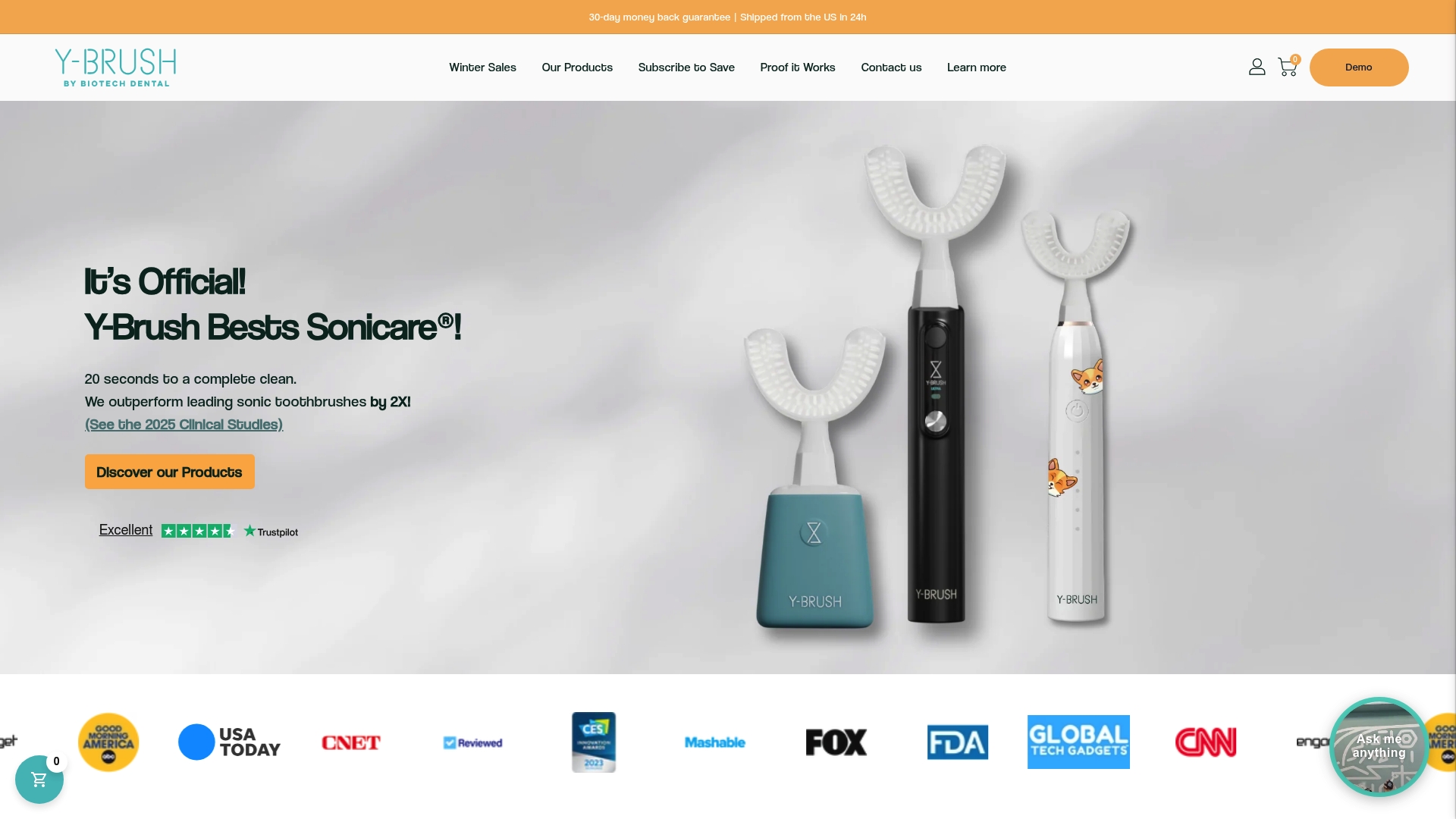
Less time with bristles moving at speed means less opportunity for slurry to get flung toward your mirror or counter, on top of the technique changes covered earlier in this article.
- The Core Plan starts at $29.90 per quarter, with the Pro Plan at $49.90 per quarter and the Pro+2 Plan at $69.90 per quarter, each including a toothbrush and recurring head refills.
- Replacement brush heads and full toothbrush options are available on our product catalog if you want to see the lineup before choosing a plan.
We encourage you to review the product details and clinical information on our site before deciding, since a shorter brushing time only matters if the clean itself holds up, and we want you making that call with full information in hand.
FAQ
What are the downsides of using a sonic toothbrush?
Sonic toothbrushes can produce more visible splatter than manual brushing because the bristles vibrate at high speed, though research shows these droplets are splatter rather than aerosol and settle within about 1.8 seconds and roughly 1 meter. Some people also find the vibration sensation takes a short adjustment period, and replacement heads add an ongoing cost compared to manual brushes.
Do dentists recommend sonic toothbrushes?
The American Dental Association notes that powered toothbrushes are effective for plaque removal and can be especially helpful for people with limited dexterity. Choosing a brush with the ADA Seal of Acceptance is a reasonable way to confirm it meets recognized safety and effectiveness standards.
What are some common issues with electric toothbrush heads?
Debris trapped at the collar where the head meets the handle is a frequent cause of unexpected spraying, along with worn seals or a head that no longer fits snugly. Regular cleaning of the connection point and timely head replacement resolve most of these issues without needing a new handle.
How do I use an electric toothbrush without making a mess?
Place the brush fully in your mouth before turning it on, use an amount of toothpaste about the size of a pea as the ADA recommends, and hold the brush at about a 45 degree angle to your gumline with steady, light contact. Spitting in short, controlled bursts and wiping the sink immediately afterward catches the small amount of splatter that does occur.


