


A sonic toothbrush moves its whole head back and forth at a rate in the audible range, and that motion cleans in two ways: bristles scrub the surface they touch, while the rapid movement drives saliva and toothpaste into fast-moving flows that disrupt plaque a little beyond the bristle tips. A motor, a drive linkage or electromagnetic driver, and an oscillating head make that motion possible.
TL;DR:
- A Cochrane review found powered brushes reduced plaque by about 21% and gingivitis by 11% versus manual brushes after three months.
- Reviews find any plaque removal edge for oscillating and rotating brushes over sonic models small and possibly not meaningful; comfort and consistent use matter more.
- Move the head slowly along the gumline with light pressure and full surface coverage; rushing or pressing hard limits the motion’s cleaning action.
- If vibration weakens, inspect the head and charge the handle; rattling usually signals a loose head or debris at the coupling.
Table of Contents
- What parts make up a sonic toothbrush system?
- How do the internal components create the vibration?
- Why does fast motion clean beyond the bristle tips?
- How does sonic differ from other electric toothbrush designs?
- What does the clinical evidence say?
- What engineering trade-offs shape a sonic brush?
- How should you use and maintain a sonic toothbrush?
- Joris on what matters more than the mechanism
- A faster clean built around your routine
- FAQ
- Sources
What parts make up a sonic toothbrush system?
Think of a sonic toothbrush as a small chain of energy conversions. The handle stores power in a battery, the electronics decide how that power is delivered, a motor or electromagnetic driver turns electrical energy into movement, and a linkage or magnetic coupling carries that movement into the brush head. Each link in the chain exists for one purpose: to produce fast, repeatable, small-amplitude motion at the bristles.
The word “sonic” is a frequency label, not a magic ingredient. A narrative review of powered toothbrush design classifies powered brushes by speed and places sonic brushes in the audible range, roughly 20 to 20,000 Hz. That is why many sonic brushes hum or buzz when you switch them on: you are hearing the motion itself. Manufacturers often describe speed in strokes per minute rather than hertz, and the numbers vary by design, so it is smarter to think in terms of a range than a single magic figure.
Here is the system, broken into the roles you will meet again in the next section:
- The handle. It holds the rechargeable battery, the charging contacts and the control electronics. Buttons and mode settings live here too, and they simply tell the electronics how hard and how fast to drive the motion.
- The driver. This is either a small motor that spins continuously or an electromagnet that pulls and releases a magnet in the head. Either way, it is the source of all movement.
- The motion converter. In motor-based designs, a linkage turns continuous rotation into back-and-forth oscillation. In electromagnetic designs, the alternating current in a coil does that job directly, with no spinning part involved.
- The brush head. It is the output of the whole system. It carries bristles, and in some designs it also contains the magnets or springs that let it oscillate at the right frequency.
- The coupling point. This is where the handle and the replaceable head meet. A good coupling transfers motion efficiently without letting the head wobble or loosen.
The central engineering goal is converting a steady input into a high-frequency, controlled oscillation. A patent-style description of motor-driven designs makes this concrete: a continuously rotating input driver turns a crank-like element, an eccentric pin moves the linkage side to side, and a balanced linkage delivers the resulting oscillation to the brush shaft. Balance matters because any lopsided moving mass would shake the handle in your hand instead of moving the bristles, wasting energy and adding noise.
Frequency and amplitude pull against each other. A higher frequency generally means a smaller sweep per stroke, and a larger sweep generally means a lower frequency, so designers pick a combination that feels comfortable, cleans well and does not rattle the handle. That trade-off shapes everything that follows, from the choice of motor to the way the head is attached.
One practical point: because the whole head moves, rather than a small round tip spinning, the bristle field on a sonic brush sweeps across a broad area at once. The sensation on your teeth is a fast, light tingle, not a distinct scrubbing circle. We return to that difference when we compare sonic with other types.
How do the internal components create the vibration?
Open a sonic toothbrush and you find a surprisingly small set of parts doing very precise work. The details differ between motor-driven and electromagnetic designs, but the logic is the same: convert stored electrical energy into a fast, controlled oscillation and deliver it to the bristles with as little waste as possible.
Motor-driven linkages
In a linkage design, a motor provides a continuously rotating input. A crank arm carrying an eccentric pin, which is a pin mounted off-center on a spinning part, traces a small circle as the motor turns. A follower linkage rides on that pin and converts the circular path into a back-and-forth swing. Patent descriptions of this arrangement show the pin driving a coupler, sometimes drawn as a dog-bone shaped link, which passes the swing on to the brush shaft. The shaft then oscillates the head through a small angle at a rapid rate.
Balancing is the quiet hero here. A moving linkage has mass, and if that mass is not centered, every stroke pushes the handle in the opposite direction. Patent literature describes aligning the center of mass of the linkage so the reaction forces cancel, and some designs add replaceable weights so engineers can tune vibration and noise during development.
Electromagnetic drives
The other major approach uses no spinning motor. A teardown analysis of a sonic toothbrush describes an electromagnetic drive in which a coil in the handle interacts with magnets in the replaceable head. The control circuit uses a clocked ASIC, an application-specific integrated circuit, to time the pulses, and MOSFET transistors switch current through the drive coils. Alternating the current reverses the magnetic force, and the head oscillates in response. The same teardown notes that earlier device patents describe converting continuous rotation into oscillation through crank-like linkages and eccentric pins, so both families trace back to the same goal.
In this style of design, a spring element such as a torsion bar can sit inside the head. The head behaves like a tuned mechanical system: it has a natural frequency at which it oscillates efficiently, and the electronics drive it near that frequency. That is one reason a head from a different design may not work well on a handle it was not built for.
What each component contributes
- Motor or drive coil. It provides the energy. A motor makes a continuous spin that must be converted, while a coil makes alternating force that needs no conversion.
- Eccentric pin and crank arm. They turn rotation into a small circular offset, the first step toward oscillation.
- Coupler or dog-bone link. It carries that offset to the brush shaft and sets the sweep angle.
- Torsion bars and magnets. They store and release energy in the head, helping it swing at a stable frequency.
- Control electronics. The ASIC sets timing, and MOSFETs switch current. Together they help control the frequency as the battery drains, though how consistent a brush feels depends on its design.
- Seals and housings. They keep water and toothpaste out of the electronics, which matters more than it sounds because the handle lives in a wet bathroom.
Pro Tip: If your brush sounds different than it did when new, check the head before blaming the handle. A worn or loosely seated head changes how the whole assembly resonates, and a fresh head often restores the original feel.
Why does fast motion clean beyond the bristle tips?
Bristle contact is only half the story. The other half is fluid. Your mouth is wet, and toothpaste mixes with saliva into a slurry. When the brush head sweeps through that liquid thousands of times a minute, the liquid cannot simply sit still. It gets dragged, thrown and sheared.

Peer-reviewed work describes this as hydrodynamic shearing, also called microstreaming. A study indexed on PubMed describes how rapid bristle motion causes microstreaming of saliva and toothpaste, helping disrupt plaque beyond direct bristle contact. In plain terms, the moving liquid pulls on the sticky film of bacteria at a distance from the bristles, loosening it so the next stroke can sweep it away.
Here is what that looks like in practice:
- Shear at a distance. Fluid moving fast next to a surface creates a drag force along that surface. Plaque sits on enamel as a soft biofilm, and shear can peel and stir it even where no bristle actually touches.
- Reach into tight spots. Liquid flows into gaps that bristle tips struggle to enter, such as the spaces between teeth and along the gumline, carrying the disrupting effect with it.
- Slurry as a tool. Toothpaste contains mild abrasives and surfactants. The agitated slurry spreads them around the mouth and keeps them in contact with plaque a little longer than static brushing would.
- Help from the sensation. That light tingle many people notice on their gums and cheeks is the fluid action itself reaching tissue the bristles are not scrubbing.
A natural question is whether this is the same as the cavitation used in ultrasonic cleaning baths, where tiny bubbles form and collapse with violent force. For consumer sonic brushes, the evidence points away from that. True cavitation generally requires much higher frequencies and energy than a handheld brush delivers, and experimental findings have not shown it occurring in typical sonic toothbrush use. The benefit comes from shear and streaming, which are gentler and more predictable.
This distinction matters for expectations. Fluid action supports bristle cleaning but does not replace it. A brush that is held still, or moved across the teeth too quickly, will not give the fluid time to work, and bristles that never reach a surface cannot do their part. The mechanism rewards slow, deliberate coverage, which is why technique gets its own section later.
The mechanism in one line: a PubMed-indexed study describes rapid bristle motion microstreaming saliva and toothpaste so that plaque is disrupted beyond direct bristle contact.
How does sonic differ from other electric toothbrush designs?
All powered brushes try to do the same job, but they move differently, and the difference shows up in how they feel and how you should use them. Three families dominate: sonic, oscillating-rotating and ultrasonic.
Sonic: the whole head vibrates
A sonic brush uses an elongated or manual-style head that swings in the audible frequency range. The bristle field sweeps across a wide area, and the fluid effect described above plays a meaningful role. Users usually guide the head slowly along the teeth, letting the vibration do the fine work.
Oscillating-rotating: a small round head spins back and forth
The narrative review of powered toothbrush design describes rotation-oscillation brushes as using a circular back-and-forth motion on a small round head, which makes them mechanically distinct from sonic designs. The scrubbing is more localized: you place the round head on one tooth at a time, and the motion works mostly through direct mechanical contact. The frequency is lower, the movement is larger, and the feel is more of a cupped, polishing action.
Ultrasonic: piezoelectric vibration at much higher frequency
Ultrasonic brushes use piezoelectric elements that vibrate above the range of human hearing. Because the motion is so fast, the amplitude is tiny, and the claimed benefit relies on acoustic effects in the fluid rather than visible bristle sweep. These brushes tend to be quieter, and the sensation is faint compared with sonic.
How they compare in practice:
- Reach. Sonic sweeps a broad area and uses fluid flow to extend its effect. Oscillating-rotating cleans mainly where the round head sits. Ultrasonic depends on acoustic effects and usually pairs them with gentle bristle contact.
- Feel. Sonic is a fast tingle across a wide surface. Oscillating-rotating is a more pronounced circular buzz on one tooth. Ultrasonic is subtle, often barely felt.
- Technique. Sonic users glide the head slowly along the gumline. Oscillating-rotating users hold the head on each tooth in turn. Ultrasonic users follow the manufacturer’s instructions closely because the effect is hard to sense.
- Comfort. Many people who find strong scrubbing uncomfortable prefer the lighter sensation of whole-head vibration, though comfort is personal and worth testing.
- Special situations. People with braces, crowded teeth or sensitive gums sometimes favor a particular head shape or motion. A dentist who knows your mouth can say which mechanism suits you best.
None of these categories is a guaranteed winner for every mouth. The next section looks at what controlled research actually says about how they perform.
What does the clinical evidence say?
Mechanism explains how a brush might work, but evidence tells us whether it does. The strongest available summary comes from systematic reviews, which pool many trials.
A Cochrane review of powered versus manual toothbrushes reports that powered brushes, including both sonic and oscillating-rotating types, reduce plaque by approximately 21% and gingivitis by 11% compared with manual toothbrushes after three months of use.
That headline deserves a careful reading:
- Powered beats manual. The effect holds across powered technologies in the pooled analysis, so the overall message is that moving from a manual brush to a powered one tends to help.
- Plaque moves more than gingivitis. Plaque is the direct target of brushing, while gingivitis is the inflammatory response that follows over time, so it is reasonable that the plaque figure is larger.
- Three months is a snapshot. The pooled result describes the three-month mark. Longer-term gum health depends on sustained habits, and short trials cannot capture everything.
Head-to-head comparisons between technologies are more nuanced. A systematic review discussed in a PubMed Central article notes that both oscillating-rotating and sonic brushes outperform manual brushing, and that some reviews find a small advantage for oscillating-rotating models in plaque removal. The same source stresses that the difference is modest and may not be practically meaningful for most users.
Why the caution? Several limits apply to this kind of research:
- Statistical versus clinical significance. A small difference can be statistically detectable in a large pool of trials without changing what a dentist would see in your mouth.
- Study design variation. Trials differ in who is brushing, how long, what toothpaste is used and how plaque is scored, which makes clean comparisons hard.
- Technique and compliance. In real life, how long and how carefully you brush often outweighs the technology in your hand.
- Short follow-up. Many trials measure outcomes over weeks or a few months, not years.
What this implies for choosing a brush is refreshingly practical. If you are switching from manual, a powered brush of either main type is supported by the evidence. If you are choosing between sonic and oscillating-rotating, comfort, ease of use and whether you will actually brush consistently matter more than a small average difference. Pick the motion you enjoy using, and your dentist can help refine the choice.
What engineering trade-offs shape a sonic brush?
Good sonic brush design is a negotiation between cleaning performance, comfort, noise and durability. Every improvement in one area tends to cost something in another.
Vibration versus noise. The same oscillation that cleans also shakes the handle and makes sound. Patent descriptions explain that centering the mass of the moving linkage cancels much of the reaction force, and replaceable weights let engineers tune how the handle feels and sounds. The goal is a brush that vibrates at the bristles, not in your palm.
Frequency stability. An electronic drive built around a coil, magnets and a clocked ASIC can hold the oscillation steady as the battery drains. A direct motor drive depends more on mechanical tolerances and wear. This is part of why electromagnetic designs often feel consistent from first use to last, while mechanical linkages may drift slightly as parts age.
Head retention and safety. The head is a small part that spends its life being shaken in a wet mouth. The powered toothbrush design review discusses safety aspects such as head plate retention and bristle retention, which is why quality designs secure the head firmly and anchor the bristles well enough that they do not shed under constant motion.
Durability and materials. Parts subject to high-frequency oscillation fatigue over time. Shafts, couplers and springs need materials that tolerate repeated movement, and seals must keep moisture away from electronics while still allowing the head to move freely.
The main design levers, in brief:
- Mass balancing reduces handle shake and noise.
- Tuned weights let engineers adjust feel without redesigning the linkage.
- Electronic drive (coil and ASIC) supports stable frequency, while a direct motor drive is simpler but depends on mechanical precision.
- Secure head and bristle retention protects against small parts coming loose.
- Sealed housings and fatigue-resistant materials extend life in a wet, vibrating environment.
When you compare brushes, these quiet details are what separate a pleasant daily tool from an irritating one.
How should you use and maintain a sonic toothbrush?
Understanding the mechanism changes how you brush. The vibration does part of the work, so your job is to give it time, liquid and coverage.
Technique
- Start with toothpaste and a little saliva. Fluid action needs liquid to work with, so do not rinse the brush dry first.
- Place the bristles at the gumline, then turn the brush on. Switching on after contact helps keep toothpaste in your mouth instead of on the mirror.
- Glide slowly, one small area at a time. The fluid flow needs a moment to do its work, so rushing across the teeth wastes the mechanism.
- Let the brush do the moving. Light pressure is enough, and pressing hard can dampen the motion and irritate gums.
- Cover every surface methodically. Work through outer, inner and chewing surfaces in a repeating order so no region is skipped.
What sensations mean
A light tingle on gums and cheeks is normal and reflects fluid action. If the vibration suddenly feels weaker, check the head first, since a loose or worn head changes how the assembly resonates. Then look at the charge: a low battery can reduce drive strength. A grinding or rattling sound usually points to a poorly seated head or debris at the coupling.
Simple maintenance
- Check head seating each time you attach it. It should click or sit firmly with no wobble.
- Rinse the head and the coupling area after brushing so toothpaste does not build up.
- Watch the charging indicator. If it behaves oddly or the brush loses charge quickly, contact the maker’s support.
- Replace heads on schedule. Worn bristles clean less well and can change how the head oscillates.
Pro Tip: Brush with the same route every time, such as upper outer, upper inner, lower outer, lower inner. A fixed pattern makes it far less likely you skip the same spot day after day.
Joris on what matters more than the mechanism
After reading the patents, the teardown and the reviews, my view is simple: the mechanism is clever, but it is not the main event. The evidence shows powered brushes beat manual ones, and the gap between sonic and its rivals is small enough that habits win. A brush you use consistently with good technique will beat a theoretically superior one that sits in a drawer.
That is why features that support habit deserve more attention than frequency numbers. Timers that pace your session, pressure sensors that warn you when you press too hard, and a handle that feels pleasant in your hand all push you toward consistent, gentle brushing. A sonic mechanism is a strong fit if you value a light whole-head vibration, have sensitive gums, or simply enjoy the feel. If you prefer a more focused, tooth-by-tooth scrubbing action, a different motion may suit you better, and that is a perfectly good choice.
Whatever you choose, pair the device with technique: slow passes, light pressure, full coverage. Your dentist can check how your habits are working. The best toothbrush is the one that gets used well.
— Joris
A faster clean built around your routine
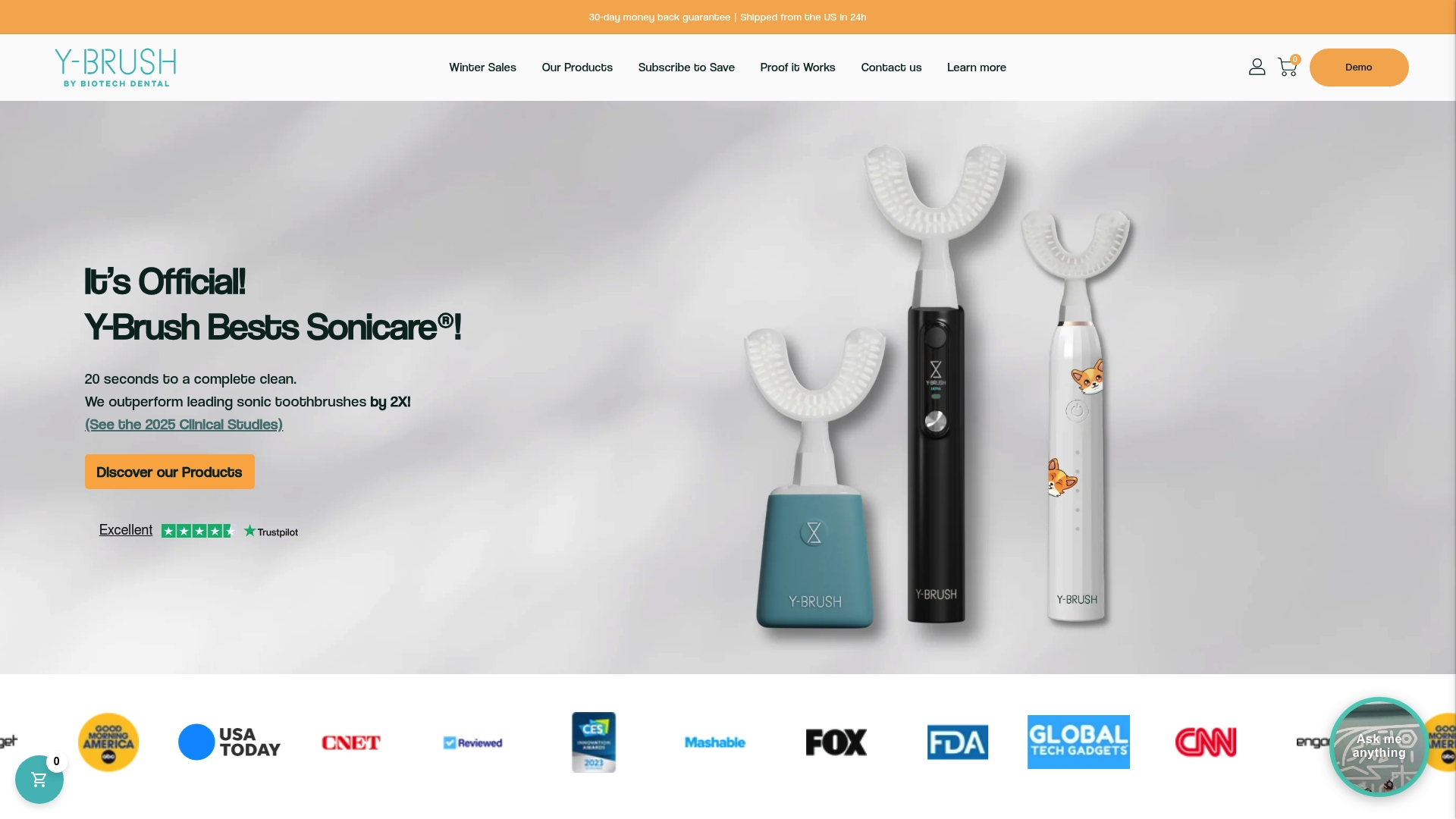
We designed Y-Brush for people who want to make brushing easier to fit into their routine. Our electric toothbrush uses a Y-shaped brush head, and we pair it with subscription plans so fresh heads arrive on schedule.
Here is what we offer:
- Core Plan at $29.90 per quarter
- Pro Plan at $49.90 per quarter
- Pro+2 Plan at $69.90 per quarter
- Replacement brush heads, including options compatible with other brands
Our head geometry works with the kind of sonic motion explained above to deliver a complete clean in 20 seconds. Browse our toothbrush plans to compare options, or visit our brush heads and accessories to find the right fit for your handle.
FAQ
What is the downside of a sonic toothbrush?
The main drawbacks are cost compared with a manual brush and the need for charging and head replacement. Pressing too hard can also irritate gums, so a light touch with a Waterpik toothbrush matters. For most people, these are minor next to the plaque and gum benefits powered brushing offers.
What do dentists say about sonic toothbrushes?
Dental guidance generally supports powered brushing, and a Cochrane review found powered brushes, sonic included, reduce plaque and gingivitis more than manual ones. Dentists usually stress that consistent technique matters more than the specific brand or type.
What is the difference between a sonic and ultrasonic toothbrush?
A sonic brush moves its head in the audible frequency range, so bristle motion and fluid flow do the cleaning. An ultrasonic brush vibrates far above audible hearing using piezoelectric elements, with a much smaller visible motion.
Why does my sonic toothbrush feel weaker over time?
A loose, worn or poorly seated head is the most common cause, followed by a low battery. Reseat or replace the head and charge the handle fully. If the problem continues, contact the manufacturer’s support.
Do sonic toothbrushes work better than oscillating-rotating ones?
Not by a meaningful margin for most people. A systematic review summary notes that both beat manual brushing and that any edge for oscillating-rotating models in plaque removal is small. Choose the one you will use consistently.


