


Maintaining an electric toothbrush comes down to four habits: rinse the head after every use, let it air-dry upright, wipe the handle and base regularly, and replace the brush head about every three months. Those habits keep the brush clean and keep the bristles working. At Y-Brush, our quarterly membership plans are built around that three-month cycle, so a fresh head arrives when the American Dental Association (ADA) says it is time.
TL;DR
- Rinse the brush head with tap water after every brushing session, then stand the brush upright so it dries in open air.
- Once a week, take off the head and wipe the handle and the base of the head with a damp cloth so residue does not build up.
- Replace the head about every three to four months, or sooner if the bristles look matted or frayed. Children’s brushes often wear out faster.
- Never share a brush, and do not put it in the microwave or dishwasher.
- Store it away from other brushes and out of closed containers, which keep moisture trapped.
Table of Contents
- Why electric toothbrush care matters
- The daily routine: rinse, dry, store
- Weekly care: handle, base and the joint under the head
- When to replace an electric brush head
- Battery and charging basics
- Special cases: kids, braces and shared bathrooms
- A care schedule you can follow
- Our perspective
- Keep a fresh head on your brush
- FAQ
- Sources
Why electric toothbrush care matters
A toothbrush spends its life in a damp bathroom and goes into your mouth twice a day. The ADA and its Council on Scientific Affairs note that microorganisms grow on toothbrushes after use, but evidence is lacking that this growth leads to specific health problems. So the goal of maintenance is not to chase a sterile brush. It is to keep the brush clean, dry and in good working shape.
An electric brush adds a few spots that a manual one does not have: the joint where the head meets the handle, the base of the head, and the charging area. Toothpaste and water collect in those places. A short routine handles all of them.
The second reason is performance. The ADA explains that effectiveness decreases as bristles wear. A well-made brush with tired bristles cleans less, however good the motor is.
The daily routine: rinse, dry, store
The daily part takes about ten seconds and has three steps.

1. Rinse the head thoroughly
After brushing, run the head under tap water. The ADA’s toothbrush care statement says to rinse thoroughly with tap water to remove toothpaste and debris. With an electric brush, turn it on for a second or two under the running water so the bristles flick out the paste trapped at their base. Where it goes wrong: a quick splash over the top of the bristles leaves paste at the bottom of the tufts.
2. Shake off the water and let it dry
Shake the head gently over the sink. Do not wrap it in a towel or tissue, because that holds in moisture. Brushes that stay wet between uses are the ones that develop residue and odor.
3. Store it upright, in open air
The ADA says to store the toothbrush upright after use and let it air-dry, and notes that a moist brush kept in a closed container promotes more microbial growth than open-air storage. That means no travel cap on a damp head and no closed cabinet drawer after brushing. If the brush has to travel, let it dry first, then use a case, and take the brush out of the case as soon as you arrive.
If several brushes share a holder, keep them apart so the heads do not touch. The ADA statement also advises keeping multiple brushes separated.
Weekly care: handle, base and the joint under the head
This is the step most people miss, and it is the one that the top search results keep coming back to. Residue builds up where the head meets the handle, and you cannot see it while the head is attached.
Once a week:
- Switch the brush off and take the head off the handle.
- Rinse the head and the metal or plastic stem under warm tap water.
- Wipe the handle and the base of the head with a damp cloth. For dried-on residue, a cloth with a drop of mild soap works, followed by a rinse with clean water.
- Let both parts dry completely before putting the head back on.
Keep water away from any charging contacts, and follow the care instructions for your model. Do not submerge a handle unless the instructions say it is made for that.
Do you need to disinfect the brush?
Not as a routine. The ADA statement says cleaning methods beyond rinsing and air-drying are not supported by current clinical evidence, and that there is no clinical evidence that soaking in antibacterial mouthrinse or using a commercial sanitizer has a positive or negative effect on health.
If you want to go further, for example after a cold, the ADA’s toothbrush page cites a study in which soaking a toothbrush in 3 percent hydrogen peroxide or a mouthwash cut bacterial load by about 85 percent. Rinse the head well afterward. The same page says a sanitizer device should be FDA-cleared.
Some methods are plainly unsafe for the brush. Microwaves and dishwashers are not recommended because high heat can damage the brush, and that goes for the head, the handle and the charger alike.

When to replace an electric brush head
The ADA recommends replacing toothbrushes approximately every three to four months, or sooner if the bristles become matted or frayed. Jane Cotter, associate professor in the Department of Dental Hygiene at Texas A&M School of Dentistry, confirms that the three-month timeline applies to electric brush heads as well as manual ones. She also says fraying or spreading bristles mean replacing the head right away, and that the brush should be replaced after an illness.
| Situation | What to do |
|---|---|
| Three to four months of regular use | Replace the head |
| Bristles flared, bent, matted or frayed | Replace the head now, whatever the date |
| You have been sick | Replace the head after you recover |
| Child’s brush | Check more often, since children’s brushes often need replacing sooner than adults’ |
| Color-changing bristles | Replace when the color has faded |
The note about children comes from the ADA statement, which says to check brushes often and replace them more frequently if needed. Kids tend to chew on the bristles, which wears them quickly.
The easiest way to never miss a replacement
Most people do not forget to brush. They forget to change the head. Tying replacement to the calendar, not to how the bristles look, solves that. This is why we offer membership plans with regular refills: a new head turns up on a quarterly rhythm, so the three-month guideline is the default.
A quick habit if you buy heads on your own: write the replacement date on a note on the bathroom mirror, or set a phone reminder the day you install a new head.
Battery and charging basics
Battery care varies by model, because brushes use different battery types and charging stands. The most reliable rule is to follow the charging instructions in your brush’s manual. As general habits, charge the brush on its own base, keep the charger dry and away from the sink splash zone, and unplug the base if you are going to be away for a long stretch. If the brush runs noticeably weaker than when it was new, check the manual or the maker’s support page before assuming the head is the problem, because a worn head is also a common cause.
Special cases: kids, braces and shared bathrooms
Kids. Rinse and store the brush the same way, and check the bristles more often. Many parents find it simplest to replace a child’s head on the same day as their own.
Braces and dental appliances. The ADA notes that powered brushes may suit people with dexterity problems or dental appliances. Wire and brackets catch food and bend bristles faster, so inspect the head more often. For wider routines around appliances, see this guide to oral hygiene with braces.
Shared bathrooms. The ADA says toothbrushes should not be shared, because sharing can exchange bodily fluids and microorganisms between people. In a shared bathroom, give each brush its own spot and keep heads from touching.
A care schedule you can follow
| When | Task | Time |
|---|---|---|
| After every brushing | Rinse head, run briefly under water, shake, stand upright | 10 seconds |
| Weekly | Remove head, rinse stem, wipe handle and head base, dry | 2 minutes |
| Every 3 to 4 months | Replace head | 1 minute |
| After illness | Replace head | 1 minute |
| Any time bristles fray | Replace head | 1 minute |
Our perspective
Most of the advice on brush care ends with “replace your head every three months,” and then people do not do it. The problem is rarely knowledge. It is that a replacement head is one more thing to remember and one more thing to order.
We built Y-Brush around the idea that oral care should fit into a day as it really goes. Our Y-shaped head is designed to deliver a complete clean in 20 seconds with sonic vibrations, and our brush heads are the part you replace on schedule. Our membership plans with regular refills put that replacement on autopilot, and our subscription-based lifetime warranty backs the brush itself.
Our own claim, backed by our clinical work, is that the Y-shaped design removes plaque 2X more effectively than leading sonic toothbrushes. A head that is fresh and clean does that job best, which is why the routine in this article matters as much as the brush you choose.
Joris
Keep a fresh head on your brush
If you want the three-month replacement handled for you, our plans are priced per quarter: the Core Plan is $29.90 per quarter, the Pro Plan $49.90 and the Pro+2 Plan $69.90. Each is a membership with regular refills, so replacing the head becomes part of the routine and not another task. We also make compatible brush heads for other brands, which you can find among our Y-Brush toothbrushes and brush heads.
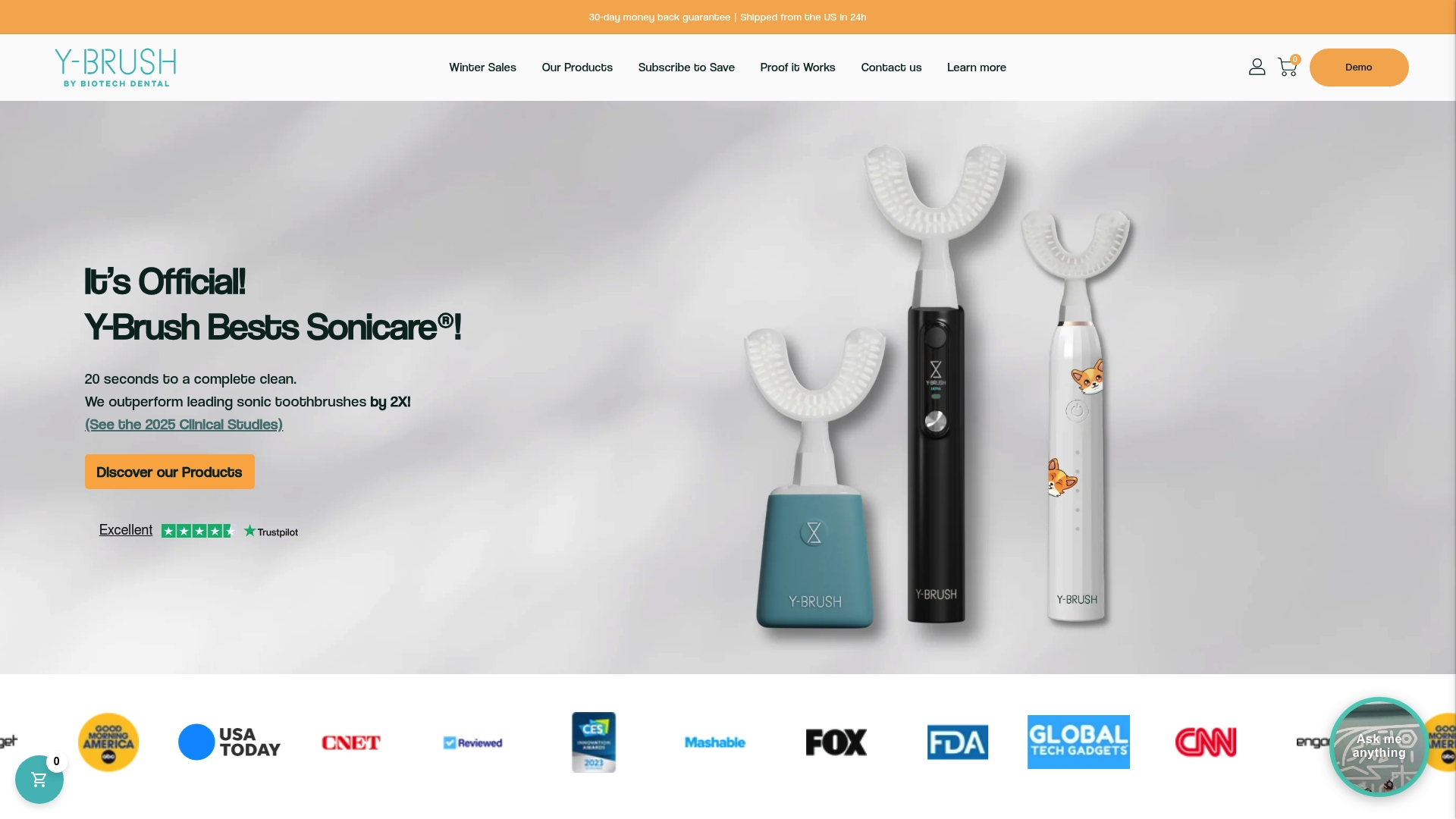
With a Y-Brush, the daily care in this article stays the same: rinse, shake, stand upright and wipe the base weekly. The 20-second brushing time also means the whole routine, brushing and care together, fits into well under a minute.
FAQ
How long does an electric toothbrush last?
The brush head is the part that wears out first, and the ADA recommends replacing it about every three to four months. The handle lasts much longer, and its life depends on the model, how it is charged and how it is cared for. Keeping it dry and following the maker’s charging instructions are the best ways to extend it.
Can I clean my electric toothbrush in the dishwasher or microwave?
No. The ADA says high heat from a microwave or dishwasher can damage the brush. Rinse the head under tap water, wipe the handle with a damp cloth and let it air-dry upright.
Should I keep my electric toothbrush plugged in?
Follow the charging guidance in your brush’s manual, since battery types and chargers differ between models. In general, keep the charger dry and unplug it if you will be away for a while.
What is the 3-3-3 rule for brushing teeth?
It is a popular shorthand with a few variations, and it is not an ADA standard. The guidance that has solid support is simpler: replace your brush head about every three months, or sooner if the bristles fray, and brush with the technique and timing your brush is designed for.
Is it safe to store my brush in a travel case?
Only once it is fully dry. The ADA notes that storing a moist brush in a closed container promotes microbial growth more than open-air storage, so take the brush out of its case as soon as you arrive.


